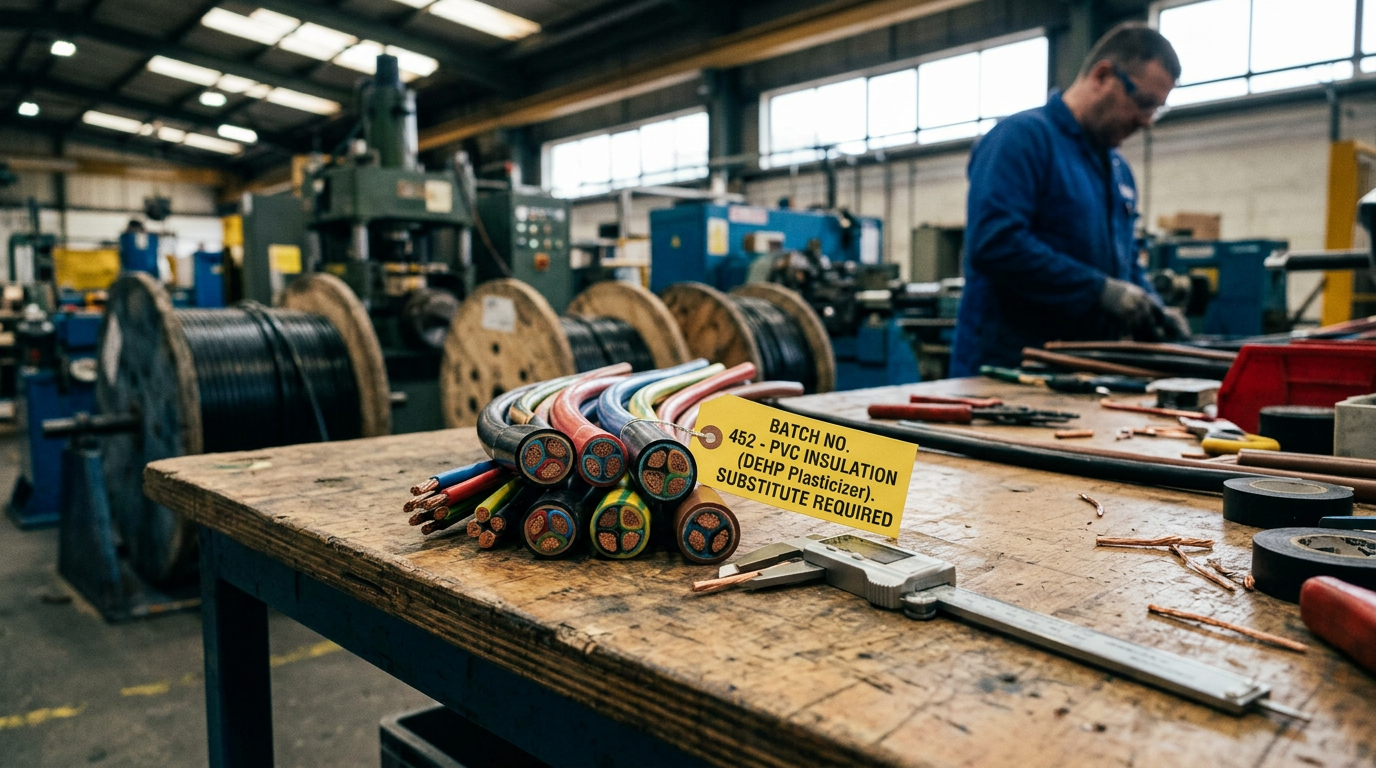
DOTP matches DEHP’s softening power at an efficiency factor of 1.03 — so why do so many reformulations fail within the first three production runs? Because compounders treat the transition as a material swap when it is actually a process re-engineering project. Every successful DEHP replacement I have managed required changes at three levels: formulation, processing parameters, and validation. Skip any one, and you are back to rejected batches.
Construction and flooring account for 48% of global DEHP demand, wire and cable another 27%. The transition approach for industrial compounders is fundamentally different from what the medical literature describes.
Why Most DEHP Replacements Fail on the Production Floor
The marketing says DOTP and DINP are “near drop-in” replacements. The efficiency factor of 1.03 says they soften PVC almost identically to DEHP. Both statements are technically correct — and both are dangerously incomplete.
Softening is one dimension. Processing behavior, migration rates, compatibility with co-additives, heat aging, and end-product performance are five more. I have watched compounders swap DEHP for DOTP at identical PHR, run their standard barrel profile, and produce compound that passes Shore hardness on day one. Three weeks later, migration testing fails. Or the wire insulation cracks at low temperature.
That gap between “softening equivalence” and “product equivalence” is where most transitions stall. Baxter International had an FDA-approved DEHP-free alternative on the market for 18 years before completing the full transition — the material was never the bottleneck.
When you choose a plasticizer for PVC, start from the end product, not the plasticizer datasheet.
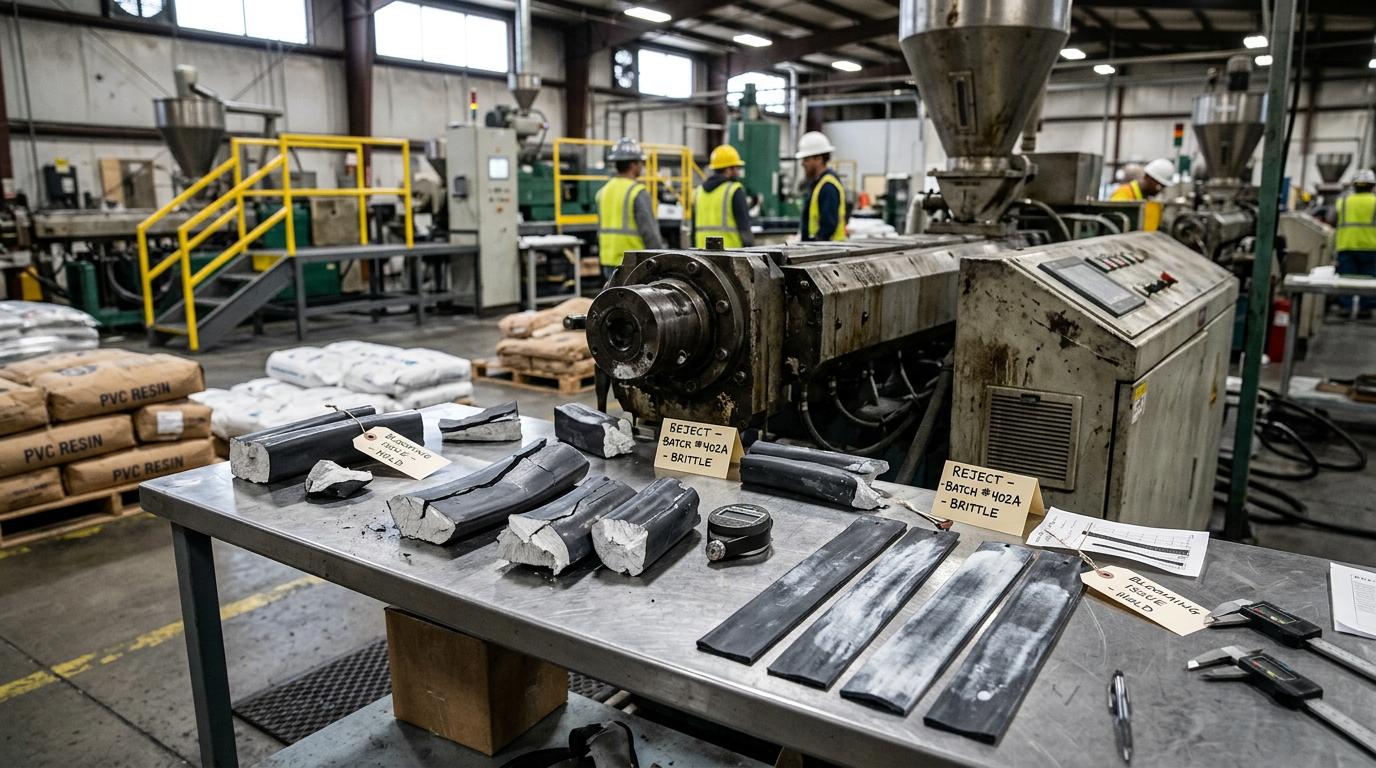
Match the Alternative to Your Application, Not the Datasheet
Your application determines which alternative works — not the other way around. A wire and cable compounder and a flooring manufacturer face entirely different performance priorities even when both are replacing DEHP.
Wire and Cable
Low-temperature flexibility and dielectric performance dominate here. DOTP is the first choice for most general-purpose wire insulation — its para-position molecular geometry reduces migration compared to DEHP while maintaining electrical properties. For jacketing that sees extreme cold, blend DOA at up to 25% of the total plasticizer system to push the brittle point below -40C.
The cost premium for DEHP alternatives compared to DEHCH typically runs 3 to 45 cents per pound. Below 10% in most cases, and shrinking as DOTP production scales.
Flooring and Wall Coverings
Migration resistance and low VOC emissions drive the selection here. DINCH’s migration rate runs roughly eightfold lower than DEHP in contact applications, making it the strongest candidate. For calendered sheet, DEHCH offers good compatibility and color stability. Diol-ester plasticizers give you Shore A readings 5-10 points lower than phthalate equivalents at the same loading — account for this when targeting a specific hardness.
Automotive and Consumer Goods
Heat aging and fogging resistance are the constraints. TOTM handles high-temperature exposure better than any general-purpose alternative but requires careful PHR adjustment. For automotive interiors, a TOTM-dominant system blended with a small percentage of DIDP for cold-flexibility offset gives the best balance.
Reformulate the System, Not Just the Plasticizer
A 50 phr DEHP formula does not become a 50 phr DOTP formula — each plasticizer family solvates PVC chains at a different rate, and copying the PHR number is the single most common reformulation error.
PHR Conversion Is Not a 1:1 Copy
Cyclic polybasic acid esters deliver 15-20% superior plasticization efficiency versus linear alternatives. Epoxidized vegetable oils at 5-15 phr dual-function as HCl scavengers, extending your processing window to 180-190C.
The formulation ratio I recommend starting from: take your current DEHP PHR, divide by the alternative’s efficiency factor, then run a trial. If your formula calls for 50 phr DOP and you are switching to DOA (efficiency 1.15), you need about 43 phr — not 50. The calculation: 50 / 1.15 = 43.5 phr. Skip this math, and you either over-plasticize (waste money, risk bloom) or under-plasticize (brittle product).
For PHR adjustment ranges by plasticizer type, specific PHR dosage guidelines narrow the starting point further.
Multi-Component Blending
No single alternative matches DEHP across every performance dimension for demanding applications. Plan for a plasticizer system, not a plasticizer.
Proven combinations:
- TOTM + DIDP for heat resistance with cold-temperature offset
- Polyester + DOA or ESBO for durability with low-temperature performance
- Phosphate esters (TCP, CDP) + general-purpose plasticizer for flame retardancy
Critical constraints: limit DOA to 25% of the total plasticizer system or you lose heat resistance. Chlorinated paraffins exude above 15-20 phr. Phosphate esters have antagonistic effects with Sb2O3 — never combine them in a flame-retardant system. That last one has cost me more troubleshooting time than any other blending mistake.
When DEHCH is part of your blending system, the incorporation process requires its own protocol for proper gelation and dispersion.
Common Reformulation Mistakes
Specifying TOTM at DOP-equivalent loadings produces under-plasticized, brittle compounds every time. TOTM’s efficiency factor is far lower — you need more PHR, not equal PHR.
DOA without a high-temperature blending partner like TOTM gives you excellent cold flexibility but products that harden above 60C. Always pair it.
Run 50 kg trial batches minimum, tested through your entire downstream process, before committing a production run.
Adjust Processing Parameters Before Scaling Up
If you change the plasticizer and keep the same barrel profile, you will get different results. This is physics, not a suggestion.
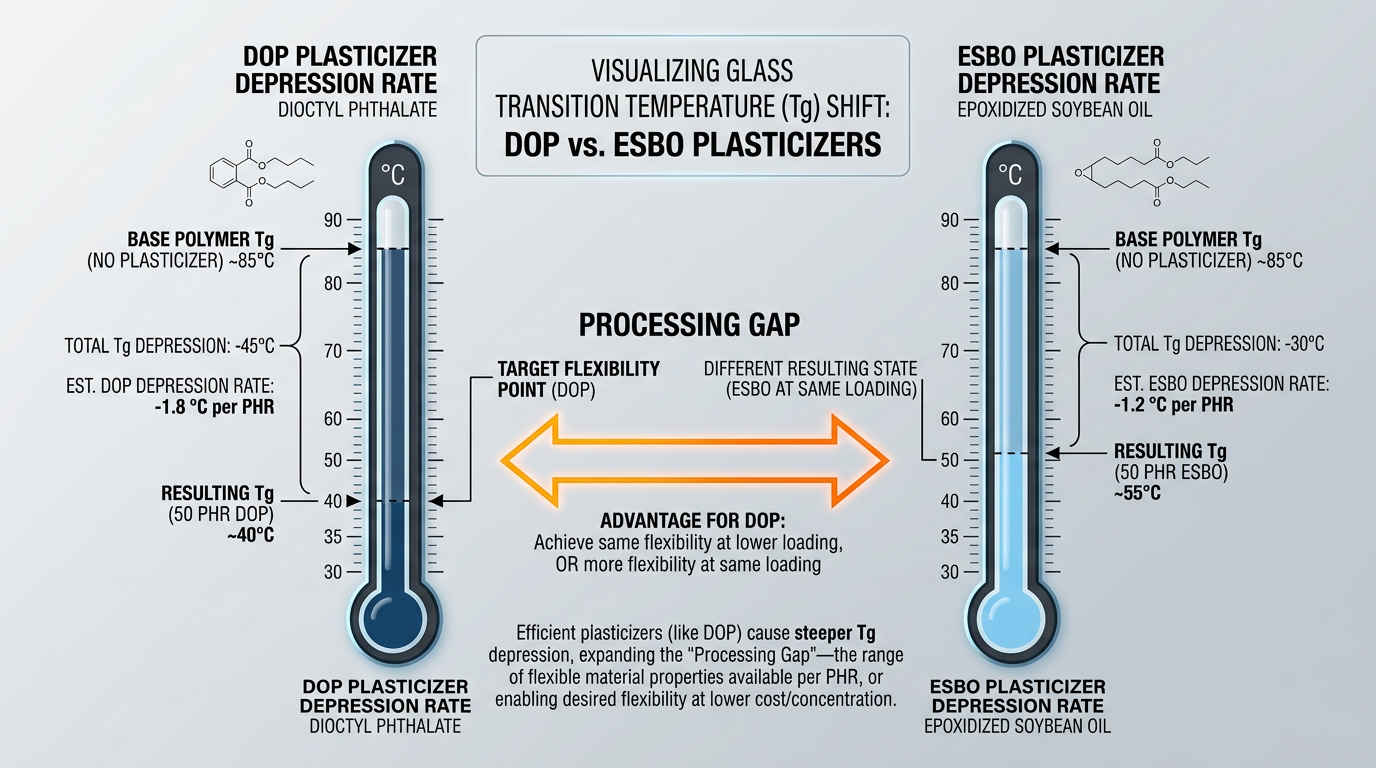
DOP depresses the glass transition temperature at 3.4C per phr. ESBO manages only 1.5C per phr. Replace 20 phr of DOP with ESBO and your compound’s Tg shifts upward by roughly 38C. Before adding to the mixer, ensure your temperature profile accounts for the new Tg.
Processing adjustments to plan for:
- Barrel temperatures: increase 5-15C for most non-phthalate alternatives, more for bio-based options
- Screw speed: reduce 10-15% initially to compensate for different melt viscosity
- Fusion time: benzoate-type plasticizers can cut fusion times by 30%, changing your speed-to-output calculation
- Cooling rate: alternatives with lower volatility hold heat longer — adjust cooling zones accordingly
Teknor Apex demonstrated the extreme end of this principle with their PVC/POE alloy formulations. Eliminating liquid plasticizers entirely, they achieved 102% elongation retention at 121C compared to 1% for standard flexible PVC. That 102-fold difference came from re-engineering the entire compounding process, not from choosing the right material.
Validate Before You Ship
The reformulated compound passes Shore hardness and processes acceptably. You are not done.
Migration testing catches what mechanical testing misses. As DEHP concentrations in the environment dropped over the past decade, DINP and DINCH levels rose sharply. Replacing one migration problem with another is regrettable substitution — and it happens when compounders skip validation.
Test every reformulated compound for: Shore hardness at 24 hours and 7 days (some alternatives shift after conditioning), migration per your end-use standard (EN 71-3, FDA 21 CFR, or IEC 62321), heat aging at worst-case service temperature for 168 hours minimum, and low-temperature brittleness if applicable.
The real cost of DEHP replacement is not the material premium. It is the production downtime from skipping the process re-engineering that makes the new formulation work. Get the reformulation right at trial scale, validate systematically, and the transition pays for itself in avoided rejects.