

Choosing the wrong PVC resin grade can ruin an entire production run. A K-value mismatch of just 2 points creates an 18% variation in viscosity. Use K-67 resin for injection molding instead of K-57, and you’ll face poor surface gloss, degradation marks, and extended cooling cycles.
I’ve watched procurement managers accept a “K-57” certificate, trust the number, then lose an entire batch to quality failures. That K-57 can actually range from K55.6 to K58.4.
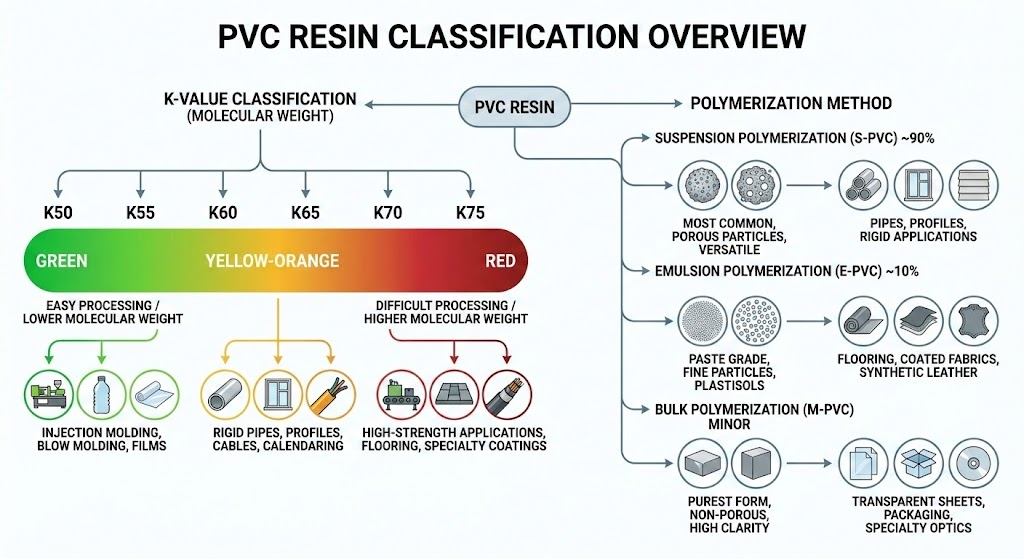
How Are PVC Resin Grades Classified?
What Does K-Value Mean and Why Does It Matter?
K-value measures the length of PVC polymer chains. Higher K-values mean longer chains and higher molecular weight.
This single number determines three critical properties of your resin:
Processing behavior: Viscosity increases dramatically with K-value. The relationship follows a power law where viscosity is proportional to K-value raised to the power of 3.4. A jump from K-66 to K-68 creates roughly a 10.7% viscosity increase.
Mechanical strength: Longer polymer chains deliver better tensile strength, impact resistance, and durability. K70-75 resins provide the best mechanical properties but demand more processing energy.
Plasticizer absorption: Higher K-value resins above K-66 absorb plasticizers more easily. Their increased porosity (around 0.41 cc/g for K-70) makes them ideal for flexible applications. Lower K-value resins like K-57 resist plasticizer uptake, making them better suited for rigid products.
What Are the Different K-Value Ranges?
The industry organizes PVC resins into five K-value categories. Each serves distinct applications based on the balance between processability and final product properties.
| K-Value Range | Grade Type | Key Characteristics | Primary Applications |
|---|---|---|---|
| K50-55 | Special Low | Easiest processing, tailor-made for demanding applications | Battery separators, blending resins to reduce paste costs |
| K57-60 | Low | Easy melting, lower viscosity, excellent flow | Injection molding, calendering, blow molding, clear packaging film |
| K65-68 | Medium | Balanced properties and processability | General-purpose applications, most popular grade range |
| K67 | Standard Pipe | Good mechanical strength, moderate processing difficulty | Rigid pipes, window profiles, building films |
| K70-75 | High | Best mechanical properties, requires more plasticizer for same softness | Flexible applications demanding superior strength |
What Are the Main Types of PVC Resin by Production Method?
How Does Suspension PVC (S-PVC) Differ from Emulsion PVC (E-PVC)?
Suspension PVC captures roughly 90% of the global market. Emulsion PVC fills the remaining 10%, serving specialized applications where fine particles and paste-forming capability matter most.
The fundamental difference lies in particle structure. Suspension PVC produces porous, granular particles ranging from 50 to 200 micrometers. Emulsion PVC creates ultra-fine powder with particles between 0.1 and 2.0 micrometers.
| Property | Suspension PVC (S-PVC) | Emulsion PVC (E-PVC) |
|---|---|---|
| Market Share | ~90% | ~10% |
| Particle Size | 50-200 micrometers | 0.1-2.0 micrometers |
| Particle Structure | Porous, relatively dust-free granules | Fine powder containing emulsifiers |
| Purity | High purity, narrow molecular weight distribution | Contains impurities from emulsifying agents |
| Water Absorption | Low | Higher |
| Processing Methods | Extrusion, injection molding, calendering | Coating, dipping, slush molding |
| Typical Applications | Pipes, profiles, cables, rigid sheets, flooring | Artificial leather, automotive coatings, textile coatings, dipped gloves |
S-PVC works best when you need rigid products or plasticized goods processed through extrusion, injection, or calendering. E-PVC excels in coating and dipping operations where the resin must form a stable paste with plasticizers.
I recommend S-PVC for most standard manufacturing applications. Switch to E-PVC only when your process specifically requires paste-grade material for coating fabrics, creating films by dipping, or slush molding.
When Should You Choose Bulk PVC?
Bulk PVC produces the purest form of polyvinyl chloride. The process uses no emulsifying or suspending agents, eliminating residual contaminants that affect optical properties.
Choose bulk PVC for transparent applications where clarity matters. The particles resemble suspension PVC but tend toward higher porosity.
The trade-off? Limited market availability and higher costs compared to suspension grades.
How Do You Select the Right PVC Grade for Your Application?
What Grade Works Best for Rigid Applications?
Pipe manufacturers need K-values above 64.5 to guarantee mechanical integrity. K-67 dominates the pipe extrusion market as the industry standard.
Key selection factors for pipes and fittings include tensile strength requirements for pressure ratings, impact resistance for handling and installation, weatherability for outdoor exposure, and processing stability to prevent degradation during extrusion.
Window profile producers typically select K65-K68 resins. The medium K-value range provides adequate strength while maintaining reasonable processing speeds.
Construction material applications like siding and rigid sheets often use K-67 resin. The global PVC market reflects this preference: pipes and fittings consume 44% of the approximately 57 million tonnes produced annually.
What Grade Works Best for Flexible Applications?
Flexible PVC demands higher K-values because the resin must absorb substantial amounts of plasticizer. K-values of 66 and above absorb plasticizers more readily due to increased particle porosity.
For cable insulation, select resins with porosity around 0.41 cc/g. K-70 grades deliver this porosity while providing excellent mechanical properties in the finished compound.
K70-75 resins produce flexible products with the best strength characteristics. The catch: they require more plasticizer to achieve the same softness as lower K-value grades.
For blown film production, K65-K67 resins offer the optimal balance. The extruded film needs enough molecular weight for strength but not so much that processing becomes problematic.
What Grade Works Best for Injection Molding?
K-57 resin dominates injection molding applications. The lower molecular weight reduces melt viscosity, making it easier to fill complex mold geometries.
K-57 provides three advantages over higher K-value grades:
Better surface gloss: Lower viscosity allows the melt to contact mold surfaces more intimately, transferring the mold’s finish to the product.
Shorter cooling times: Less energy input during processing means faster cycle times.
Higher die swell: Helps fill the mold cavity and sharp corners.
I’ve watched processors struggle when they substitute K-67 for K-57 in injection molding. The gloss decreases noticeably. Processing temperatures must increase, which raises degradation risk. Shear in the nozzle creates silver streaks and splay marks on the molded parts.
K-57 also works well for calendering UPVC sheets. The lower viscosity improves sheet uniformity and surface quality.
Conclusion
PVC grade selection comes down to matching K-value and polymerization type to your specific application and processing capabilities.
For rigid applications like pipes and profiles, start with K-67 suspension resin. For injection molding, K-57 delivers better results. Flexible products generally need K-66 or higher to absorb plasticizers effectively.
Test your incoming resin. Certificate values represent ranges, not absolutes. A 2-point K-value variation creates nearly 20% viscosity change.
The processors who consistently produce quality PVC products aren’t lucky. They understand their grades, verify their incoming materials, and adjust formulations based on actual resin properties rather than assumptions.