

UPVC is what you get when plasticizer loading equals zero. The “U” stands for Unplasticized, and the full form is Unplasticized Polyvinyl Chloride. That single formulation choice produces every property a buyer reads off a UPVC compound spec.
The numbers cluster tightly: 1.38-1.42 g/cm³ density, 40-51 MPa tensile, 65-70 °C heat deflection, 82-85 °C glass transition, and a 50-year ISO design lifetime for buried UPVC pressure pipe. Skip the 20-50 phr softener that flexible PVC requires, and rigidity is the consequence.
For a PVC compounder, formulator, or procurement engineer reading a CoA, the recipe is the question. The K-value of the base resin, the stabilizer system, and the cell class on the datasheet sit at the formulation level — where UPVC actually gets specified.
What UPVC Is at the Formulation Level
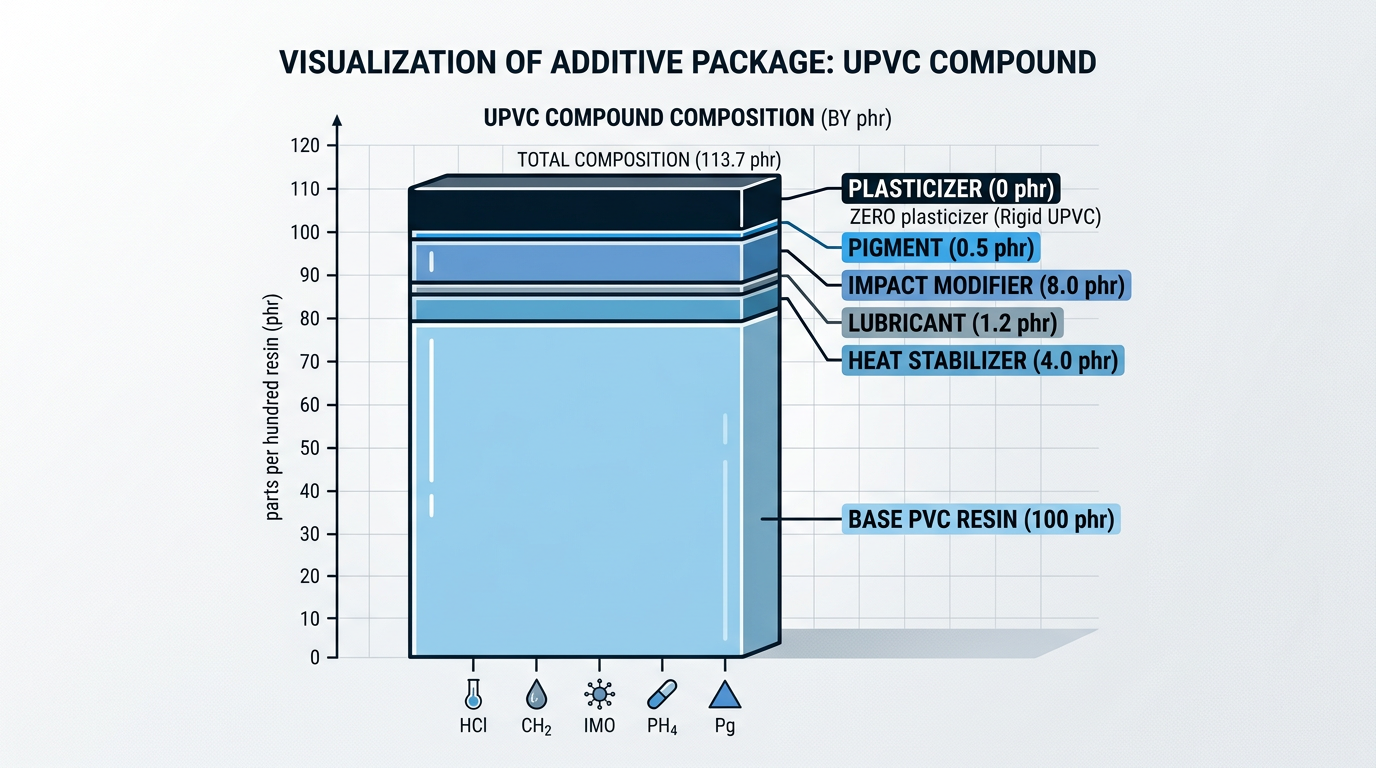
UPVC is rigid PVC formulated at zero plasticizer phr (parts per hundred resin). The base is a K65-K67 suspension PVC, and a heat-stabilizer / lubricant / impact-modifier package fills the rest of the compound.
The molecular structure explains why this single absence produces rigidity. About 57% of PVC’s mass is chlorine, which gives the polymer its 1.40 g/cm³ density and inherent flame resistance — both well above the polyolefin family at 0.88-0.96 g/cm³. Without a plasticizer to lubricate chain motion, the densely packed C-Cl backbones sit locked below the glass transition at room temperature, and the compound behaves like a rigid solid.
Two formulation decisions sit beneath every UPVC CoA: the base resin grade and the additive package.
Base Resin Grade (K65-K67 S-PVC)
About 80% of global PVC is suspension polymerization (S-PVC), yielding 100-180 μm particles. Within that pool, K-67 is the typical rigid-extrusion grade for UPVC pipe and profile; K-57 calendars UPVC sheet and injection-moulds fittings.
Within a K57±1 spec, viscosity scales as roughly Mw^3.4 — a 5% molecular-weight spread translates to ~18% viscosity variation, which is why lubricant levels get tweaked lot to lot. The different grades of PVC resin shake out differently for rigid versus plasticized service.
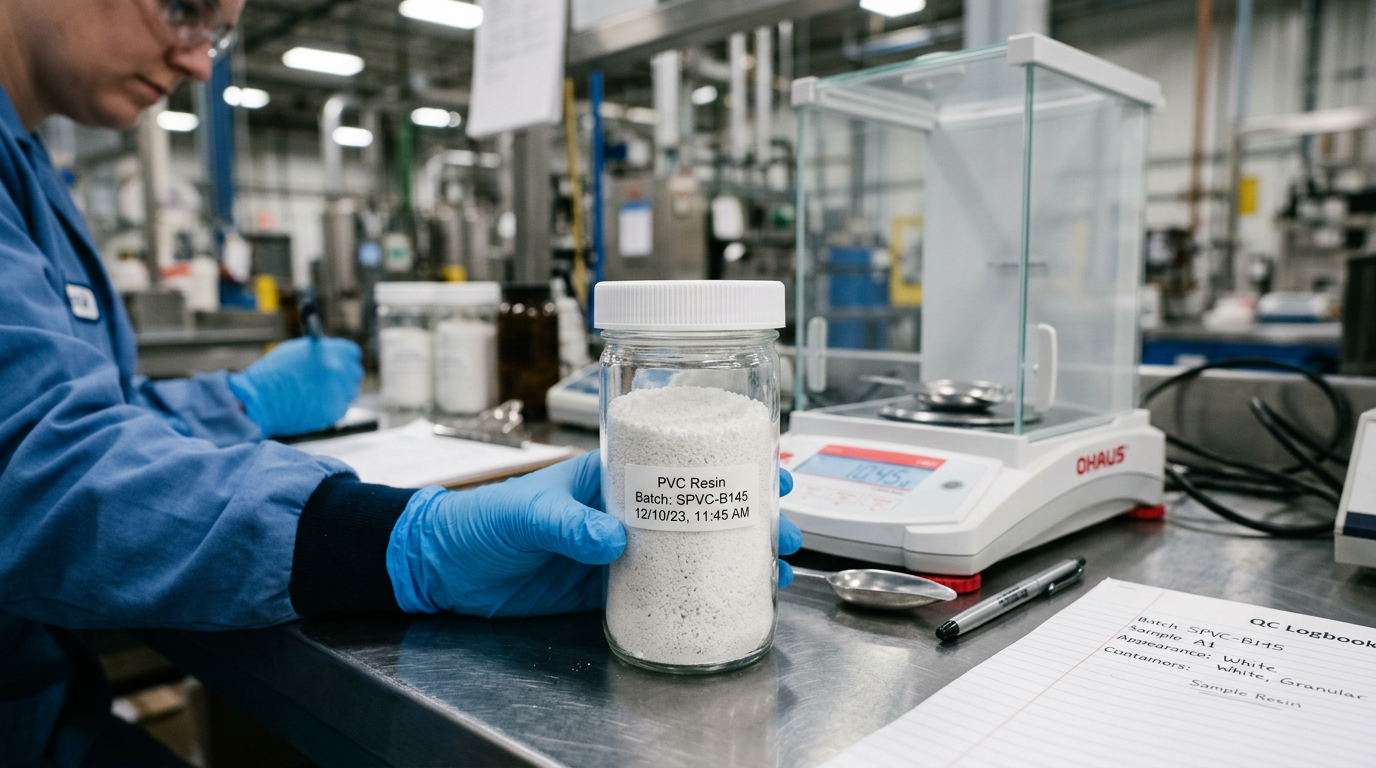
Additive Package (Heat Stabilizer + Lubricant + Impact Modifier)
Unplasticized does not mean additive-free. Heat stabilizers (typically 1-3 phr Ca-Zn or organotin), 0.5-2 phr lubricants, and 0-10 phr impact modifiers are non-negotiable in any UPVC compound. The PVC additive package does most of the processing work that plasticizers handle in flexible grades.
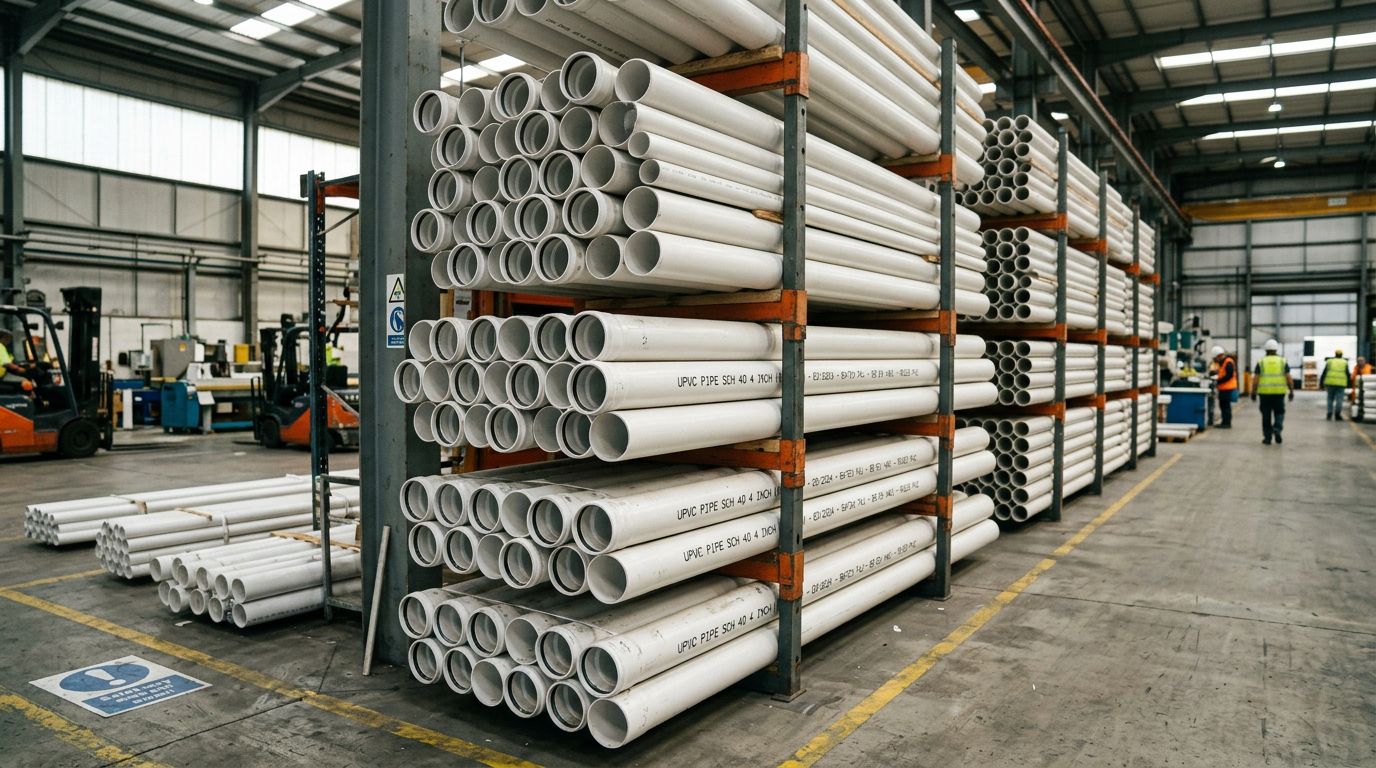
UPVC Properties: Density, Tensile, HDT, and Tg
At zero plasticizer loading, UPVC lands on a tightly clustered property sheet. The numbers below come from the AzoM property column drawn from RAPRA’s Plascams database — typical values for unmodified UPVC, with modern impact-modified compounds shifting the brittle temperature downward and HDT slightly upward.
| Property | Typical UPVC value | Test condition |
|---|---|---|
| Density | 1.40 g/cm³ | 20 °C |
| Tensile strength | 51 MPa | ASTM D638 typical |
| Flexural modulus | 3 GPa | — |
| Notched Izod impact | 0.08 kJ/m | unmodified |
| Elongation at break | 60% | — |
| HDT @ 0.45 MPa | 70 °C | low-load |
| HDT @ 1.80 MPa | 67 °C | high-load |
| Oxygen index (LOI) | 45% | inherently flame-retardant |
| UL94 flammability | V0 | — |
| Volume resistivity | 10¹⁴ Ω·cm | — |
| Maximum continuous service | 50 °C | — |
| Linear thermal expansion | 6 × 10⁻⁵ /°C | — |
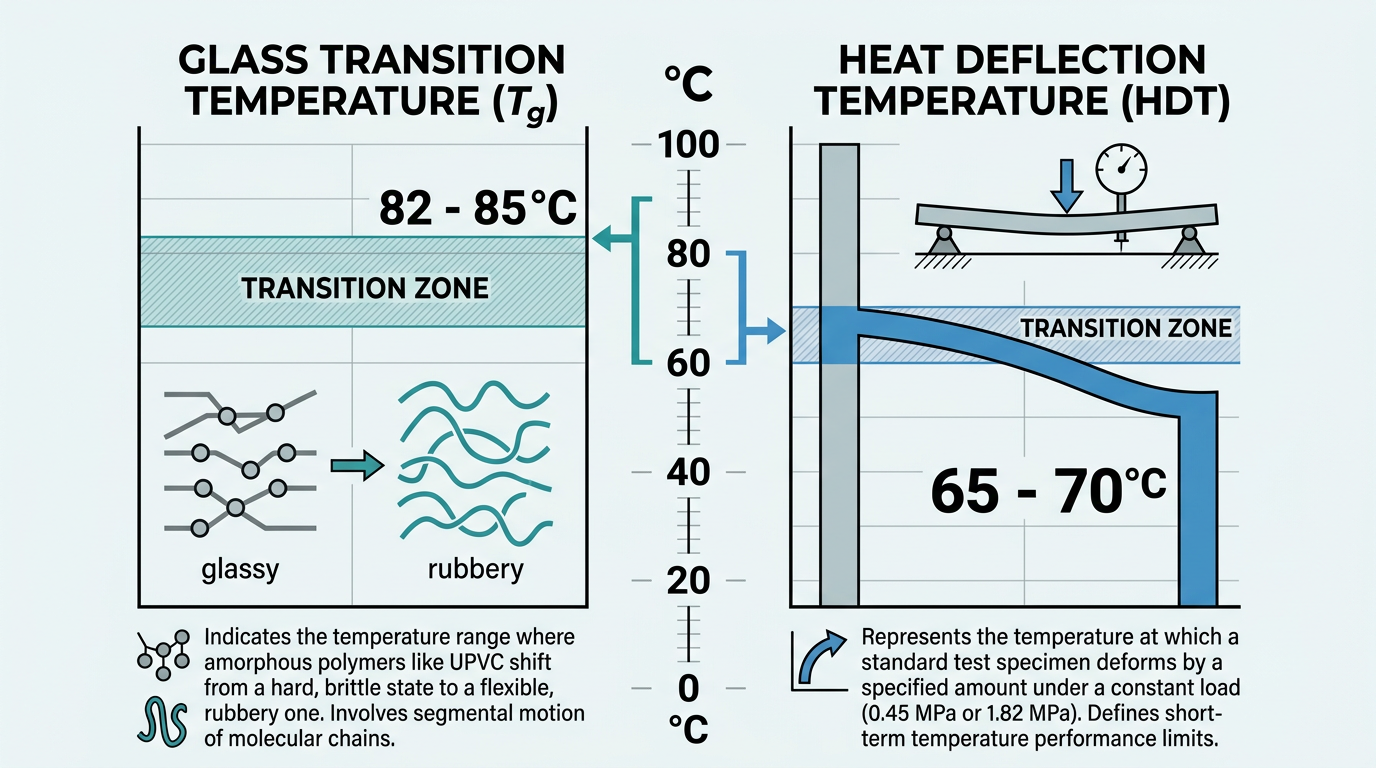
Two thermal numbers on UPVC datasheets routinely get conflated. The Tg of unplasticized PVC sits at 82-85 °C — Wilkes’ PVC Handbook lists 82 °C; Netzsch’s DSC measurement on PVC-U comes in at 84 °C with a step height of 0.32 J/(g·K).
HDT is the lower number, 65-70 °C, because heat deflection measures load-bearing softening at a defined stress, not the calorimetric chain-mobility transition. A UPVC profile rated “80 °C service” is borrowing from Tg; a load-bearing application has to design around HDT.
The Tg-vs-K-value relationship surprises specifiers who expect mechanical performance to scale with chain length. Tg = 356 K – 506 / Xn^0.666 places K-57 and K-67 within 1 °C of each other on paper, both pulling toward an 83 °C ceiling.
Lab-measured 84 °C reflects the lift contributed by the stabilizer / lubricant package, not the resin grade. K-value buys porosity and processability; thermal performance is set by the polymer chemistry itself.
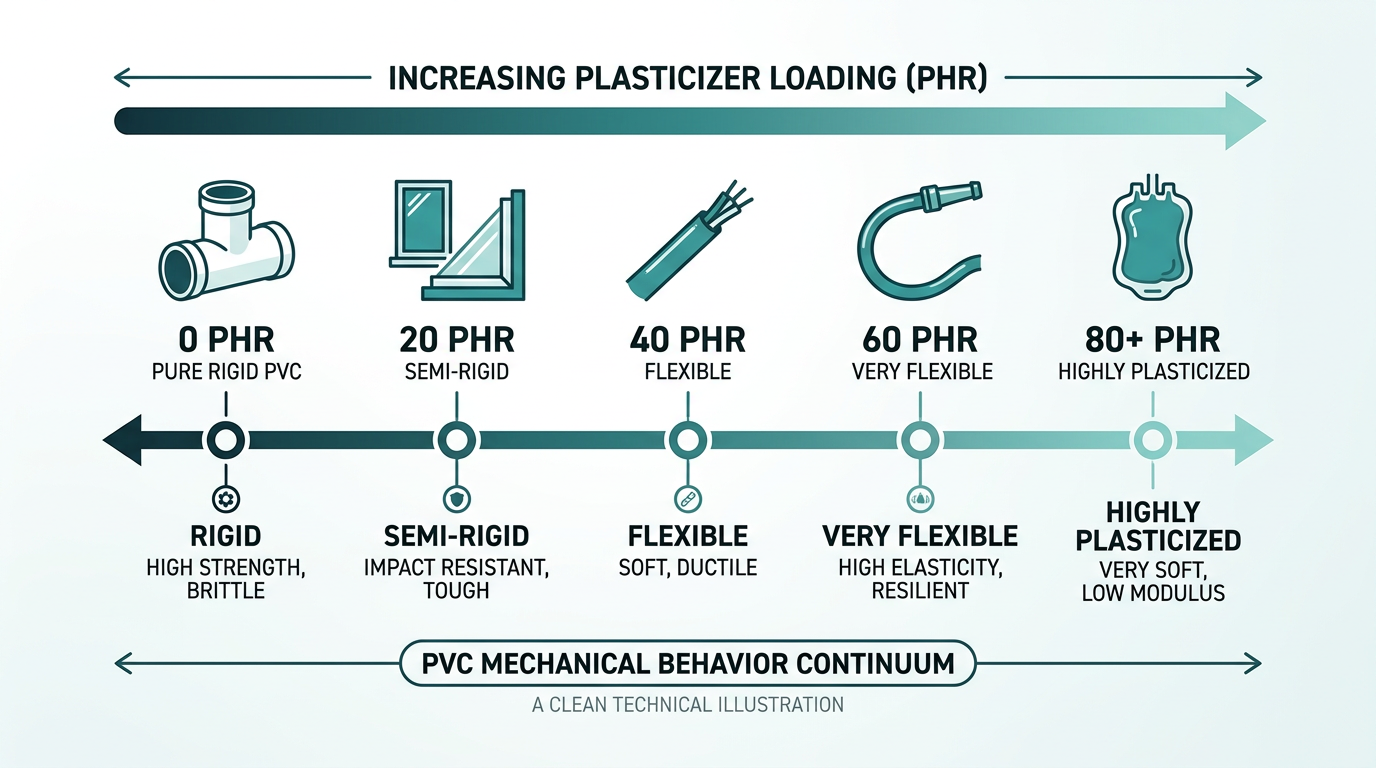
Where UPVC Sits on the PVC Plasticizer Continuum
UPVC sits at one end of a continuum. The same suspension PVC polymer, blended with progressively higher DINP loadings, produces every PVC mechanical class in commerce. The cascade from rigid to flexible runs monotonically across density, hardness, stiffness, tensile, and elongation.
| Plasticizer (% DINP) | Specific gravity | Shore A | Flexural stiffness (MPa) | Tensile (MPa) | Elongation (%) | Application |
|---|---|---|---|---|---|---|
| 0% (UPVC) | 1.40 | — (82 Shore D) | 3,000 | 41 | <15 | Rigid pipe, profile, window frames |
| 25% | 1.26 | 94 | 69 | 31 | 225 | Vinyl flooring, semi-rigid pipe |
| 33% | 1.22 | 84 | 12 | 21 | 295 | Wire and cable insulation |
| 44% | 1.17 | 66 | 3.4 | 14 | 400 | Boots, inflatables, clothing |
| 86% | 1.02 | <10 | — | — | — | Plastisol inks, soft baits |
The cascade reframes what UPVC is. UPVC is not a different polymer from “PVC” — UPVC is the same suspension-polymerized base resin with a different additive recipe.
A wire-and-cable compounder at 33% DINP and a UPVC pipe extruder at phr=0 are buying the same S-PVC polymer, often in different K-value grades. The additive package downstream of resin selection splits the two product lines.
UPVC Standards: ASTM D1784 Cell Classes and NSF/ANSI 61
Two specifying frameworks define a compliant UPVC compound: ASTM D1784 for mechanical property minimums, and NSF/ANSI 61 for potable-water contact.
ASTM D1784 Cell Classes 12454 / 12364 / 14333
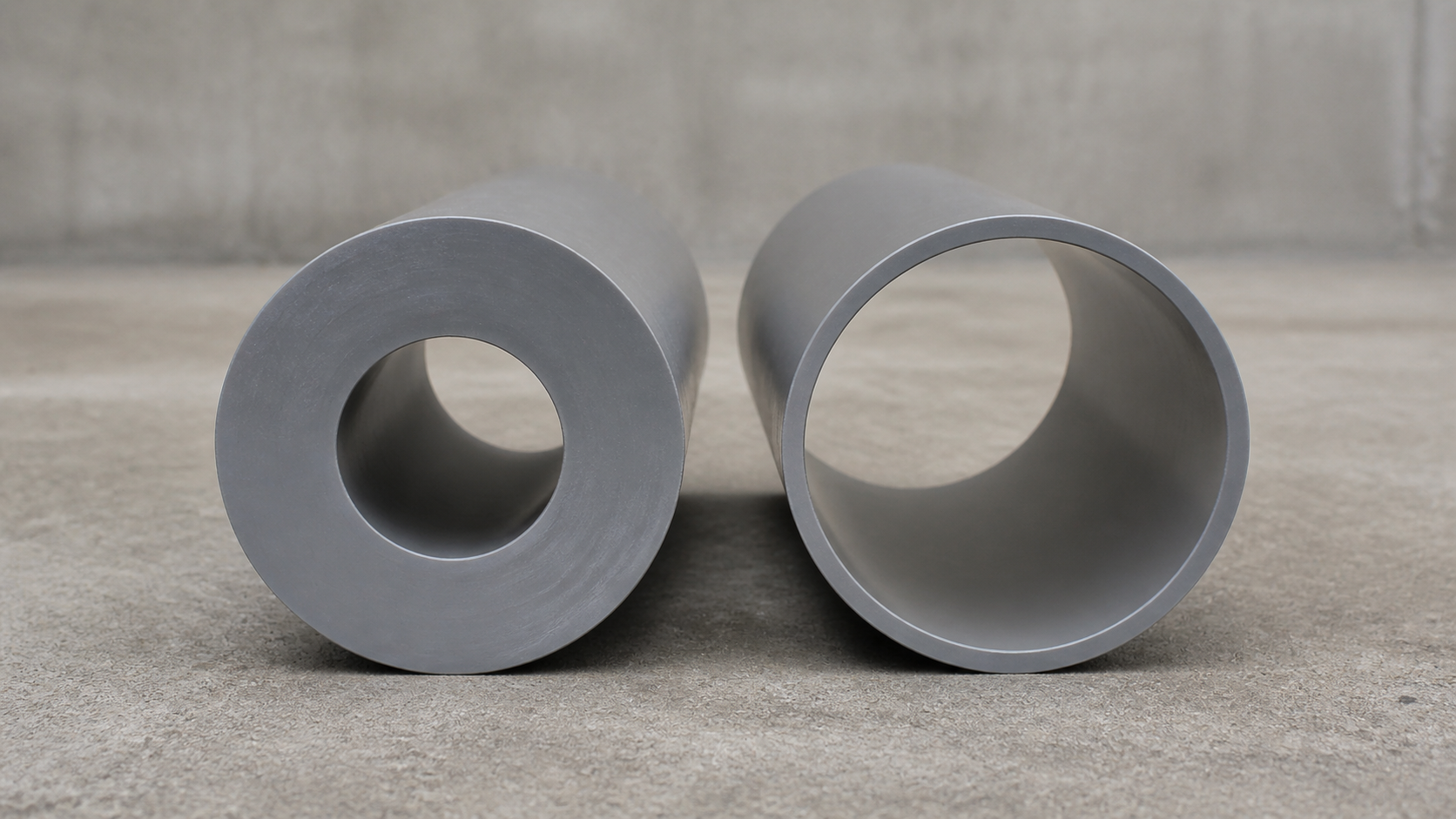
ASTM D1784 classifies rigid PVC and CPVC compounds with a five-cell number — base material, IZOD impact, tensile strength, tensile modulus, and deflection temperature under load. Cell 12454 is the dominant municipal pressure-pipe spec, requiring 7,000 psi tensile minimum (≈ 48 MPa) and 400,000 psi tensile modulus.
Cell 12364 covers solid-wall gravity sewer at 6,000 psi. Cell 14333 is the higher-impact compound carried by NSF-listed water-service products, with lower tensile, modulus and DTUL minimums than 12454. Almost all US municipal pressure pipe meets 12454, and the 51 MPa AzoM tensile figure sits 6% above that 48 MPa minimum — the margin a typical lot is buying you.
NSF/ANSI 61 Listing for UPVC in Potable Water
For potable water, the relevant overlay is NSF/ANSI/CAN 61. The 2024 revision added a seven-PFAS test battery to align with the EPA’s PFAS National Primary Drinking Water Regulations. Compliance with the new testing requirements is due January 1, 2028.
Anyone specifying UPVC pipe or fittings into a US potable-water system before that deadline should note that the post-2024 PFAS panel covers PTFE, ETFE, PVDF and fluoroelastomer components, not the UPVC itself. Older listings may need recertification.
Why UPVC Is Not Additive-Free Despite Being Unplasticized
Strip the plasticizer from a PVC compound and the resin still cannot be melt-processed. PVC has atactic stereochemistry and head-to-tail monomer arrangement, which give only a few percent syndiotactic crystallinity — too low to behave as a semi-crystalline polymer.
The 150-220 °C “melting range” on UPVC datasheets is the decomposition zone, not a true Tm. HCl elimination becomes autocatalytic above 70 °C, which is why every commercial UPVC compound carries a Ca-Zn, organotin, or lead-based heat-stabilizer package — typically at 1-3 phr. Drop the stabilizer and the polymer browns and crosslinks before the screw zone reaches forming temperature.
The “unplasticized” descriptor specifically excludes the plasticizer category. UPVC does not exclude:
- Heat stabilizers (1-3 phr) preventing HCl autocatalytic degradation
- Lubricants (0.5-2 phr) controlling shear, plate-out, and metal-release
- Impact modifiers (0-10 phr) lowering the brittle temperature below ~5 °C for outdoor service
- Pigments, fillers, processing aids as the application demands
Suspension PVC at K65-K67 is the typical base resin for UPVC profile and pipe extrusion. A UPVC compound is not a one-ingredient material — it is a five-to-eight ingredient recipe with one specific category zeroed out.
What UPVC Means in Practice
When a procurement spec says “UPVC,” read it as a formulation specification, not a product category. The plasticizer phr is zero, and the base resin is K65-K67 suspension PVC.
The property sheet falls out of those two decisions — 1.40 g/cm³, 40-51 MPa tensile, 82-85 °C Tg, ASTM D1784 cell 12454 or 14333.
Two specifier mistakes recur. The first is conflating Tg with HDT and designing service temperature against the wrong number.
The second is treating “unplasticized” as a synonym for “additive-free” and forgetting that the stabilizer package is what makes UPVC processable at all. Get the formulation lever right, and the property sheet writes itself.