

DEHCH gels PVC roughly twice as fast as DINCH. That single processing difference tells you more about these two cyclohexanoates than any spec sheet will. Both are non-phthalate, both sit on a cyclohexane core, and both pass REACH — yet they behave differently on the production floor and in the regulatory file. The molecular structure explains why: a C8 alcohol chain at the 1,4 position versus a C9 chain at the 1,2 position creates distinct processing windows and migration profiles. For general PVC compounding, DEHCH’s speed and viscosity advantages make it the practical choice. For food contact, medical devices, and toys, DINCH’s 17-year regulatory track record justifies its premium.
Chemical Structure and Molecular Differences
DEHCH and DINCH share a cyclohexane ring as their backbone, but the similarities end there.
DEHCH (bis(2-ethylhexyl) cyclohexane-1,4-dicarboxylate) places its ester groups at opposite positions on the ring — the 1,4 configuration — with two 2-ethylhexyl (C8) alcohol chains. Its molecular weight is 396.6 g/mol. DINCH (diisononyl cyclohexane-1,2-dicarboxylate) places ester groups at adjacent positions — the 1,2 configuration — with longer isononyl (C9) chains, giving it a molecular weight of 424.7 g/mol. Commercial DINCH consists of approximately 90% cis and 10% trans isomers.
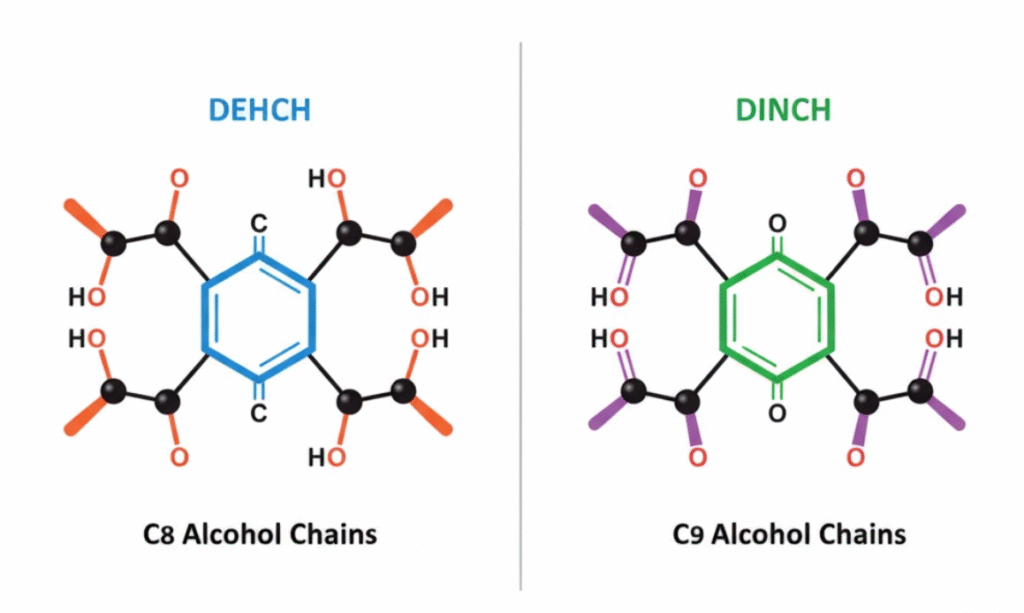
These structural differences are not academic. The 1,4 symmetry in DEHCH allows faster interaction with PVC polymer chains during processing, which directly translates to shorter gelation times. The 1,2 adjacency in DINCH, combined with its longer C9 chains, produces slower gelation but also restricts molecular mobility in the finished product — reducing migration. The compatibility between plasticizer and polymer follows directly from this geometry: shorter chains and symmetrical positioning mean faster incorporation but easier escape. Longer chains and adjacent positioning mean slower processing but better retention.
Processing Performance
DEHCH outperforms DINCH in nearly every processing metric relevant to general PVC compounding.
Gelation speed is the biggest difference. DEHCH plasticizes PVC at roughly twice the speed of DINCH, which means shorter cycle times and higher throughput on calendering lines, extruders, and injection molders. For a production supervisor running three shifts, that speed difference directly affects output volume.
Viscosity reinforces this advantage. DEHCH runs at 30-45 mPa.s at 20 C, while DINCH measures 44-60 mPa.s at the same temperature. Lower viscosity means easier mixing, faster dispersion in dry blends, and less mechanical energy required during compounding. I recommend DEHCH for any application where processing efficiency drives profitability — wire and cable insulation, wallcoverings, general-purpose flexible PVC — and where sensitive-application regulations do not apply.
Where DINCH holds its own is in formulations where slower gelation is actually desirable. Plastisol applications that require longer open times or controlled flow before fusion can benefit from DINCH’s more gradual incorporation. But for most high-volume PVC processing, DEHCH’s speed is a clear advantage.
Migration and Safety
Migration rate depends on molecular weight, chain length, and how tightly the plasticizer integrates with PVC polymer chains. This is where DINCH earns its reputation in sensitive applications.
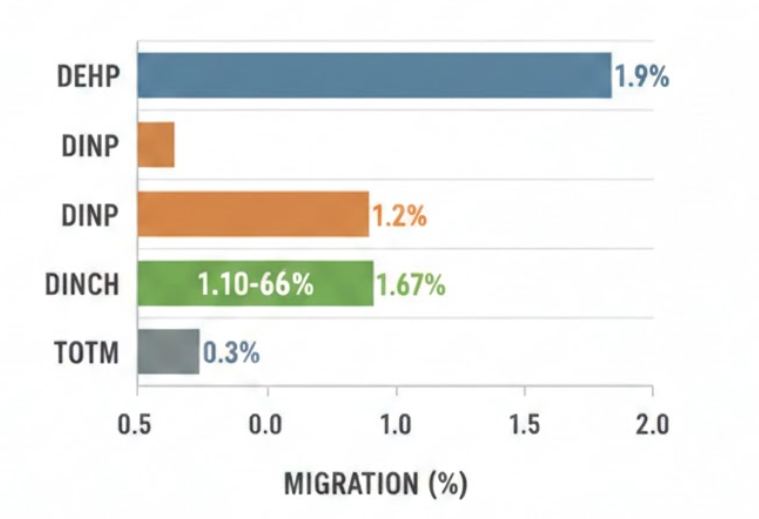
DINCH migrates approximately eight times less than DEHP in comparable formulations. In medical PVC devices, peer-reviewed testing measured DINCH migration at 1.10-1.67% of initial plasticizer content over 24 hours in lipophilic simulant. That is moderate among non-phthalate alternatives — TOTM outperforms it — but substantially better than legacy phthalates.
DEHCH’s safety profile is well-established through a different pathway. Hughes, Cox, and Bhat published a reference dose (RfD) derivation of 0.3 mg/kg-day for DEHCH in Regulatory Toxicology and Pharmacology. Their approach used DINCH as a read-across compound because of similar physical and chemical properties, meaning regulators consider these two cyclohexanoates toxicologically comparable. EFSA found no adverse effects up to 1,000 mg/kg body weight per day in their assessment. These findings confirm DEHCH as safe for general PVC use.
The practical distinction: DINCH has deeper migration data specifically for food contact and medical scenarios, accumulated over 17-plus years of real-world use and regulatory scrutiny. BASF invested over 7 million euros in DINCH toxicological research alone. DEHCH’s safety data is strong but younger. For applications where plasticizer migration into food or bodily fluids is a regulatory concern, DINCH’s longer track record reduces qualification risk.
Regulatory Status
DINCH holds a clear regulatory head start. EFSA approved DINCH for food contact applications in October 2006 — over 17 years of established compliance. It carries broad food contact clearance across the EU, is REACH-registered at volumes exceeding 10,000 tonnes per year, and has extensive approvals for phthalate-sensitive sectors including toys and childcare articles.
DEHCH’s regulatory portfolio is catching up rapidly. EU Commission Regulation 2023/1627 authorized DEHCH for food contact plastic materials effective August 31, 2023, with a specific migration limit of 0.050 mg/kg food. It passes 16P, RoHS, SVHC, and REACH requirements. However, DEHCH’s food contact scope is currently narrower than DINCH’s — limited to aqueous, acidic, and low-alcohol foods at room temperature or below.
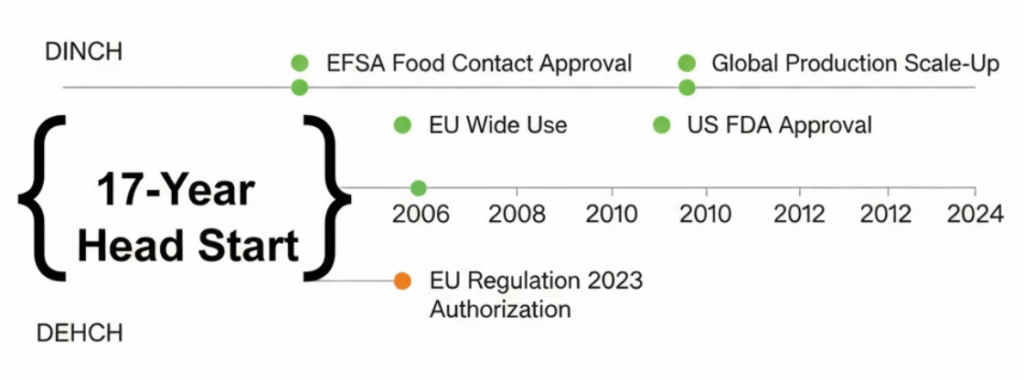
Per REACH regulations, both plasticizers meet current European compliance thresholds. The difference is depth of portfolio: DINCH covers more application categories with longer regulatory histories, while DEHCH covers the essentials for general PVC and recently entered the food contact space. For procurement managers evaluating qualification timelines, DINCH’s existing approvals can save months of testing in regulated product categories. For general industrial PVC where food and medical regulations do not apply, DEHCH’s regulatory status is fully sufficient.
Cost and Supply Chain
DINCH requires higher loading levels than legacy phthalates — roughly 40% versus 30% for equivalent flexibility. That loading penalty, combined with DINCH’s higher unit price, translates to an estimated 15% overall cost increase compared to DEHP-based formulations. DEHCH, with its faster gelation and higher molecular weight efficiency, can partially offset this gap through reduced processing time and potentially lower loading requirements.
Supply chain geography also favors DEHCH. Hanwha Solutions operates a 65,000 metric ton per year facility in Ulsan, South Korea — quadrupled from its original 15,000 mt capacity. Multiple Chinese manufacturers also produce DEHCH, providing procurement managers with competitive sourcing options across Asia.
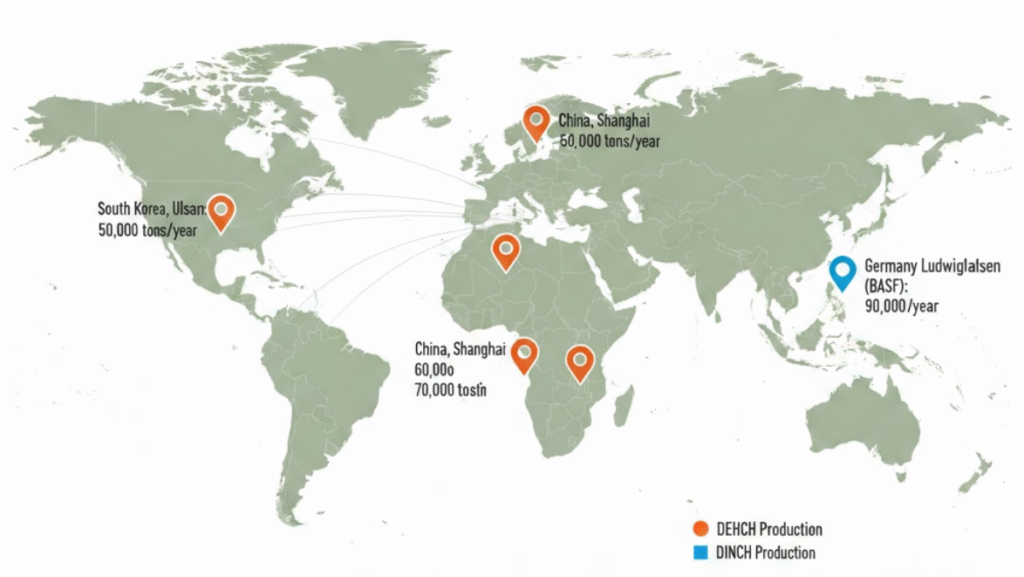
DINCH production concentrates in Europe. BASF manufactures it at Ludwigshafen, and Evonik Oxeno recently expanded DINCH capacity (branded ELATUR CH) at its Marl, Germany site, establishing itself as a second European producer. This partially mitigates single-source risk, but production remains geographically concentrated. For manufacturers in Asia or those prioritizing supply chain diversification, DEHCH offers more procurement flexibility.
Making the Right Choice
Neither DEHCH nor DINCH is universally superior — application sensitivity is the deciding factor.
Choose DEHCH for general PVC compounding where processing speed and cost efficiency drive the decision: wire and cable insulation, wallcoverings, construction materials, and general flexible PVC products. Its twice-faster gelation, lower viscosity, and multi-source supply chain make it the practical choice when food contact or medical regulations do not apply.
Choose DINCH when regulatory depth is non-negotiable: food contact packaging, medical devices, toys, and childcare articles. Its 17-year regulatory track record, deeper migration data, and broad application clearances justify the cost premium in these sensitive categories. Treating these two cyclohexanoates as interchangeable ignores the structural and regulatory differences that should drive your selection.