

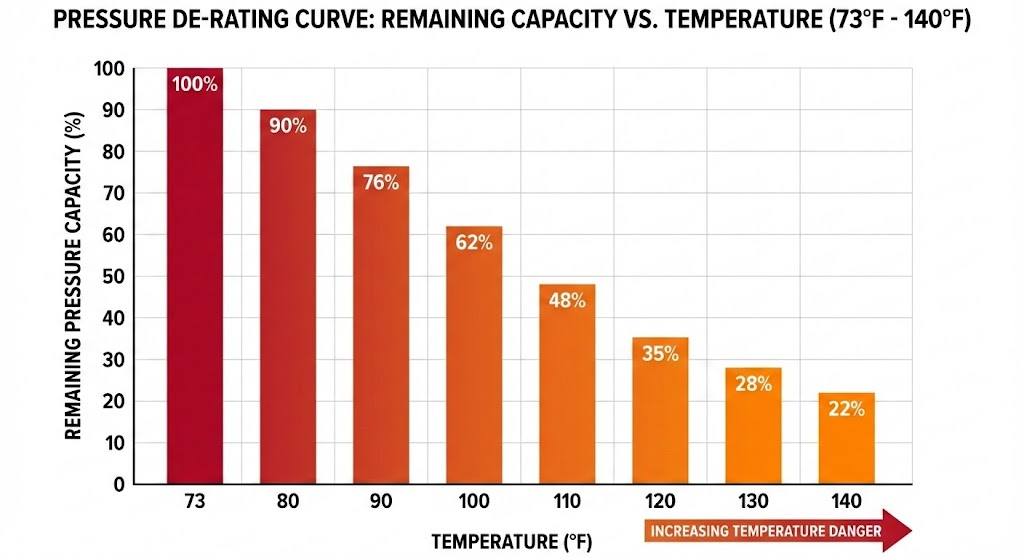
At 140F, PVC pipe retains only 20% of its room-temperature pressure capacity. That single fact explains why temperature ratings matter far more than most people realize.
Temperature limits on PVC datasheets can seem arbitrary. Why 140F and not 150F? Why does pressure drop so dramatically as temperature rises? The answer lies in understanding how PVC behaves at the molecular level. Once you grasp that, choosing the right material for your application becomes straightforward.
This guide explains the temperature limits for different PVC types, why those limits exist, and how to select the right material based on your specific temperature requirements.
What Temperature Can PVC Withstand?
Standard PVC pipe has a maximum continuous operating temperature of 140F (60C). For pressure applications, I recommend staying below 100F (38C) to maintain adequate pressure capacity.
These numbers come with important context. The 140F limit applies under pressure only with heavy de-rating. Add pressure, and the safe operating temperature drops significantly.
Here’s the complete de-rating table that shows how pressure capacity decreases as temperature rises:
| Temperature | De-rating Factor | Remaining Capacity |
|---|---|---|
| 73F (23C) | 1.00 | 100% (baseline) |
| 80F (27C) | 0.88 | 88% |
| 90F (32C) | 0.75 | 75% |
| 100F (38C) | 0.62 | 62% |
| 110F (43C) | 0.50 | 50% |
| 120F (49C) | 0.40 | 40% |
| 130F (54C) | 0.30 | 30% |
| 140F (60C) | 0.22 | 22% |
The pattern is striking: at just 100F, you’ve already lost nearly 40% of your pressure capacity. At the 140F maximum, you’re down to about one-fifth of the original rating.
For intermittent exposure, PVC can handle higher temperatures briefly. Drainage systems can tolerate discharges up to 100C (212F) provided they last less than two minutes. But this is an emergency tolerance, not a design parameter.
Why Does PVC Have Temperature Limits?
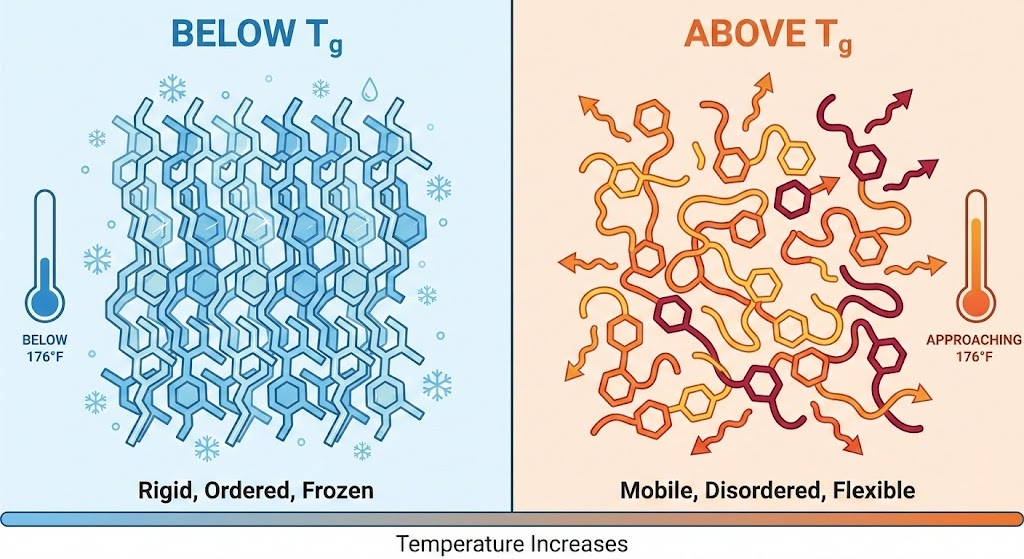
The temperature limits exist because of a phenomenon called glass transition temperature, or Tg. Understanding Tg helps you predict PVC behavior in any situation, not just the ones covered in specification sheets.
Think of glass transition like butter. Cold butter is hard and rigid. Leave it on the counter, and it gradually softens as it warms. The butter doesn’t melt suddenly at one specific temperature – it transitions from firm to soft over a range.
PVC works the same way. Below its glass transition temperature, the polymer chains are essentially frozen in place, creating a rigid material. As temperature approaches Tg, those chains gain mobility. The material begins to soften and lose its structural integrity.
Rigid PVC has a glass transition temperature of approximately 80C (176F). The 140F maximum operating limit sits well below this – a deliberate safety margin.
This is why I believe understanding Tg is more valuable than memorizing temperature limits. If you know the material starts transitioning around 176F, you intuitively understand why operating at 140F is the limit, and why 100F is preferable for pressurized systems.
How Do Plasticizers Change PVC Temperature Behavior?
Plasticizers are additives that increase PVC’s flexibility by lowering its glass transition temperature. This creates one of the most dramatic examples of how formulation changes material behavior.
Rigid PVC (without plasticizers) has a Tg around 80C. Add an efficient plasticizer, and that same base polymer can have a Tg as low as -42C. Same material, completely different temperature behavior.
This works because plasticizer molecules insert themselves between PVC polymer chains, increasing the space and reducing chain-to-chain friction. The chains can move more easily, making the material flexible at lower temperatures.
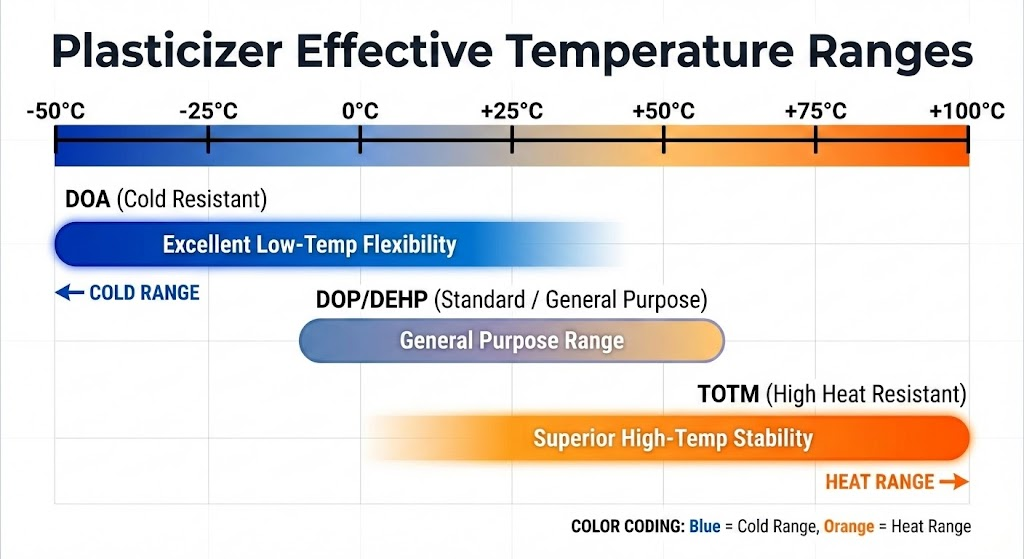
Different plasticizers offer different temperature performance:
- Standard plasticizers (DOP/DEHP): Good general performance, moderate temperature range
- TOTM (trioctyl trimellitate): Best for high-temperature applications like automotive wiring and electrical cables
- DOA (dioctyl adipate): Excellent for cold-weather flexibility, reduces low-temperature brittleness
The plasticizer content matters too. In flexible PVC products, plasticizer content typically ranges from 10% to 50% by weight. Higher plasticizer content means lower Tg and greater flexibility, but also reduced strength and chemical resistance.
If you’re specifying PVC for unusual temperature conditions, choosing the right plasticizer is often more important than choosing a different base material.
What Happens When PVC Gets Too Hot or Too Cold?
When PVC exceeds its temperature limits, the consequences depend on how far and how long the exposure lasts.
Hot Temperature Effects
As PVC approaches its glass transition temperature, several things happen:
- Softening: The material loses rigidity and can deform under load
- Pressure loss: Pressure capacity drops dramatically (recall the de-rating table)
- Permanent damage: Pipes can sag, warp, or distort
- Catastrophic failure: In extreme cases, pipes rupture
Cold Temperature Effects
Cold temperatures make PVC more brittle, but the effect is less severe than most people assume. At 32F, PVC pipe still maintains 70% to 90% of its room-temperature impact strength. Fifty years of field experience confirm that PVC performs well in cold-weather installations.
The real cold-weather risk is impact damage. A PVC pipe that easily withstands a bump at 70F might crack if struck the same way at 0F. During cold-weather installation, handle pipes more carefully and avoid dropping or striking them.
Freezing is a separate concern. Water expands when it freezes, and that expansion can crack any pipe material. This isn’t a PVC-specific weakness – it’s physics. Proper insulation and drainage prevent freezing damage.
For consistently cold environments, formulations using cold-temperature plasticizers like DOA or DOS significantly reduce brittleness.
How to Install PVC Properly for Temperature Variations
Plastics expand and contract four to five times more than metal pipes. Ignoring this causes leaks, cracked fittings, and premature failures – regardless of whether you’re within temperature ratings.
The thermal expansion coefficient for PVC is 2.9 x 10^-5 in/in/F. In practical terms, for every 100F temperature change in a 100-foot run of PVC pipe, expect about 3.6 inches of expansion or contraction.
That’s not a trivial amount. An 80-foot run of PVC exposed to a 47F temperature swing (say, from 73F to 120F) will expand by 1.35 inches.
Managing Thermal Expansion
Expansion loops: Install U-shaped sections that absorb movement
Flexible connections: Use flexible fittings at key points to accommodate expansion
Proper support spacing: Follow manufacturer guidelines for support intervals, which account for expansion
Temperature transitions: When temperature variation exceeds 25F, thermal expansion must be designed for, not ignored
Code Requirements
Many building codes prohibit PEX and similar plastic tubing within the first 18 inches of piping connected to water heaters. This accounts for the high temperatures immediately around heating equipment. Common practice is to use stainless steel flex hoses for the water heater connection, then transition to plastic beyond the heat zone.
Most building codes also prohibit PVC for hot water distribution inside buildings. CPVC or copper are typically required instead.
How to Choose the Right PVC Type for Your Temperature Needs
Start with your maximum expected temperature, add a safety margin, then select the appropriate material. Here’s a quick decision guide:
| Your Temperature Range | Recommended Material |
|---|---|
| Below 100F (38C) | Standard PVC – de-rate above 73F (23C) |
| 100-120F (38-49C) | PVC acceptable with de-rating, consider CPVC |
| 120-140F (49-60C) | CPVC recommended |
| 140-200F (60-93C) | CPVC required |
| Above 200F (93C) | Consider metal or specialty plastics |
Questions to Ask Your Supplier
- What is the maximum continuous temperature this application will see? Not the average – the maximum.
- Will there be pressure involved? If yes, use the de-rating table and size accordingly.
- What are the temperature swings? Large variations require thermal expansion planning.
- Is the application indoor or outdoor? Outdoor applications see larger temperature ranges.
- Are there any code requirements? Many jurisdictions restrict plastic pipe use in certain applications.
When to Consider Alternatives
For temperatures consistently above CPVC’s 200F limit, or for applications involving thermal cycling that could stress plastic materials, metal piping (stainless steel, copper) or specialty high-temperature plastics may be more appropriate.
For rigid applications without plasticizer (known as uPVC), temperature limits are fixed by the base material. For flexible PVC applications, specifying the right plasticizer can extend both high-temperature and low-temperature performance within limits.
What’s Next
You now understand why PVC has temperature limits and how to choose the right material for your application. The key insight: temperature limits come from molecular behavior, not arbitrary specifications. Use that understanding to evaluate any PVC application.
Ready to discuss specific material requirements or plasticizer selection for your temperature conditions? Contact a materials supplier who can match formulations to your exact application needs.