

Choosing between TINTM and TOTM plasticizers directly impacts your PVC product’s performance, durability, cost, and regulatory compliance. Both trimellitate esters dominate demanding applications like wire insulation and automotive components, but they excel in different scenarios.
What Are Trimellitate Plasticizers?
Before comparing these two chemistry workhorses, you need to understand what makes them special.
Trimellitate plasticizers are high-performance PVC additives derived from trimellitic acid. They function by inserting themselves into the rigid PVC polymer matrix, increasing chain flexibility and softness. The key difference between trimellitates and traditional phthalate plasticizers is their superior heat stability and lower volatility. This makes them indispensable when regular plasticizers would simply evaporate or degrade.
Think of it this way: phthalates work fine in applications where temperatures stay moderate. But when your wire insulation needs to handle 105°C continuously or your automotive seal must resist engine heat while maintaining flexibility, trimellitates are what you reach for. They’re the premium solution for premium problems.
TINTM (Tri-isononyl Trimellitate) Fundamentals
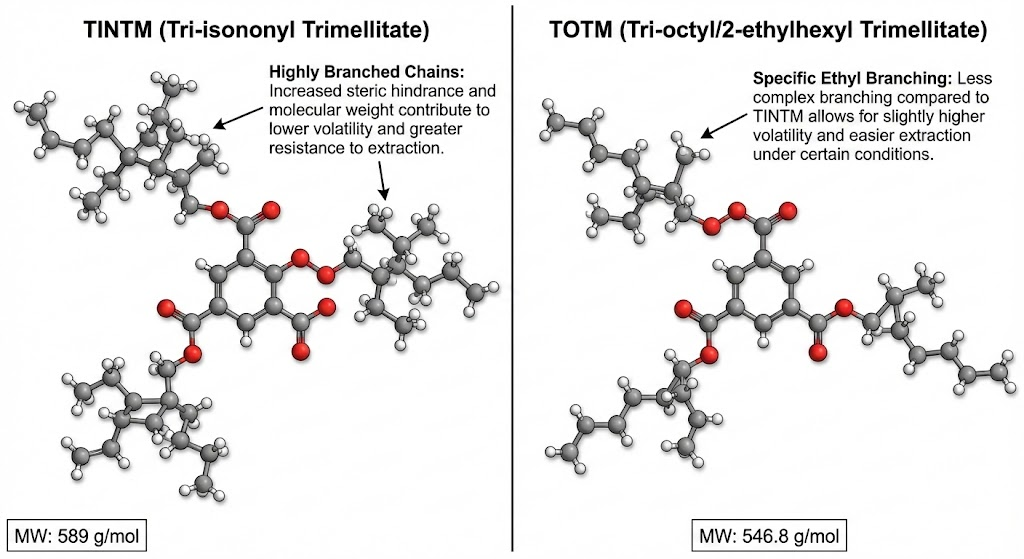
TINTM, with its molecular formula C₃₆H₆₀O₆ and molecular weight of 589 g/mol, represents the higher branching density option in the trimellitate family.
TINTM appears as a clear, colorless liquid with mild odor. Its defining characteristic is exceptional thermal permanence—it maintains structural integrity even at extreme temperatures. The specific branched structure of TINTM makes it particularly sticky to PVC resins, meaning it doesn’t want to escape the polymer matrix under heat stress.
The industrial sector primarily uses TINTM for heat-resistant cables rated at 105°C or higher, structural planks requiring durability, and seals that must survive harsh temperature cycling. BASF markets it as Palatinol® TINTM, while other manufacturers offer it under various brand names. The compound’s low migration tendency makes it valuable in applications where plasticizer loss through evaporation or extraction is problematic.
TOTM (Trioctyl Trimellitate) Fundamentals
TOTM, chemically known as tris(2-ethylhexyl) trimellitate, has the molecular formula C₃₃H₅₄O₆ and a lower molecular weight of 546.8 g/mol compared to TINTM.
TOTM also appears as a clear, yellowish liquid with oily consistency. Where TINTM emphasizes permanence, TOTM emphasizes efficiency and extraction resistance. Its slightly less branched structure allows better processing flow while maintaining exceptional performance characteristics. The compound has practically negligible vapor pressure (less than 10⁻⁷ mmHg at 25°C), virtually eliminating the “fogging” problem that plagues conventional plasticizers.
The most widely used trimellitate globally, TOTM dominates wire and cable insulation, automotive interior components, seals, dishwasher gaskets, and demanding industrial applications. Eastman produces it under their TOTM brand, while numerous other suppliers offer equivalent products. Its superior extraction resistance to oils, soaps, water, and food simulants makes it the go-to choice for applications facing multiple extraction stresses.
Head-to-Head Performance Comparison
Here’s where the practical differences emerge. I’ll break down how TINTM and TOTM stack up across critical performance dimensions.
Physical and Chemical Properties
Both compounds possess similar thermal stability profiles, but their molecular architectures create measurable differences:
TINTM Specifications:
- Molecular weight: 589 g/mol
- Density: 0.98 g/mL at 20°C
- Boiling point: 349.8°C
- Flash point: 248.6°C
- Vapor pressure: 0.011 Pa at 20°C
TOTM Specifications:
- Molecular weight: 546.8 g/mol
- Appearance: Clear yellowish liquid
- Boiling point: Similar thermal stability range
- Vapor pressure: Less than 10⁻⁷ mmHg at 25°C (practically negligible)
The critical difference lies in vapor pressure. TOTM’s practically non-existent vapor pressure means virtually zero volatility loss during processing or service. TINTM shows slightly higher volatility but remains significantly better than phthalate alternatives. For applications where even minimal plasticizer loss is unacceptable, TOTM’s advantage becomes material.
Temperature Performance
Temperature resistance determines success in the most demanding PVC applications.
Both TINTM and TOTM maintain PVC flexibility at continuous service temperatures up to 105°C, where conventional phthalate plasticizers degrade. This 105°C rating represents the threshold where trimellitates prove their worth—traditional plasticizers simply cannot survive.
The difference: TINTM demonstrates slightly superior high-temperature permanence due to its higher molecular weight and enhanced branching. In extended thermal aging tests, TINTM-formulated compounds retain their mechanical properties longer than TOTM at extreme temperatures. However, TOTM excels at maintaining elongation retention after aging—a crucial property for applications requiring continued flexibility after thermal stress.
For 90°C applications (common in building wire), both perform excellently. For 105°C applications and beyond, TINTM edges ahead. For applications where maintaining flexibility after temperature cycling matters more than peak temperature resistance, TOTM pulls ahead.
Extraction and Migration Resistance
Extraction resistance separates the adequate from the exceptional.
TINTM shows excellent resistance to water and soap extraction due to its strong polymer-plasticizer bonding. When PVC products encounter soapy water—common in dishwashers, laundry environments, and food contact scenarios—the plasticizer tries to escape the polymer matrix. TINTM’s branched structure resists this extraction better than many alternatives.
TOTM takes extraction resistance further. Testing shows that TOTM is the least extractable trimellitate when exposed to soapy water. It also outperforms in water extraction, oil extraction, and solvent extraction across multiple testing standards. The compound’s molecular structure creates stronger van der Waals interactions with PVC, essentially locking it in place.
This advantage becomes critical in food contact applications, dishwasher seals, and any scenario where multiple extraction stresses occur. TOTM’s superior extraction resistance directly translates to longer product life and fewer regulatory compliance issues.
Electrical Properties
Both trimellitates deliver excellent electrical properties, which matters for wire and cable insulation.
TINTM and TOTM both maintain good electrical conductivity and dielectric strength. They provide excellent surface resistance and suitability for high-voltage applications. There’s minimal practical difference between them in this dimension—both far exceed the electrical property requirements for building wire and industrial cable insulation.
Where they do differ slightly is processing ease. TOTM’s slightly lower molecular weight and less branched structure allows easier processing on production equipment, which can indirectly affect electrical property consistency. But once formulated into final compounds, the electrical performance difference is negligible.
Application-Specific Performance
Different applications demand different plasticizer characteristics. Let me break down where each excels.
Wire and Cable Insulation
Wire and cable represents the largest market for trimellitate plasticizers—particularly building wire rated for 90°C and 105°C service.
Building wire standards like UL62 (building wire), UL758 (appliance wires), NM-B (building wire insulation), and THHN (high-temperature building wire) specifically permit trimellitate plasticizers. In the United States, building wire insulation is typically formulated with TOTM or TINTM blended with heavier phthalates like DTDP or DUP to optimize processing and reduce costs.
Here’s the practical reality: wire manufacturers choose TINTM when they need maximum permanence in 105°C applications. They choose TOTM when they need excellent performance with easier processing and maximum extraction resistance in 90°C applications. Many formulations actually use both in a blend—TINTM provides heat permanence while TOTM optimizes extraction resistance.
TOTM generally represents the industry standard because its superior extraction resistance benefits most wire applications. When drinking water contacts wiring insulation (as it does in commercial buildings), TOTM’s resistance to water extraction prevents flavor changes and regulatory violations. But TINTM remains the preference when serving 105°C applications in harsh industrial environments.
Automotive Interior Applications
Automotive trim components face unique challenges: temperature cycling from -40°C to 80°C+, UV exposure, oil contact, and strict fogging regulations.
Both TINTM and TOTM work in automotive applications. Automotive interior trim applications typically select from DIDP, DPHP, and trimellitates to meet strict fogging requirements. Fogging refers to the condensation of plasticizer vapors onto cooler window surfaces—a visible and problematic defect customers notice immediately.
TOTM’s vanishingly low volatility makes it the default choice for trim components where fogging prevention is critical. Its low compound weight loss after thermal aging combined with superior elongation retention means trim components remain flexible and don’t shrink noticeably over the vehicle’s lifetime. This is why OEMs favor TOTM in premium interior trim where appearance and durability matter most.
TINTM appears in automotive applications less frequently than TOTM, mainly in high-temperature seal and gasket components where extreme heat resistance outweighs other concerns.
Industrial and Consumer Products
Beyond wire and automotive, trimellitates appear in flooring, wall coverings, films, sheets, coated fabrics, and gaskets.
The selection logic mirrors wire and automotive: TOTM dominates high-performance applications where extraction resistance matters (seals, dishwasher gaskets, food-contact film). TINTM appears in applications emphasizing maximum heat permanence (heat-resistant sheets, high-temperature coated fabrics).
In practical commercial formulations, manufacturers often blend both plasticizers. This hybrid approach captures TINTM’s thermal permanence advantage while leveraging TOTM’s superior extraction resistance and processing characteristics. The cost trade-off becomes manageable when blending reduces the percentage of each expensive trimellitate required.
Regulatory and Environmental Considerations
Modern plasticizer selection cannot ignore compliance requirements and sustainability pressures.
Compliance Requirements
Both TINTM and TOTM must meet REACH (Registration, Evaluation, Authorization, and Restriction of Chemicals) requirements in Europe and RoHS standards in regulated industries. They’re classified as non-phthalate plasticizers, which gives them regulatory advantages over traditional phthalate alternatives.
Migration testing represents a crucial regulatory requirement for both. Products destined for food contact must undergo migration testing to demonstrate that TINTM or TOTM don’t leach into food at unsafe levels. FDA regulations establish strict migration limits—typically less than 10 mg/dm² for food contact materials.
Importantly, both TINTM and TOTM have been extensively tested and meet FDA migration requirements for food contact applications, provided they’re formulated at appropriate concentrations. This regulatory compliance opens doors that phthalate plasticizers cannot enter.
Sustainability and Environmental Considerations
Here’s an uncomfortable truth: trimellitate plasticizers sit in a gray area regarding environmental impact.
They’re undoubtedly superior to phthalates. Unlike phthalate plasticizers, which exhibit endocrine-disrupting activity at certain exposure levels, TINTM and TOTM show lower such activity. This makes them the responsible choice compared to traditional plasticizers—they’re why regulatory bodies phased out phthalates for sensitive applications like children’s toys and medical devices.
But trimellitates aren’t environmental saints either. TOTM, specifically, has documented environmental persistence. Research indicates it persists in aquatic environments and sediments, though its toxicity to aquatic organisms remains low. The compound’s very property that makes it valuable—its reluctance to migrate or degrade—means it doesn’t break down readily in the environment either.
The industry’s response has been pragmatic: for applications where safer chemistry matters (medical devices, food contact, children’s products), TINTM and TOTM represent the responsible choice. Manufacturers continue researching truly eco-friendly alternatives, but currently, there’s no drop-in replacement offering equivalent performance at commercial scale.
Cost Considerations
Both trimellitates cost substantially more than traditional phthalate plasticizers. This premium reflects their superior performance and the cost of manufacturing processes.
Pricing rarely differs dramatically between TINTM and TOTM—they typically trade within 5-15% of each other depending on market conditions and volume. However, TOTM’s lower molecular weight means slightly more pounds of TINTM deliver equivalent plasticization, creating a volume-based cost differential beyond the unit price.
Ultimately, the cost decision depends on performance requirements. If standard phthalates suffice for your application, using TINTM or TOTM makes no economic sense. If trimellitate performance is mandatory, the choice between them depends on whether TINTM’s thermal permanence or TOTM’s extraction resistance provides the deciding advantage.
Making the Selection: TINTM or TOTM?
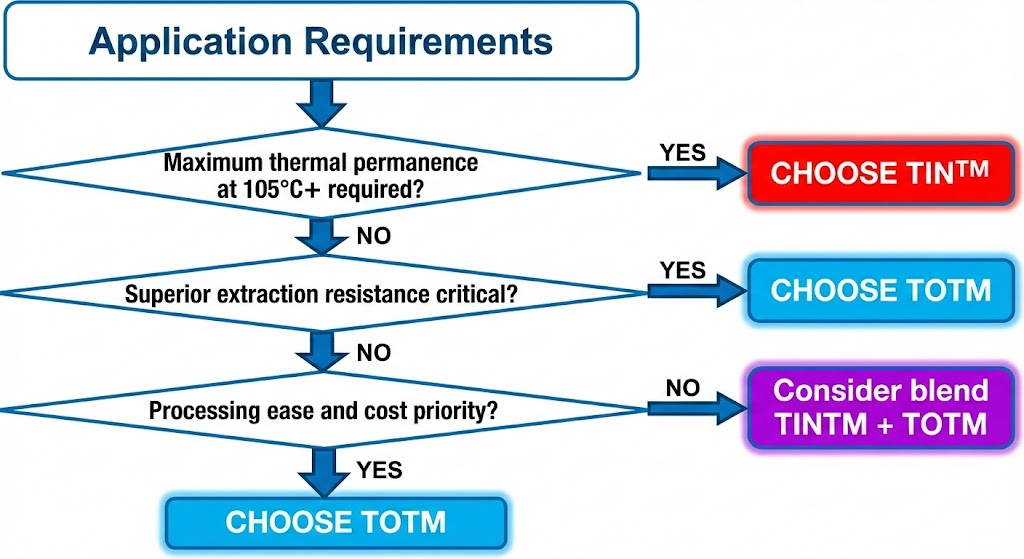
This is the decision that matters. Let me give you a clear framework.
Choose TINTM When:
Your application requires maximum thermal permanence at extreme temperatures. The compound’s higher molecular weight and branched structure make it the superior choice when your PVC compound must maintain properties at 105°C+ continuously or withstand extended thermal aging at high temperatures without degradation.
Examples include high-temperature cable insulation in demanding industrial environments, heat-resistant film applications, and seals operating in engine compartments where TOTM might gradually lose its elasticity.
Your application faces challenging extraction conditions combined with extreme heat. When PVC encounters both high temperatures AND extraction threats (simultaneous heat and oil/solvent exposure), TINTM’s combination of thermal permanence plus decent extraction resistance provides protection.
Your regulatory approval specifically requires TINTM. Certain industries have established supplier approval lists specifying TINTM formulations. Rather than spending money convincing regulators to accept TOTM, simply specify TINTM and maintain regulatory compliance.
Choose TOTM When:
Your application demands superior extraction resistance. If your PVC product faces water, oil, soap, or multiple extraction stresses, TOTM’s molecular structure provides better resistance. This includes dishwasher seals, food contact applications, drain line tubing, and automotive interiors where repeated washing occurs.
Your processing equipment or timeline requires easier manufacturing. TOTM’s slightly lower molecular weight and different branching pattern enable easier processing on production equipment. If processing proves challenging with TINTM, switching to TOTM frequently resolves die temperature issues, residence time problems, and surface defects.
Your application targets the 90°C service temperature range where both compounds excel, and extraction resistance represents the deciding factor. In building wire, HVAC applications, and other 90°C rated applications, TOTM’s superiority in extraction resistance makes it the logical choice.
Your cost sensitivity makes market-standard selection prudent. TOTM’s larger market and supplier base mean more competitive pricing and easier supply chain management. Unless TINTM’s specific advantages are essential, defaulting to TOTM reduces costs and simplifies procurement.