

DINP (Di-isononyl Phthalate) is an important phthalate-based plasticizer known for its low volatility, excellent migration resistance, and environmental safety profile compared to traditional plasticizers like DOP (Di-octyl Phthalate). The following describes a modern synthesis method uses a titanium-based catalyst system to improve efficiency and reduce environmental impact.
Reaction Route
The synthesis involves two steps:
- Mon esterification: Phthalic anhydride (PA) reacts with one molecule of isononyl alcohol (INA) to form mono-isononyl phthalate. This reaction is exothermic and occurs readily around 120°C without a catalyst.
- Diesterification: The monoester further reacts with another molecule of isononyl alcohol to form DINP. This step is reversible and requires a catalyst and elevated temperature to drive the reaction to completion.

Production Process
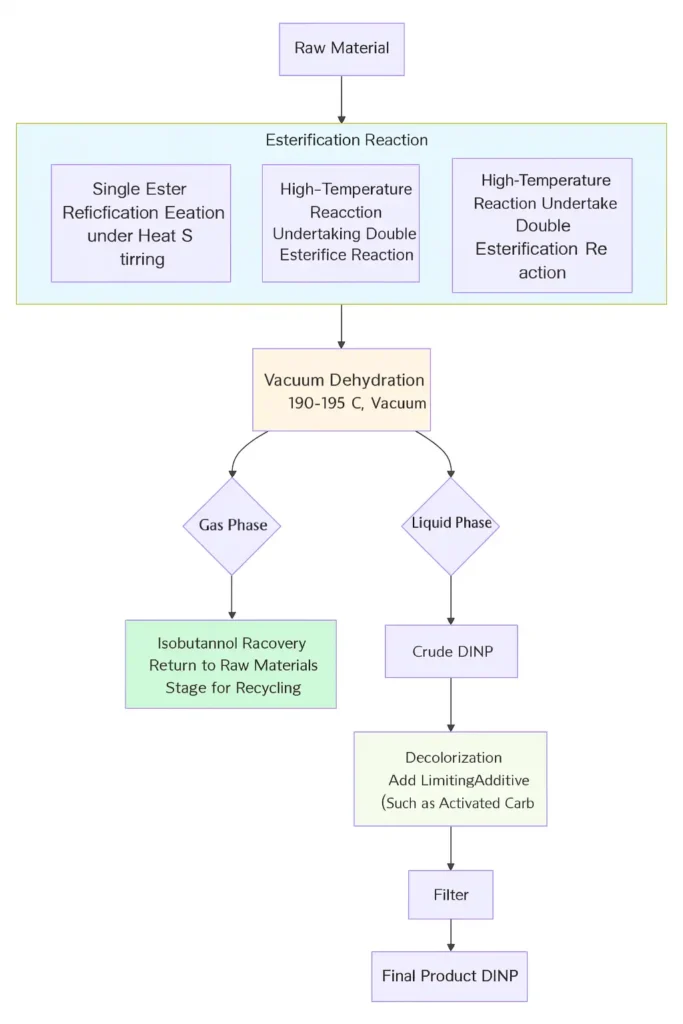
Step 1: Monoester Formation
- Charge a reaction vessel with 1 part phthalic anhydride and 3–4 parts isononyl alcohol (molar excess to promote complete reaction).
- Heat with stirring. The monoester forms spontaneously as temperature rises.
Step 2: Catalyst Addition
- At 150–180°C, add 0.001–0.002 parts (by weight relative to reactants) of a composite catalyst consisting of:
- Solid titanium-based compound
- Tetra-isopropyl titanate
- Mixed in a 1:1 ratio
Step 3: Diesterification
- Raise temperature to 225–235°C and maintain for 2–3 hours.
- This ensures complete conversion to the diester (DINP).
Step 4: Removal of Excess Alcohol
- Cool to 190–195°C and apply vacuum distillation to remove unreacted alcohol.
- The crude DINP is collected.
Step 5: Purification
- The crude product is decolorized (e.g., with activated carbon) and filtered to obtain pure DINP.
✅ Advantages of BASTONE’s DINP Production Technology
- High esterification conversion rate (>99%)
- Excellent color stability and low acid value
- Closed-loop alcohol recovery system for sustainable production
- Titanium catalyst system – non-corrosive, reusable, and environmentally friendly
BASTONE continues to deliver world-class plasticizers like DOP, DOTP, DINP, DOA, and DPHP that enhance PVC flexibility, stability, and performance.
To learn more about our plasticizer solutions, visit: https://bastone-plastics.com/product-category/plasticizer/