

DOTP and DINP are two of the most widely used plasticizers in the plastics industry, but they have important differences between DOTP and DINP that affect their performance, safety, and applications.
DOTP (dioctyl terephthalate) offers better environmental safety and is replacing traditional phthalates in many products, while DINP (diisononyl phthalate) remains common due to its cost-effectiveness and established performance record.
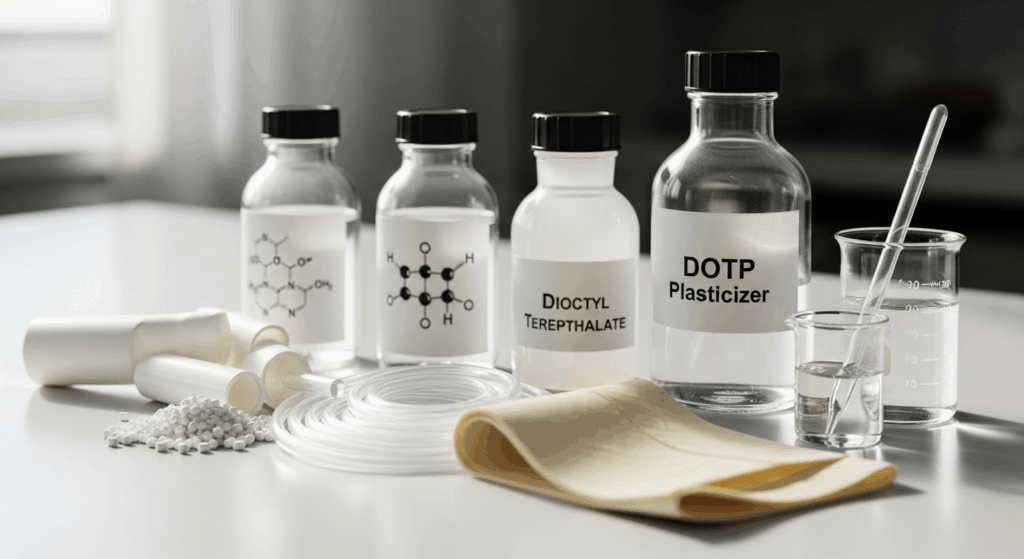
What is DOTP
DOTP (dioctyl terephthalate) is a non-phthalate plasticizer that makes rigid plastics like PVC flexible and workable. Think of it as a molecular lubricant that slides between polymer chains, allowing them to move freely past each other instead of staying locked in place.
This plasticizer emerged as a safer alternative to traditional phthalates in the early 2000s. It’s made from terephthalic acid (the same stuff used to make plastic bottles) and 2-ethylhexanol, creating a molecule that delivers excellent performance without the health concerns of older plasticizers.
DOTP excels in applications where human contact is likely. You’ll find it in children’s toys, medical devices, food packaging, and artificial leather.
What is DINP
DINP (diisononyl phthalate) is a high-molecular-weight phthalate plasticizer that has been the industry standard for flexible PVC products since the 1990s. It works by embedding itself between PVC polymer chains, preventing them from packing tightly together and creating flexibility.
This plasticizer replaced earlier phthalates like DEHP in many applications because of its better safety profile. DINP molecules are larger and less likely to migrate out of plastic products, making them more stable over time.
DINP dominates in construction materials, wire and cable insulation, and automotive parts. Its combination of good performance and competitive pricing keeps it popular despite growing regulatory scrutiny.
Physicochemical and Thermal Properties of DOTP and DINP
| Property | DOTP | DINP |
|---|---|---|
| Molecular Weight | 391 g/mol | 420 g/mol |
| Density at 20°C | 0.984 g/cm³ | 0.972 g/cm³ |
| Viscosity at 20°C | 70 mPa·s | 75-85 mPa·s |
| Boiling Point | 400°C | 370-413°C |
| Flash Point | 238°C | 220°C |
| Freezing Point | -48°C | -43°C |
| Volatility (% weight loss at 100°C for 24h) | 0.2% | 0.3% |
| Solubility in Water | <0.001 g/L | <0.001 g/L |
| Saponification Value | 285 mg KOH/g | 265 mg KOH/g |
| Refractive Index | 1.488 | 1.485 |
Performance Difference in Flexible PVC Formulations
Plasticizing Efficiency
DOTP requires slightly more plasticizer to achieve the same flexibility as DINP – typically about 5-8% more by weight. This happens because DOTP molecules don’t nestle between PVC chains quite as efficiently as DINP molecules do.
However, DOTP compensates with superior processing characteristics. It fuses with PVC resin faster during manufacturing, reducing cycle times and energy costs.
The gelation temperature for DOTP is about 5°C lower than DINP, meaning you can process it at lower temperatures. This saves energy and reduces the risk of thermal degradation during production.
Mechanical and Physical Properties
- Tensile Strength and Elongation: DOTP-plasticized PVC shows 10-15% higher tensile strength than DINP formulations at the same plasticizer level. Products made with DOTP can stretch 20-30% further before breaking, making them ideal for applications requiring durability and flexibility.
- Tear Strength: DINP provides better tear resistance, especially in thin films. DINP-based products resist tearing forces about 15% better than DOTP equivalents.
- Low-Temperature Flexibility: DOTP shines in cold weather applications with a glass transition temperature 3-5°C lower than DINP. Your DOTP-plasticized cables stay flexible at -40°C while DINP versions become stiff and crack-prone.
Permanence and Resistance to Extraction
- Extraction Resistance: DOTP resists extraction by oils and solvents significantly better than DINP. In standard oil extraction tests at 100°C, DOTP loses only 2-3% of its weight compared to 5-7% for DINP.
- Activated Carbon Loss: Both plasticizers show similar resistance to activated carbon extraction, losing about 10-12% after 24 hours of contact. This similarity means they perform equally well in applications involving carbon filters or adsorbents.
Electrical Insulation Properties
DINP provides superior electrical insulation with a volume resistivity about 20% higher than DOTP. Cable manufacturers prefer DINP for high-voltage applications where insulation integrity is critical.
DOTP offers adequate insulation for most consumer electronics and low-voltage applications. Its slightly lower resistivity doesn’t affect performance in typical household items.
Toxicology Difference
DOTP represents a significant safety improvement over DINP in toxicological terms. DOTP isn’t classified as an endocrine disruptor and shows no reproductive toxicity in extensive testing, while DINP faces increasing regulatory scrutiny for potential hormonal effects.
The human body processes DOTP more efficiently than DINP. DOTP metabolizes quickly into harmless compounds that your kidneys eliminate within 24 hours, whereas DINP metabolites can persist for several days.
Migration studies show DOTP leaches from products at rates 30-40% lower than DINP under identical conditions. This reduced migration means less exposure risk, particularly important for children’s products and food packaging.
DINP is restricted in toys and childcare articles in the EU and US at concentrations above 0.1%. DOTP faces no such restrictions and is approved for sensitive applications including medical devices and food contact materials.
Application Difference
- Children’s Products and Toys: DOTP dominates this market due to its superior safety profile. Major toy manufacturers switched to DOTP to meet strict international regulations and consumer demands for safer plastics.
- Medical Devices: DOTP is the preferred choice for blood bags, IV tubing, and medical packaging. Its non-toxic nature and excellent clarity make it ideal for healthcare applications where patient safety is paramount.
- Food Contact Materials: DOTP meets FDA and EU requirements for food packaging films, jar gaskets, and conveyor belts. DINP is gradually being phased out of direct food contact applications.
- Wire and Cable Insulation: DINP remains the industry standard for electrical cables, especially in construction and automotive sectors. Its superior electrical properties and cost-effectiveness maintain its dominance here.
- Flooring and Wall Coverings: Both plasticizers compete in this market. DINP offers better durability and lower cost for commercial flooring, while DOTP gains ground in residential applications where safety concerns drive purchasing decisions.
- Automotive Interiors: DINP still leads in car interiors due to its excellent heat stability and lower fogging characteristics. However, DOTP is gaining market share in electric vehicles where manufacturers prioritize environmental credentials.
- Artificial Leather and Textiles: DOTP provides the soft hand-feel and flexibility needed for high-quality synthetic leather. Its lower migration rate prevents surface blooming that can make products look aged or dusty.
FAQs
Is DOTP more expensive than DINP?
Yes, DOTP typically costs 10-20% more than DINP due to higher raw material costs and smaller production volumes. However, the price gap is narrowing as DOTP production scales up and DINP faces more regulatory pressure.
Can I directly replace DINP with DOTP in my formulation?
You can’t simply swap them one-for-one. DOTP usually requires 5-8% more plasticizer by weight to achieve the same flexibility, and you may need to adjust processing temperatures and stabilizer packages for optimal results.
Which plasticizer is better for outdoor applications?
DOTP generally performs better outdoors due to its superior UV resistance and lower volatility. Products made with DOTP maintain flexibility and appearance longer when exposed to sunlight and weather.
Are there any applications where DINP is clearly superior?
DINP excels in high-temperature electrical insulation applications and situations requiring maximum tear resistance. Its established performance record and lower cost also make it preferred for large-scale industrial applications.
How do I know which plasticizer is in my product?
Check the product’s safety data sheet or technical specifications. Manufacturers must disclose plasticizer content for regulated products like toys and medical devices. You can also request this information directly from suppliers.
Will DINP be banned in the future?
Complete bans are unlikely, but restrictions will probably increase. The EU and other regions are progressively limiting DINP use in consumer products, particularly those involving prolonged human contact or sensitive populations.