

In PVC blood tubing tested for pediatric bypass, switching the plasticizer from DEHP to TOTM cut migration by a factor of roughly 350 (Eckert et al., Chemosphere, 2015). The polymer did not change. Only the ester did.
Tubing specifiers weighing a TPU quote against a plasticized PVC compound often see migration (what the supply chain calls “leaching”) framed as PVC’s inherent weakness. That framing hides two things: the two property columns were almost certainly written at different Shore A values, and the PVC side carries a second variable the TPU side does not have.
Which ester the PVC compound carries shifts service temperature, extractables and cold-flex point further than switching polymer does. The comparison starts by fixing the hardness, then naming the ester.
Hardness and Flexibility at a Matched Shore A
Flexible PVC tubing is stocked from Shore A 50 to 90, while polyurethane tubing starts at Shore A 70 and runs to 95 (Megaflex tubing distributor range). At the soft end of a tubing spec, below Shore A 70, PVC covers a hardness band that polyurethane tube does not.
A PVC hose quoted at Shore A 60 will always feel more pliable than a TPU tube stocked at Shore A 85. The gap is the durometer, not the polymer.
On the PVC side, hardness is set by plasticizer loading. A compounder targets roughly 45 phr of TOTM to reach Shore A 70, versus about 30 phr of a general-purpose phthalate like DOP. The ester choice moves both the Shore A target and the property envelope that follows from it.
Fix the Shore A first. Then compare.
Service Temperature and Cold Flex
Published vendor bands place PVC hose at -10 °C to +60 °C and TPU hose at -40 °C to +90 °C (Qingdao Renato Plastic, 2025). Neither figure names a compound, a test method or a wall thickness.
PVC’s +60 °C upper limit is a general-purpose hose figure. Loading a trimellitate such as TOTM raises the compound’s heat ceiling, while blending an adipate such as DOA pushes the cold-flex point lower with retained heat aging (ExxonMobil US9534104B2).
TPU tubing vendors report -40 °C cold service, but that figure comes from a hose product listing and is not matched for Shore A or wall against the PVC number.
The plasticizer loaded into a PVC hose compound is what sets both ends of the temperature window. The PVC temperature ceiling is a formulation output, not a material constant.
Does Plasticizer Migration Rule Out PVC Tubing?
Migration behavior depends on which ester the compound carries and how the device is built, not on whether the base polymer is PVC or TPU.
Measured Migration by Ester
A 2018 PLOS ONE study (Bernard et al.) tested four alternative plasticizers in PVC infusion devices under clinical flow at 25 °C for 24 hours, measuring release by GC-MS:
| Ester | Migration at 24 h (% of initial amount) |
|---|---|
| TOTM | 0.02-0.14 % |
| DEHT (DOTP) | 0.70 % |
| DINP | 1.10 % |
| DINCH | 0.82-1.50 % |
Swapping a phthalate for a non-ortho-phthalate is not by itself an extractables improvement.
Bernard et al. also found that coextruding a polyethylene inner layer cut TOTM migration by more than half, confirming that device construction can outrank ester choice. Migration rate depends on the compound’s formulation and the device’s construction, not on a polymer-class label.
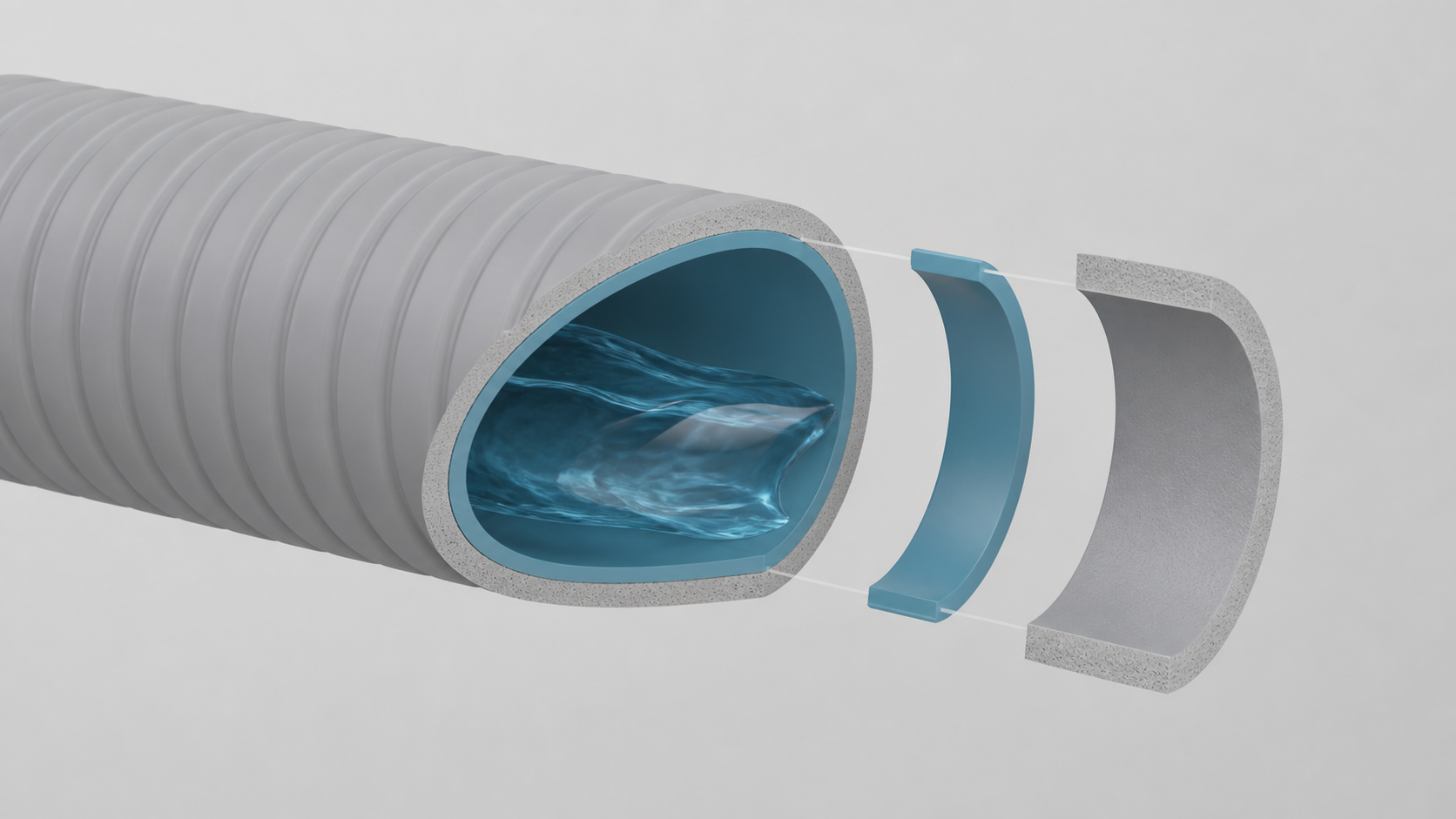
The full plasticizer family (DOTP, DINCH, TOTM and DOA) is specified against the contact medium and the duty, not substituted by brand promise.
What REACH Entry 51 Actually Restricts
REACH Annex XVII entry 51 (Commission Regulation (EU) 2018/2005) names exactly four ortho-phthalates: DEHP, DBP, BBP and DIBP, restricted at 0.1 % by weight of the plasticised material from 7 July 2020. No terephthalate, trimellitate, adipate or cyclohexanedicarboxylate appears in the entry.
Paragraph 4 derogates food-contact materials (under Regulation (EC) 1935/2004) and medical devices from the article restriction entirely. For tubing in those duties, entry 51 is not the instrument that applies.
Food-contact tubing answers to its own regulation, and medical tubing to its own medical-device rules. The question in both is which ester the compound was qualified against and by which test method.
Choosing the right plasticizer requires matching the ester to its regulatory and performance window.
Cost per Metre at Equal Hardness and Wall Thickness
One hose vendor publishes approximate market ranges of $0.60-$2.50 per metre for PVC and $4.00-$12.00 per metre for TPU (Qingdao Renato Plastic, 2025). Those figures are for finished hose, not matched for Shore A, wall thickness or reinforcement construction.
TPU vendors cite 5-10 year service life in heavy duty against 1-3 years for PVC in UV-exposed outdoor use. Where abrasion or oil contact drives replacement, TPU’s higher purchase price can amortize over a longer service interval.
For general-purpose fluid handling without sustained chemical attack, plasticized PVC costs a fraction of TPU per metre at equivalent hardness and delivers adequate service life when the ester is matched to the duty.
When to Choose TPU and When to Choose Plasticized PVC
Four tubing duties genuinely belong to TPU. The remaining majority routes to plasticized PVC with the right ester package.
| Choose TPU | Choose plasticized PVC |
|---|---|
| Sustained oil or fuel contact | General-purpose fluid handling |
| High-abrasion pneumatic or drag duty | Medical or food-contact tubing with an extractables spec tied to a named ester and test method |
| Thin-wall, high-burst-pressure construction | Specs below Shore A 70, beneath the stocked polyurethane tubing range |
| Continuous service above the PVC compound’s upper temperature limit | Cost-per-metre-governed applications at equivalent hardness |
TPU wins where abrasion life, chemical inertness to hydrocarbons, or thin-wall burst pressure is the dominant failure mode. Those duties are real, and pretending otherwise would cost the PVC recommendation its credibility.
For everything else, the decision is not “PVC or TPU” but “which ester does the PVC compound need.”
DOTP and DINCH serve medical and food-contact extractables specs. TOTM holds permanence at sustained heat. DOA buys cold flex.
Match the ester to the tubing’s service temperature and extractables spec, then formulate the compound against the application.
The Bottom Line for Flexible Tubing
Start with the tubing’s Shore A, service temperature, media contact and any extractables or sterilization requirement.
If the duty is sustained oil or fuel contact, high abrasion, thin-wall high burst, or continuous service above the PVC compound’s ceiling, TPU is the right polymer. For the rest, plasticized PVC covers the same hardness range at a fraction of the cost per metre.
The plasticizer is not a liability. It is the design variable.
TOTM migrated roughly 350 times less than DEHP in the same PVC tubing, and the migration ranking across esters did not follow the phthalate label. Name the ester, name the test method, and the material question answers itself.