

You’re standing in the hardware store aisle, looking at two PVC pipes. One is white, one is gray. They’re both PVC. They look nearly identical. The gray electrical conduit costs more than the white plumbing pipe sitting right next to it.
The temptation is obvious: grab the cheaper one and save some money.
That decision could strip the insulation off your wires, fail your electrical inspection, and create a fire hazard that won’t reveal itself until smoke is pouring from your walls. These two pipes are engineered for completely different jobs, and substituting one for the other is both a code violation and a safety risk.
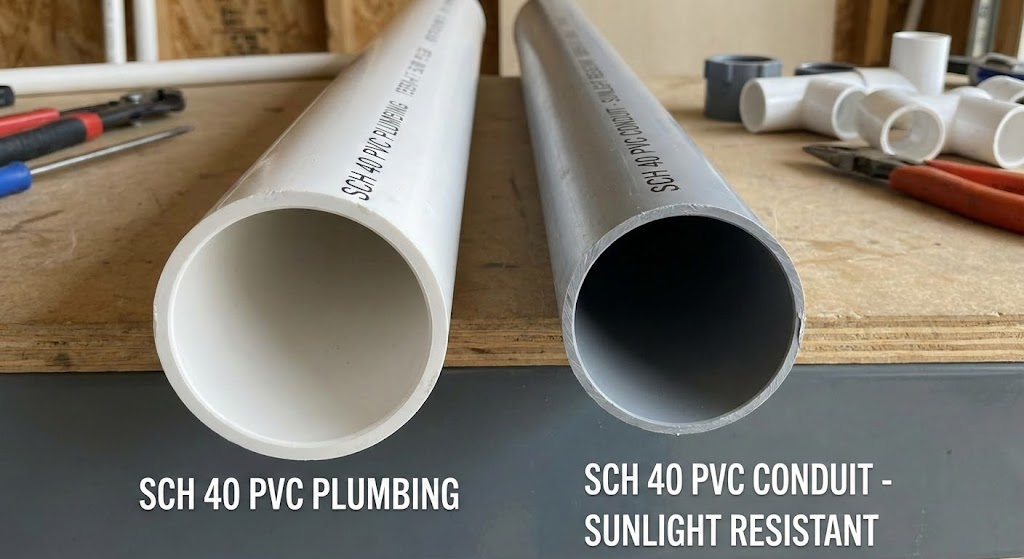
What Makes Electrical Conduit Different from Plumbing PVC?
The difference isn’t visible from the outside – it’s in the testing standards, additives, and interior finish.
Plumbing PVC follows ASTM D1785 standards, which focus on pressure containment and water safety. Electrical conduit follows UL 651, which focuses on protecting wires and resisting fire. Same base material, different engineering.
Electrical conduit contains UV stabilizers, typically titanium dioxide, that protect the pipe from sun damage. Plumbing PVC is considered “virgin” material without these additives because it’s designed for underground or indoor use where sunlight never reaches it.
The critical difference you can’t see: interior surface finish. Electrical conduit must have a smooth interior so wires slide through without damage during installation. Plumbing PVC often has an internal weld bead – a small ridge left from the manufacturing process – that can strip wire insulation as you pull conductors through.
The real difference isn’t what you can see. It’s what’s printed on the pipe: the UL listing that tells inspectors this product was tested and approved for electrical use.
Why Can’t You Use Plumbing PVC for Electrical Work?
The National Electrical Code (NEC) Article 352 governs PVC conduit installation, and it requires all conduit to be “Listed” – meaning tested and certified by a recognized testing laboratory like UL.
Plumbing PVC lacks UL 651 electrical listing. Full stop.
Beyond the listing issue, plumbing fittings create practical problems. Plumbing elbows use tight-radius bends designed to maintain water flow. Electrical fittings use long-sweep bends that let wires glide through without snagging. Try pulling 10 gauge wire through a plumbing elbow, and you’ll understand why electrical fittings exist.
Even if plumbing pipe were physically identical to electrical conduit – same wall thickness, same interior finish, same additives – it would still be illegal for electrical use because it lacks the required testing and certification. The listing isn’t a technicality. It’s the legal requirement that allows you to install the product and pass inspection.
How Do You Identify Which Type of PVC Pipe You Have?
Color provides the first clue: white typically means plumbing Schedule 40, gray typically means electrical conduit.
But don’t trust color alone. Schedule 80 plumbing pipe is also gray. Grabbing the wrong gray pipe could mean installing pressure-rated plumbing material in your electrical system.
The reliable method is reading the printed markings on the pipe itself. Electrical conduit displays:
- UL symbol – Proves third-party testing for electrical safety
- Schedule designation – “EPC-40” for Schedule 40 electrical, “EPC-80” for Schedule 80
- Trade size – The nominal diameter
- Temperature rating – Often “Max 90C” for higher-rated conductors
- “Sunlight Resistant” – Required for outdoor above-ground installations
- NEMA TC-2 – Dimensional compliance standard
Plumbing pipe shows different markings: ASTM D1785, pressure ratings in PSI, and often NSF certification for potable water contact.
If you can’t find UL 651 or an electrical schedule designation on the pipe, it’s not electrical conduit – regardless of color.
Next Steps
Plumbing PVC and electrical conduit share a base material but serve entirely different purposes. The listing requirement, interior finish, UV protection, and testing standards make them non-interchangeable – regardless of how similar they look on the shelf.
When planning electrical work, verify you’re purchasing UL 651 listed conduit by checking the printed markings.
For questions about PVC resin formulations or plasticizer applications in flexible PVC products, our technical team can help you select the right compounds for your manufacturing needs.