

Effect of plasticizer on the volume resistivity of PVC cable
Keywords: PVC; plasticizer(DOTP, DOP, DIDP, DIOP, DINP, TOTM); cable; volume resistivity
This study compares six plasticizers — including DOTP for PVC cable — at loadings from 26 to 56 phr to identify which retains the highest volume resistivity, the property that determines cable insulation performance.
Study Methodology
- Sample Preparation: PVC resins from five manufacturers (A/B/C: calcium carbide process; D/E: ethylene process) were blended with stabilizers, stearic acid, and varying amounts of plasticizers (DOTP, DOP, DIDP, DIOP, DINP, TOTM). The plasticizer content ranged from 26 to 56 parts per 100 parts of PVC.
- Processing: Samples were mixed in a two-roll open mill at 155–160°C (roller speed ratio 1:1.35) and compression-molded in a flat vulcanizing machine (160°C, 0.2 MPa preheating for 5 min, 15 MPa hot pressing for 3 min, and 15 MPa cold pressing for 3 min).
- Volume Resistivity Testing: Conducted according to GB/T 8815-2008 and GB/T 1410-2006 standards using a high-resistance meter (ZC-36).
Experimental Design
- Materials:
- PVC resins (Type 5, calcium carbide/ethylene processes).
- Additives: Calcium-zinc stabilizer (Adik Chemical), stearic acid (Indonesia Sineen), plasticizers (DOTP, DOP).
- Equipment: Two-roll open mill, flat vulcanizing machine, high-resistance meter, analytical balance.
- Formulation:
- Fixed components: PVC (100 parts), stabilizer (3.5 parts), stearic acid (0.8 parts).
- Variable component: Plasticizer (26, 34, 42, 50, or 56 parts).
- Procedure: Mixing → Plasticization → Molding → Resistivity Testing.
Results and Analysis
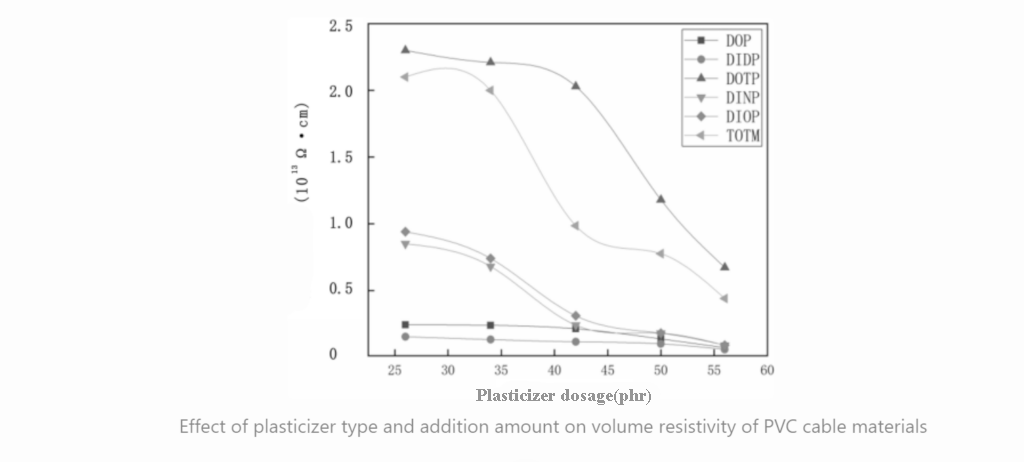
- Plasticizer Type and Concentration Effects:
- At 26 parts plasticizer, resistivity ranking (from highest to lowest) was: DOTP > TOTM > DIOP > DINP > DOP > DIDP.
- With increasing plasticizer content, resistivity trends diverged (Table 2):
Low concentration (26–34 parts): DOTP/DOTP-based formulations exhibited superior electrical performance.
- High concentration (≥42 parts): DOP/DIDP showed sharper resistivity declines due to enhanced ion mobility.
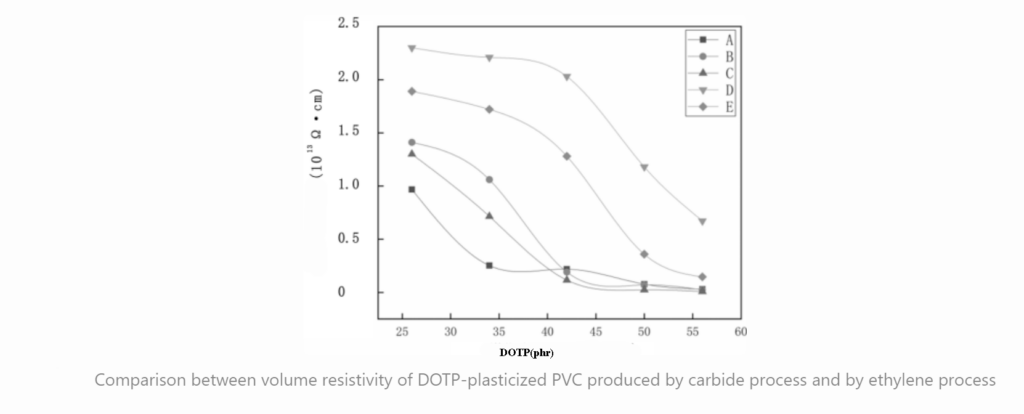
2. Calcium Carbide vs. Ethylene Process PVC:
- Calcium carbide PVC consistently showed lower resistivity than ethylene process PVC
- Thermal instability and broader molecular weight distribution in calcium carbide PVC amplified resistivity reductions with plasticizer addition.
How Manufacturers Select a Plasticizer for PVC Cable
The resistivity study above settles factor 1; a manufacturer specifying cable compound weighs six together. Skip any one and the cable passes the lab and fails in service.
1. Volume resistivity (covered above). At 26–34 phr, DOTP and TOTM hold the high-resistivity zone. Above 42 phr, DOP and DIDP drop sharply, which is why high-flex insulation grades stay below that threshold.
2. Volatility and migration. Cable jackets sit at 70–90°C for decades, and a plasticizer with vapor pressure two orders of magnitude higher than TOTM will migrate, embrittle the polymer, and crack insulation long before the copper fails. ASTM D1203 is the screening test; long-life specs replace DOP with TOTM or polymeric plasticizers.
3. Low-temperature flexibility. Outdoor and refrigerated-service cable must stay flexible below −20°C — DOP stiffens fast there, while DOA and DINA hold flexibility down to roughly −40°C. Low-temperature torsional stiffness per ASTM D1043 is the qualifying test.
4. Regulatory compliance. REACH Annex XIV requires authorisation to use DEHP/DOP, DBP, and BBP in the EU, and RoHS restricts them, plus DIBP, in EU-bound cable and other electrical equipment. DOTP, DINP, DIDP, and TOTM clear both — for EU shipments the regulatory shortlist is shorter than the technical one.
5. Processability. DOTP needs more than twice DOP’s fusion time in Brabender dry-blend tests; underfusion shows up as resistivity scatter and tensile loss. Switching plasticizers without adjusting the extruder profile causes most in-line failures.
6. Cost-per-meter-of-cable. DOTP runs at a modest premium over DOP; TOTM is materially more expensive. The right comparison is cost-per-meter at the target spec — a higher-priced DOTP plasticizer that drops loading by 4 phr or skips a stabilizer can be the cheaper compound.
| Cable application | Recommended plasticizer |
|---|---|
| LV insulation (≤1 kV) | DOTP or DINP |
| Heat-resistant LV insulation, ≥90°C service | TOTM |
| Outdoor / cold-climate jacket | DOA or DINA blend |
| Building wire, REACH-bound | DOTP |
Choosing the Right Loading Band for Cable Insulation
DOTP for PVC cable wins at the 26–34 phr band because the terephthalate ester structure traps polymer-chain ions tighter than ortho-phthalates — the resistivity study above shows roughly one order of magnitude over DOP at 26 phr. That margin lets a manufacturer specify thinner insulation at the same dielectric rating, or hit IEC 60502-1 retention specs without overloading the stabilizer system.
In cable procurement the customization signal is the loading band, not the plasticizer name. At 26–34 phr DOTP holds volume resistivity above 10¹⁴ Ω·cm and meets REACH for LV building wire; 34–42 phr suits flexible cordage where bend radius matters more than peak resistivity. Above 42 phr the decision shifts to migration resistance and cost.
The Common Mistake
Cable specifications fail in service when one factor of the six gets optimized in isolation. Resistivity at 26 phr looks impressive in the lab; the cable still fails if the loading band ignores migration at 80°C or cold-bend at −20°C. Specify across the full envelope from day one — every factor carries a service-life consequence.