

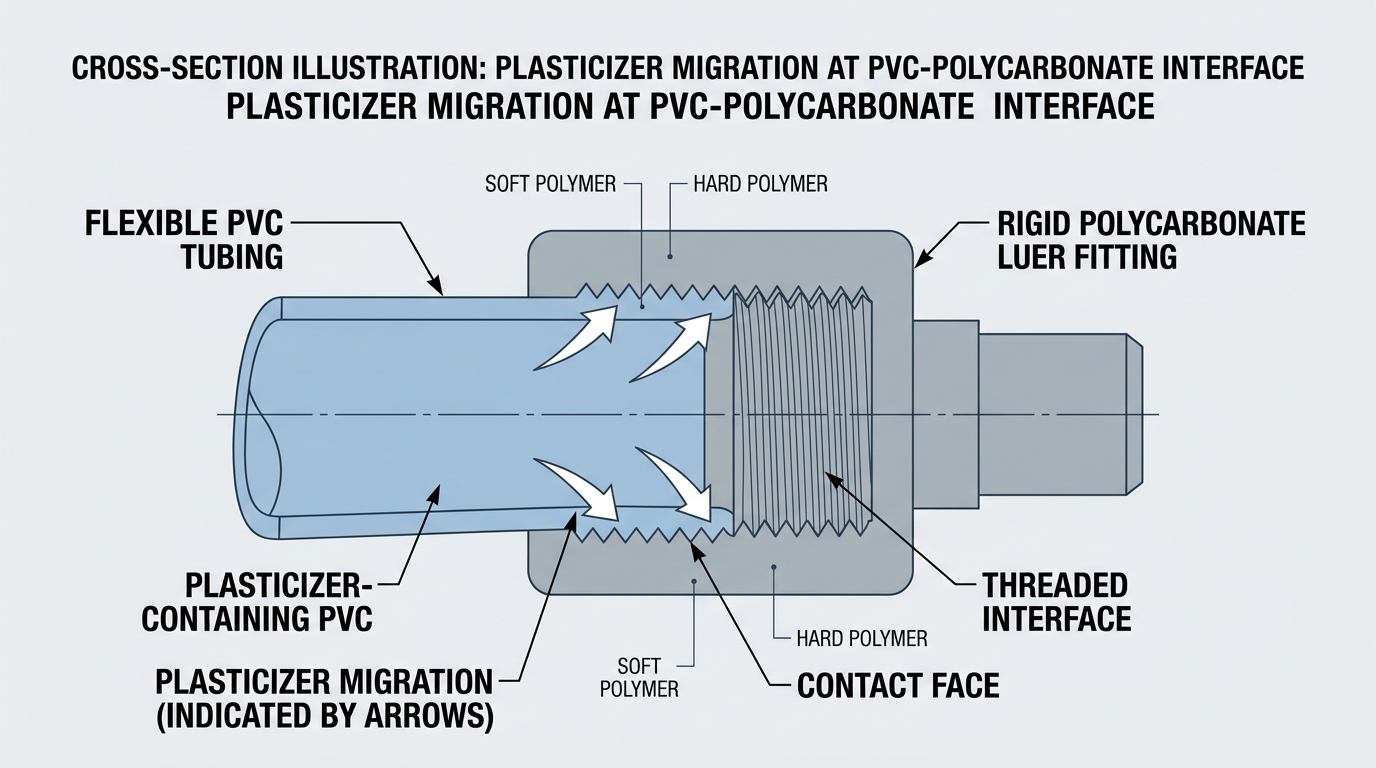
A flexible PVC tubing specifier swaps DEHP for ATBC to clean up the regulatory profile, and the polycarbonate luer cracks within the first week of service. Paul Kroushl at Teknor Apex documented this exact failure in 2016: at 3% strain on ASTM D-638 Type 1 specimens, ATBC visibly cracked PC inside seven days while DEHP needed the full 28-day window.
The substitution that satisfied REACH broke the assembly. Single-polymer compatibility — the snapshot HSP framing covered in our plasticizer compatibility with PVC overview — does not predict how a non-phthalate behaves against the rigid plastic bonded to it. The assembly interface decides.
Why the Family Ranking Flips When the Adjacent Polymer Changes
Plasticizers act on two independent timescales in a mixed-rigidity assembly, and the two scales rank chemistries differently. Surface attack at the contact face operates in hours to days. It is governed by plasticizer viscosity — low-viscosity esters diffuse into the adjacent rigid polymer fast enough to induce environmental stress cracking (ESC) before bulk migration occurs.
Bulk migration through the PVC matrix operates in months to years and is governed by molecular weight. Plasticizers below 300 g/mol migrate roughly ten times faster than those above 500 g/mol. Migration drops below 1% once MW crosses ~300.
| Timescale | Driver | Failure at the interface |
|---|---|---|
| Hours to days | Plasticizer viscosity | ESC of the adjacent rigid polymer |
| Months to years | Plasticizer molecular weight | Bulk leaching out of the PVC matrix |
The compatibility between plasticizer and polymer therefore has two answers, not one.
Kroushl’s observation pins the surface mechanism: “Direct correlation between plasticizer viscosity and ability to induce stress cracking.” ATBC has a respectable molecular weight of 402 g/mol and looks acceptable on the bulk-migration ledger. Its low viscosity drives PC ESC inside a week anyway. TOTM at 547 g/mol carries both high MW and high viscosity, so it survives on both timescales.
The two heuristics most specifiers reach for — “higher MW means less migration” and “non-phthalate equals safer substitution” — fail at the mixed-rigidity interface. Both treat plasticizer behavior as a single rate.
Contact medium compounds the flip. ATBC migrates roughly 9 mg/kg into 3% acetic acid but up to 28 mg/kg into olive oil. The ranking inverts depending on what the assembly contacts inside.
The molecular structure explains why: ATBC’s acetyl group is more aqueous-tolerant than fatty-tolerant; DOTP behaves the opposite way.
What 28 Days of Contact Reveals About Each Non-Phthalate Family
A 28-day fixture test under ASTM D-638 Type 1 geometry at 3% strain — Kroushl’s protocol — separates the six common chemistries cleanly. On polycarbonate, DOA cracks specimens in hours and ATBC inside a week; TOTM and ESO survive the full window. The rigid-PVC ranking holds with delayed kinetics.
| Plasticizer | MW (g/mol) | PC cracking onset | Rigid PVC cracking onset |
|---|---|---|---|
| DOA | ~370 | 0.2 hours | 6 hours |
| ATBC | ~402 | <7 days | 14 days |
| DOP (DEHP) | ~390 | <28 days | <28 days |
| DOTP (DEHT) | ~390 | <28 days | <28 days |
| TOTM | ~547 | no cracking 28d | no cracking 28d |
| ESO | ~1,000 | no cracking 28d | no cracking 28d |
DOTP — the headline ortho-phthalate substitute marketed largely on health grounds — does not improve PC ESC behavior versus DOP. Per Larry Wallace at DuPont Spectrum, DOTP “failed some long-term aging and adhesion tests” despite an acceptable bulk-migration profile. Substituting DEHP for DOTP solves the regulatory question, not the assembly question.
The gap between ATBC and TOTM on PC is the difference between seven days and never, on the same fixture geometry. ESO survives 28 days cleanly but caps at roughly 5-7 phr practical loading before surface exudation defeats the seal. ESO is a low-ESC-risk secondary plasticizer, not a primary replacement above that loading.
For the upstream drivers — partition coefficient, free-volume, temperature — work back through what causes plasticizer migration in PVC before specifying the chemistry.

Matching the Chemistry to the Mating Part
The bulk-migration ledger ranks chemistries differently from the surface-ESC ledger, so the assembly decision combines both. Eckert and colleagues at Erlangen measured TOTM migration from heart-lung machine PVC tubing at roughly 1/350th of DEHP migration into blood.
Horne and colleagues at Strathclyde extended the comparison to a 28-day ECMO protocol across four named tubing types. Raumedic and Sorin DEHP tubing reached 0.079 ± 0.025 and 0.0624 ± 0.0134 mg/mL in albumin.
Tekni-plex Action TOTM tubing reached 0.0086 ± 0.00057 mg/mL in saline — about 10% of DEHP levels. Saint-Gobain Tygon DOA tubing showed no measurable migration in the first four hours, but reached 0.0252 ± 0.02 mg/mL by day 28.
TOTM wins on both ledgers — no PC cracking at 28 days plus 350× lower bulk migration — which earns it the medical luer-PC interface.
| Assembly interface | First-choice chemistry | Why | Avoid |
|---|---|---|---|
| Flexible PVC × PC luer (medical) | TOTM | 28-day PC ESC clear + 350× lower migration than DEHP | ATBC (<7d); DOA (0.2h) |
| Flexible PVC × rigid PVC mating part | TOTM or ESO ≤7 phr | No 28-day rigid-PVC cracking | DOA (6h ESC) |
| Flexible PVC × PA hose connector | DOTP or DINCH | PA absorbs ester slower than PC | Low-MW DOA |
| Food-contact PVC, no PC interface | ATBC | Bio-based, FDA-friendly | TOTM where ATBC suffices |
| General industrial PVC, no rigid interface | DOTP, DOA, or ESO blend | Cost-effective primary | TOTM with no PC constraint |
For mixed-rigidity assemblies in medical, food-contact, and industrial flexible PVC, this duty can be addressed by Bastone’s DOTP, DOA, and ESO grades — matched against the interface, not as a universal DEHP substitute.
Field-returned assemblies make the failure mode visible long before the laboratory catches it. Sticky or oily contact zones, plastic odor, brittleness in previously flexible bend radii, and white powder bloom all signal plasticizer leaving the PVC.
Once migration has occurred, the damaged section requires replacement. Reading the signature against the 28-day ESC table tells the specifier which timescale failed.
What This Means When You Specify the Next Assembly
The non-phthalate that satisfies REACH is not the non-phthalate that survives the mating part. Per REACH regulations, DOP and DINP are the chemistries being phased out. The substitute that wins the regulatory profile — ATBC for bio credentials, DOTP for cost-effective drop-in — can lose the assembly profile once flexible PVC contacts PC or rigid PVC.
Read the 28-day ESC table against the bulk-migration data. Pick for the slower of the two timescales your assembly actually faces. Migration rate depends on the chemistry, the mating polymer, and the medium inside — a three-way match, not a one-way substitution.