

Wire and cable insulation is the barrier between electricity and you. Get it wrong, and you risk failure, fires, and safety hazards. Get it right, and you’ve got reliable, long-lasting electrical systems.
The key to reliable insulation isn’t just picking any plastic. It’s choosing the right plasticizer – the chemical that makes PVC flexible and resistant to heat. For decades, manufacturers used DOP (dioctyl phthalate), but things changed. Since 2015, the European Union banned DOP due to health concerns, and most major manufacturers switched to DOTP (dioctyl terephthalate).
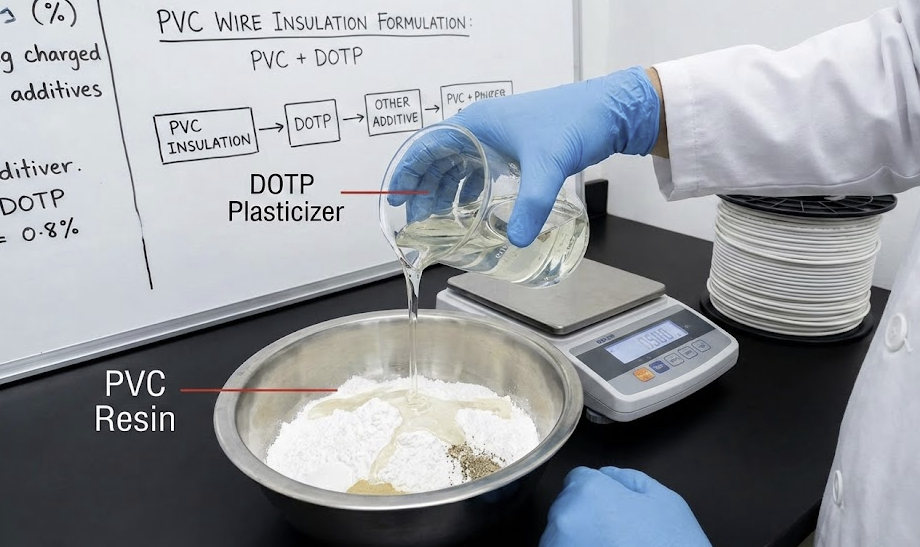
Understanding PVC Formulation Basics
Before you mix anything, you need to understand what goes into a PVC compound.
The Five Core Components
A typical PVC wire insulation formulation contains:
PVC Resin (60-100 parts per hundred resin): This is your base material. It’s stiff and rigid on its own, which is why you add plasticizers. The type of PVC resin you choose affects how easily it absorbs plasticizer and how well the final product performs. Suspension PVC is most common for wire insulation.
Plasticizer – DOTP (40-50 PHR for insulation): This is the star ingredient. DOTP makes the PVC flexible and soft. The amount you add determines how soft the final insulation is. Too little, and your insulation is brittle and cracks easily. Too much, and it’s too soft and doesn’t hold its shape well.
Heat Stabilizer (6-8 PHR): This prevents the PVC from degrading during the hot mixing and extrusion process. Without it, the material breaks down and releases toxic hydrogen chloride gas. Modern formulations use calcium-zinc or organic stabilizers rather than lead-based ones.
Lubricant (1-2 PHR): This helps the material flow smoothly through processing equipment and prevents sticking to hot metal surfaces. Calcium stearate is common, but you might also use fatty alcohols or waxes.
Filler (10-20 PHR optional): Many formulations add calcium carbonate to reduce cost while improving electrical or physical properties. Fillers don’t change the fundamental performance but make the compound more economical.
Insulation-Grade vs. Sheath-Grade
Wire insulation (what touches the conductor) and cable sheath (the outer protective layer) need different formulations. Insulation needs to be softer and more flexible – that’s why it uses more plasticizer (40-50 PHR). The sheath is tougher and less flexible, so it uses less plasticizer (0-60 PHR range, typically 30-40 PHR).
This guide focuses on insulation-grade formulations since that’s where electrical properties matter most.
Step-by-Step DOTP Formulation Process for Wire Insulation
Now let’s get into the actual process. I’ll walk you through each step so you understand what happens and why it matters.
Step 1: Select Quality PVC Resin and Raw Materials
Start with the foundation. Buy PVC resin from a trusted supplier who can provide specifications and certificates of analysis.
Look for suspension PVC (S-PVC) rather than emulsion PVC. Suspension PVC has larger particle size and absorbs plasticizer more efficiently. Check that the resin has good thermal stability – this means it won’t start breaking down during mixing and extrusion.
Verify the purity of all materials. Any impurities – especially moisture – will create defects in your final product. If moisture gets into the PVC during storage, dry it first using a vacuum oven or desiccant dryer before mixing. Moisture causes foaming and weak spots in the insulation.
Get your DOTP from a reliable chemical supplier. Check the specification sheet to confirm it’s industrial-grade (not food-grade, which is overkill and more expensive). The DOTP should have a viscosity around 7-8 Pa·s at 20°C and a boiling point above 370°C.
Step 2: Calculate Precise Component Ratios
Now let’s define your formulation. For a standard 70°C insulation, use this as your starting point:
- PVC Resin: 100 PHR (parts per hundred resin)
- DOTP: 45 PHR
- Calcium-Zinc Stabilizer: 7 PHR
- Calcium Stearate (lubricant): 1.5 PHR
- Calcium Carbonate (filler): 15 PHR
This gives you a balanced, cost-effective formulation that meets electrical requirements. The DOTP dosage of 45 PHR is in the sweet spot – high enough for good flexibility, but not so high that you get excessive softness.
If you need higher temperature resistance (90°C rating), reduce the DOTP slightly to 42 PHR and increase the stabilizer to 8 PHR. This makes the material less prone to thermal aging.
If you need extra flexibility (for very thin insulation), increase DOTP to 50 PHR, but understand you’re trading some thermal resistance for softness.
Write down your formulation in grams. Let’s say you’re making 10 kg of compound:
- PVC Resin: 3,448 g
- DOTP: 1,552 g
- Stabilizer: 241 g
- Lubricant: 52 g
- Filler: 518 g
These weights add up to 10 kg total.
Step 3: Prepare DOTP and Other Additives
Don’t just dump cold DOTP into the mixer. Pre-heat it first.
Heat your DOTP to approximately 80°C using a heated container or water bath. Why 80°C? This is roughly the glass transition temperature of PVC – the point where PVC particles start to open up and absorb plasticizer. Warm DOTP has lower viscosity, so it flows into the PVC particles more easily and speeds up absorption.
Pre-blend your heat stabilizer and other additives. Sometimes stabilizers come as concentrates in a carrier, so mix them thoroughly to avoid uneven distribution. If you’re using a pigment or colorant, pre-blend it too so it spreads evenly throughout the material.
Have all your materials ready and measured before you start the mixer. Once you begin, the process moves quickly, and you don’t want to be scrambling to measure the next ingredient.
Step 4: Mix Components Using High-Shear Blending
This is where the chemistry happens. The order of addition and mixing conditions determine whether you get a smooth, uniform compound or one full of lumps and defects.
Add PVC resin first. Pour your 100 PHR of PVC powder into the mixer (usually a Banbury mixer or high-speed blade mixer) running at moderate speed. Let the mixer run for about 1-2 minutes to generate some heat and help the resin warm up. You’re aiming to get the resin temperature to about 80-90°C.
Add DOTP next. Once the resin is warm, slowly add your pre-heated DOTP (at 80°C) to the mixer. The high-speed blades create intense shear that forces the PVC particles to open up like sponges and absorb the plasticizer. This process is called “gelation” or “fusion.”
The mixing temperature is critical. If the resin is too cold (below 70°C), the DOTP won’t absorb properly and you’ll get lumps. If it’s too hot (above 120°C during this stage), the PVC starts degrading and turns yellowish. Aim for 80-100°C when adding the plasticizer.
Add stabilizer next. After 2-3 minutes of mixing DOTP and resin, add your heat stabilizer. It needs to distribute evenly to protect the material during later heating steps.
Add lubricant. Then add your lubricant (calcium stearate). This helps the material flow better during extrusion.
Add filler last. Finally, add your calcium carbonate filler. Fillers are denser and sink to the bottom, so add them after the plasticizer and stabilizers are well distributed.
Total mixing time: 5-8 minutes. You’ll know the material is ready when it forms a smooth, homogeneous mass. If you see lumps, keep mixing until they disappear.
The key principle here is that high-speed blade mixing creates the shear force needed for absorption. If you use slow mixing, the DOTP just sits on the surface of the resin particles without fully incorporating. Low-speed mixing also results in poor heat generation, making absorption even slower.
Step 5: Process Through Extruder or Compounder
After mixing, your compound is ready for extrusion or pelletizing. This step turns your mixed compound into the form you’ll actually use – whether that’s pellets, strand, or directly extruded insulation on wire.
Set your extruder temperature profile to 150-180°C. The exact temperature depends on your equipment and the resin type, but this range is typical for PVC processing.
Monitor the residence time in the extruder. Too short (under 5 seconds), and you don’t get good mixing. Too long (over 30 seconds), and the material starts degrading, becoming discolored (yellow or brown) and losing strength.
As the material exits the extruder, it should be smooth and glossy with a consistent color. If you see surface defects like roughness or pitting, it usually means decomposition occurred – either the temperature was too high, or the residence time was too long.
Cool the extruded material in a water bath or cold air stream. This stops the degradation immediately and locks in the properties you want.
Step 6: Quality Control Testing and Verification
Don’t skip this step. Testing confirms your formulation actually works for electrical applications.
Volume Resistivity Testing: Use ASTM D257 to measure volume resistivity. You’re looking for at least 10^9 to 10^15 ohm-cm depending on the application. DOTP formulations typically reach 10^12 to 10^14 ohm-cm, which is excellent. If your results are lower, it usually means contamination or improper mixing.
Thermal Stability: Run accelerated aging tests at 70°C or 90°C (depending on your cable rating) and measure how the material changes over time. Properties like tensile strength and elongation at break should remain relatively stable after 168 hours of aging.
Mechanical Properties: Test tensile strength, elongation at break, and hardness (Shore A). These ensure the insulation is flexible enough to wrap around a conductor but strong enough not to tear.
Dielectric Breakdown: Measure how much voltage the insulation can withstand before electrical breakdown occurs. IEC standards specify minimum values based on insulation thickness.
If any test fails, go back and troubleshoot. Common issues:
- Low volume resistivity = contamination, moisture, or improper DOTP dosage
- Brittleness = insufficient DOTP or poor stabilizer
- Discoloration = decomposition due to temperature or time issues
- Lumps or defects = inadequate mixing or improper DOTP absorption
Common Formulation Challenges and Solutions
Manufacturing isn’t always smooth. Here’s how to fix the problems that come up.
Challenge: Brittleness in the Final Product
Your insulation cracks or breaks easily when you bend it. This is a processing or formulation failure.
Root Causes:
- Insufficient DOTP (you added less than 40 PHR)
- Poor PVC resin quality (short molecular chains make brittle plastics)
- Inadequate or wrong stabilizer type
- Temperature too high during extrusion, degrading the material
Solutions:
- Increase DOTP dosage to 45-50 PHR (within limits)
- Switch to a higher-quality PVC resin with longer chains
- Verify you’re using the right stabilizer for your temperature range
- Lower extrusion temperature by 10-20°C and monitor residence time
- Check that the material isn’t over-mixing – some mills run too hot
If brittleness appears after aging (not right away), it’s usually plasticizer migration. Switch to DOTP if you’re not using it already.
Challenge: Lumps and Surface Defects
Your extruded insulation has visible lumps, pits, or rough surface patches.
Root Causes:
- Inadequate mixing (DOTP didn’t fully absorb into PVC)
- Wrong mixing temperature (too cold to allow proper absorption)
- Improper additive addition order
- DOTP contamination (water or other materials mixed in)
- Decomposition during extrusion (temperature too high)
Solutions:
- Extend mixing time to 8-10 minutes and verify you’re getting good heat generation
- Pre-heat DOTP to 80°C before adding
- Dry DOTP in an oven if it’s absorbed moisture from the air
- Follow the exact addition sequence: resin → DOTP → stabilizer → lubricant → filler
- Lower extrusion temperature by 10°C increments until defects disappear
- Check that your mixer isn’t worn out – worn blades won’t generate enough shear
Challenge: Poor Thermal Aging Performance
After 168 hours at 70°C or 90°C, the material loses too much strength or elongation.
Root Causes:
- Inadequate stabilizer (6 PHR is minimum, but 8 PHR is safer for 90°C)
- DOTP contamination with other plasticizers
- Oxidative degradation (open to air during storage or processing)
- Wrong stabilizer type for your temperature rating
Solutions:
- Increase stabilizer to 7-8 PHR depending on temperature
- Buy DOTP from reputable suppliers and verify it’s pure
- Store materials in sealed, temperature-controlled containers
- Use a stabilizer system designed for your temperature rating – ask your supplier for recommendations
- Add antioxidants if aging performance is still poor
Challenge: Inadequate Electrical Properties
Volume resistivity tests show values below 10^12 ohm-cm, or electrical breakdown occurs at lower voltages than expected.
Root Causes:
- Contamination (moisture, salt, conductive particles in materials)
- Wrong DOTP formulation or impure DOTP
- Improper mixing (material isn’t homogeneous)
- Moisture in the final compound
Solutions:
- Verify all raw materials come from reliable suppliers – ask for material certificates
- Dry PVC resin and DOTP before use if they’ve been exposed to humid air
- Confirm your mixing process is creating a uniform compound
- Use moisture analysis on raw materials before production
- Store finished compounds in dry conditions – moisture absorption causes conductivity increase
Conclusion
Formulating PVC with DOTP for wire insulation isn’t complicated once you understand what each component does and why temperature and mixing matter.
The core formula is simple: 100 PHR PVC resin, 45 PHR DOTP, 7 PHR stabilizer, 1.5 PHR lubricant, and 15 PHR filler. Start with this, test it thoroughly, and adjust based on your results.