

When was the last time you recalculated your stabilizer loading specifically for foam extrusion — or are you still running the numbers from a rigid pipe datasheet? Most foam PVC producers carry 20-30% more stabilizer than the process actually demands because they copy formulations designed for rigid pipe at 200-220C and apply them unchanged to foam lines operating at 185-195C.
The formulation ratio I recommend starts from your actual thermal exposure, not from a generic PVC recipe. Right-sizing your stabilizer package is the single highest-ROI change available — but it only works when you adjust filler and processing parameters in coordination.
The Cost-Lever Hierarchy: Which Changes Save the Most per Ton
Stabilizer right-sizing alone can cut additive cost by 8% or more — but only if you pull that lever first. Rank your cost levers by potential impact and quality risk before running trials.
Stabilizer Right-Sizing (Highest ROI)
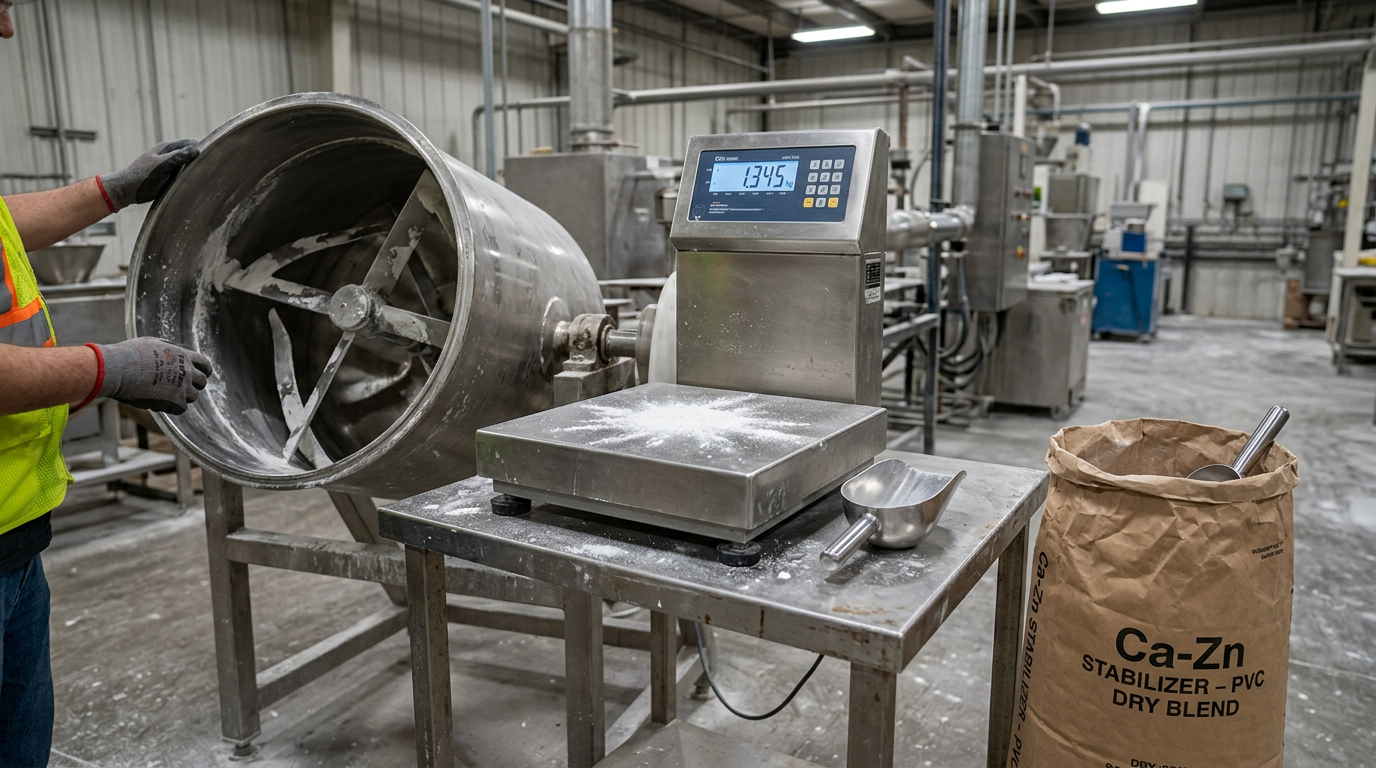
Stabilizer is the most expensive additive per PHR in a foam formulation. Ca-Zn systems cost several times more per kilogram than CaCO3 filler, yet many plants run 4.0-5.0 PHR without questioning whether 3.0-3.5 PHR would perform identically at foam processing temperatures. No equipment changes required — just a formulation adjustment and validation run.
Filler Loading Optimization
CaCO3 is your cheapest component. Pushing loading from 15 to 25-30 PHR cuts raw material cost meaningfully, but every PHR increase above 20 affects cell nucleation, surface finish, and impact strength. The savings are real — the risk is moderate and requires compensating adjustments to processing aid and stabilizer.
Blowing Agent Efficiency
Chemical foaming agent (CFA) dosage has a non-linear relationship with density reduction. Blending AC (exothermic) and NC (endothermic) agents often achieves better cell structure at lower total loading than either alone. The interaction with stabilizer demand makes this lever trickier to isolate.
Processing Aid and Lubricant Trim
Processing aids and lubricant systems are the smallest cost levers, but imbalanced internal/external lubricant ratios create surface defects that get misattributed to other formulation variables. Trim these last, in 0.5 PHR steps, after stabilizer and filler are settled.
Why Foam Extrusion Needs Less Stabilizer Than Rigid PVC
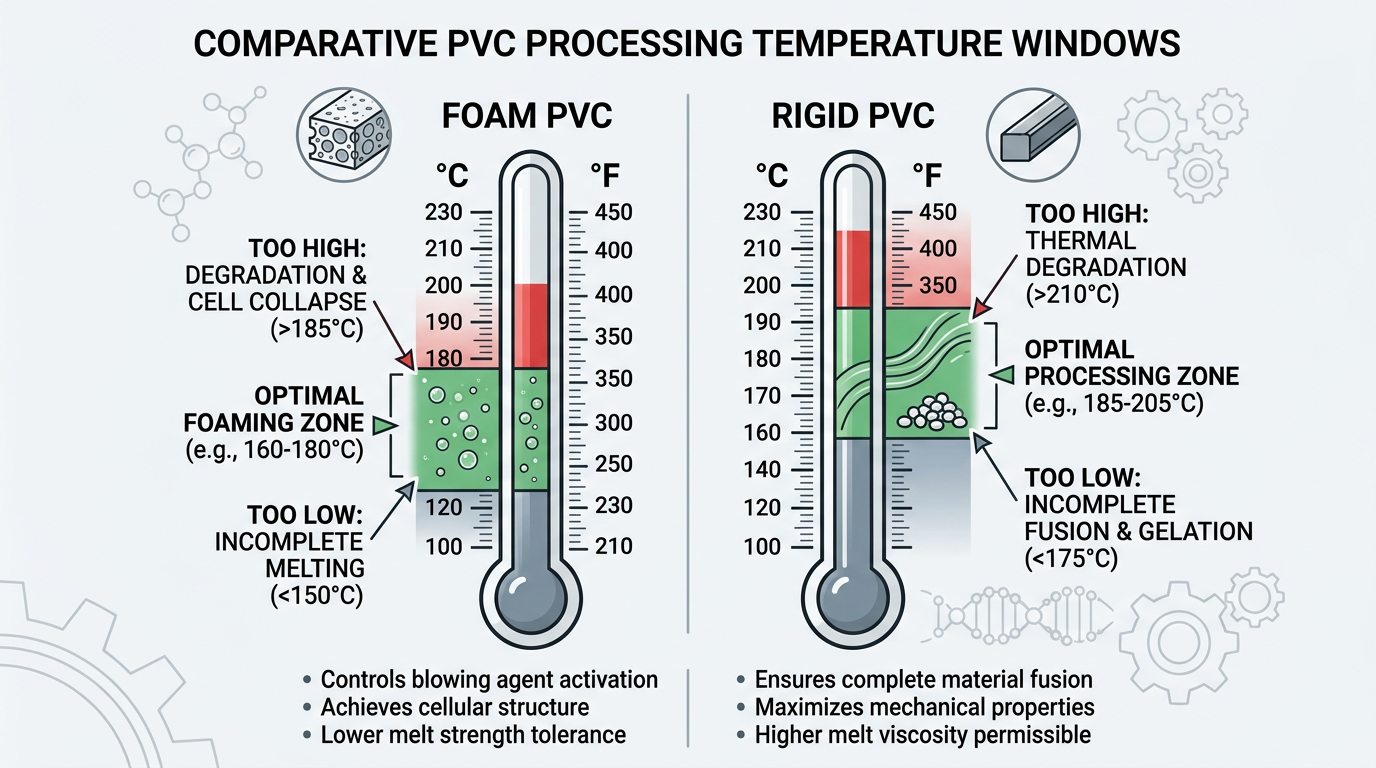
A foam extrusion line running at 185-192C with a 45-second residence time generates substantially less hydrogen chloride than a rigid pipe line at 205-220C with a 90-second residence. The entire basis for stabilizer loading — neutralizing HCl before it catalyzes chain degradation — scales with temperature and time. Yet formulators routinely specify identical Ca-Zn loadings across rigid pipe, flexible film, and foam sheet.
The Temperature Window Argument
Rigid pipe processes PVC at 200-220C. Foam extrusion targets 185-195C at the die, with optimal results around 188-192C. HCl generation is an Arrhenius-rate process — a 10C drop roughly halves the degradation rate. Rigid pipe at 3.0 PHR Ca-Zn achieves equivalent pressure resistance and surface smoothness to legacy lead-salt formulations. Foam extrusion at lower temperatures can maintain quality at 2.5-3.0 PHR, provided dispersion is adequate.
The Dispersion-Before-Dosage Rule
When foam boards show yellowing or brittleness, the instinct on most plant floors is to add more stabilizer. That instinct is usually wrong. Stabilizers protect PVC only when evenly dispersed throughout the melt. If your high-speed mixer doesn’t reach adequate frictional heat (120-130C) to soften PVC particles above their glass transition, stabilizers remain as agglomerates — leaving unprotected zones that degrade locally regardless of total loading.
I’ve seen plants running 4.5 PHR with yellowing problems switch to 3.5 PHR with better mixing parameters and get cleaner boards. Before adding to the mixer, ensure your dry blend reaches proper temperature uniformly — check whiteness consistency across batches as your diagnostic indicator.
One foam board producer cut stabilizer costs 8% and scrap rate 10% by adjusting their Ca-Zn ratio and optimizing foaming agent compatibility — without increasing total stabilizer loading.
The Two-Sided Failure Envelope
Stabilizer dosage in foam PVC has a failure mode on both sides. Too little causes surface yellowing and brittleness. Too much triggers premature blowing agent decomposition, leading to cracking and blown cells. Many manufacturers add extra stabilizer “just to be safe,” but that safety margin can push you past the upper boundary — where excess stabilizer catalyzes your foaming agent before it reaches the die.
Target the middle of the envelope: enough stabilizer to prevent degradation at your actual die temperature, not enough to interfere with blowing agent decomposition timing. For Ca-Zn systems in foam, that typically means 2.5-3.5 PHR depending on CaCO3 loading and processing temperature.

How to Adjust Filler Loading Without Killing Cell Structure
CaCO3 loading in foam PVC typically ranges from 10 to 40 PHR, with most commercial formulations at 15-25 PHR. Pushing higher saves material cost but introduces two compounding effects that trip up formulators who treat filler as a simple dilution variable.
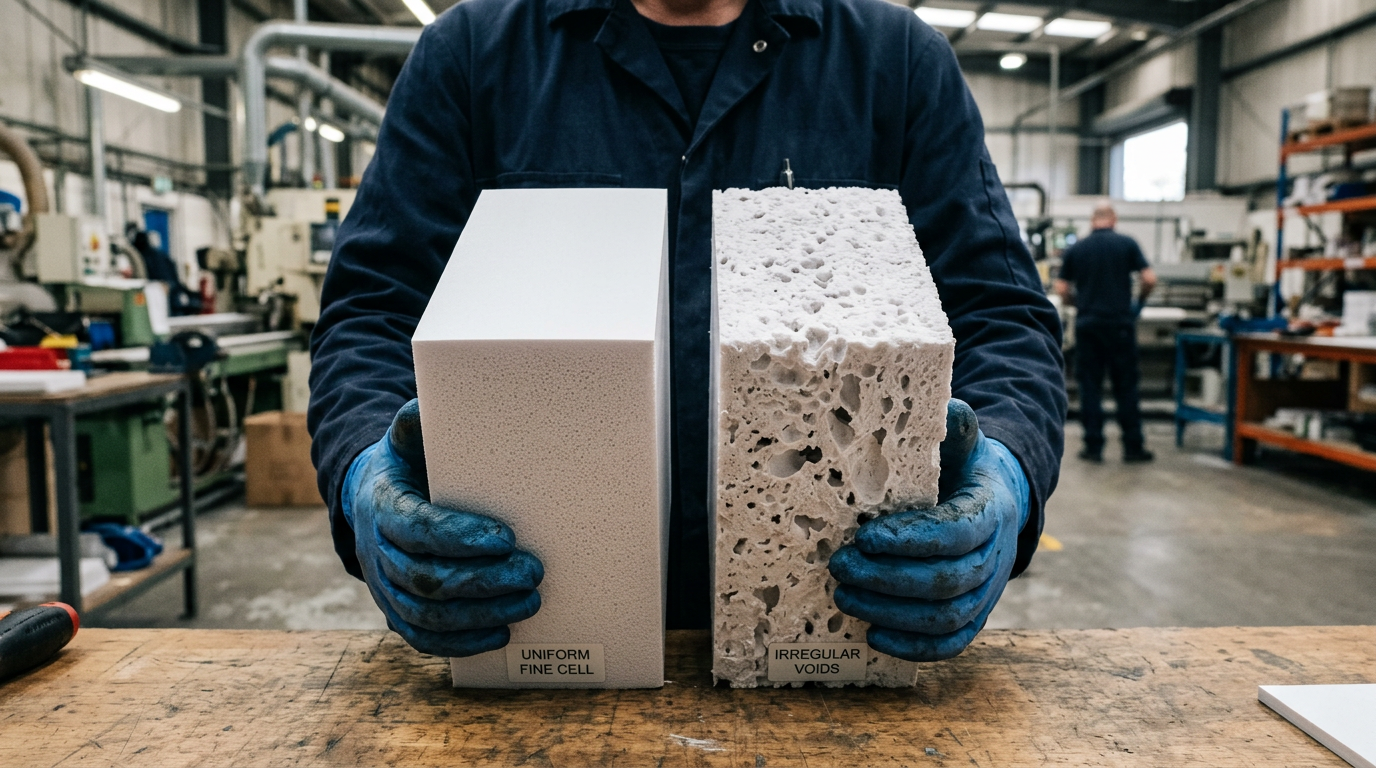
CaCO3 acts as a cell nucleation site. Moderate loading (15-20 PHR) actually improves cell uniformity. Above 25-30 PHR, excessive nucleation creates too many small cells that merge into irregular voids, degrading surface finish and mechanical properties.
The interaction most formulators miss: CaCO3 particles adsorb stabilizer molecules on their surfaces. Increasing filler from 15 to 30 PHR actively reduces the effective stabilizer concentration available to protect the resin, without changing a single number on your formulation sheet. This hidden depletion is why some plants increase filler for cost savings, then see yellowing and assume they need more stabilizer — creating a cycle of over-specification on both components.
For every 10 PHR increase in CaCO3 above 20 PHR, test with a 0.3-0.5 PHR stabilizer increase to compensate for surface adsorption. Use coated CaCO3 (stearic acid treatment) to reduce the adsorption effect. Keep filler moisture below specification — damp calcium carbonate forms bubbles and silver lines that get misdiagnosed as foaming agent issues.
Run a density test on every trial batch to quantify the cell structure impact objectively.
Processing Parameter Compensation When You Reformulate
Changing stabilizer or filler loading and running the same temperature profile is how trial batches become scrap.
Peter Schroeck of Reedy International established processing rules that still hold: use a bell-shaped temperature profile (barrel zones ramping up, then dropping at the die), maintain minimum 24:1 L/D ratio, and size the die exit 20% smaller than intended final cross-section for a 20% density reduction target.
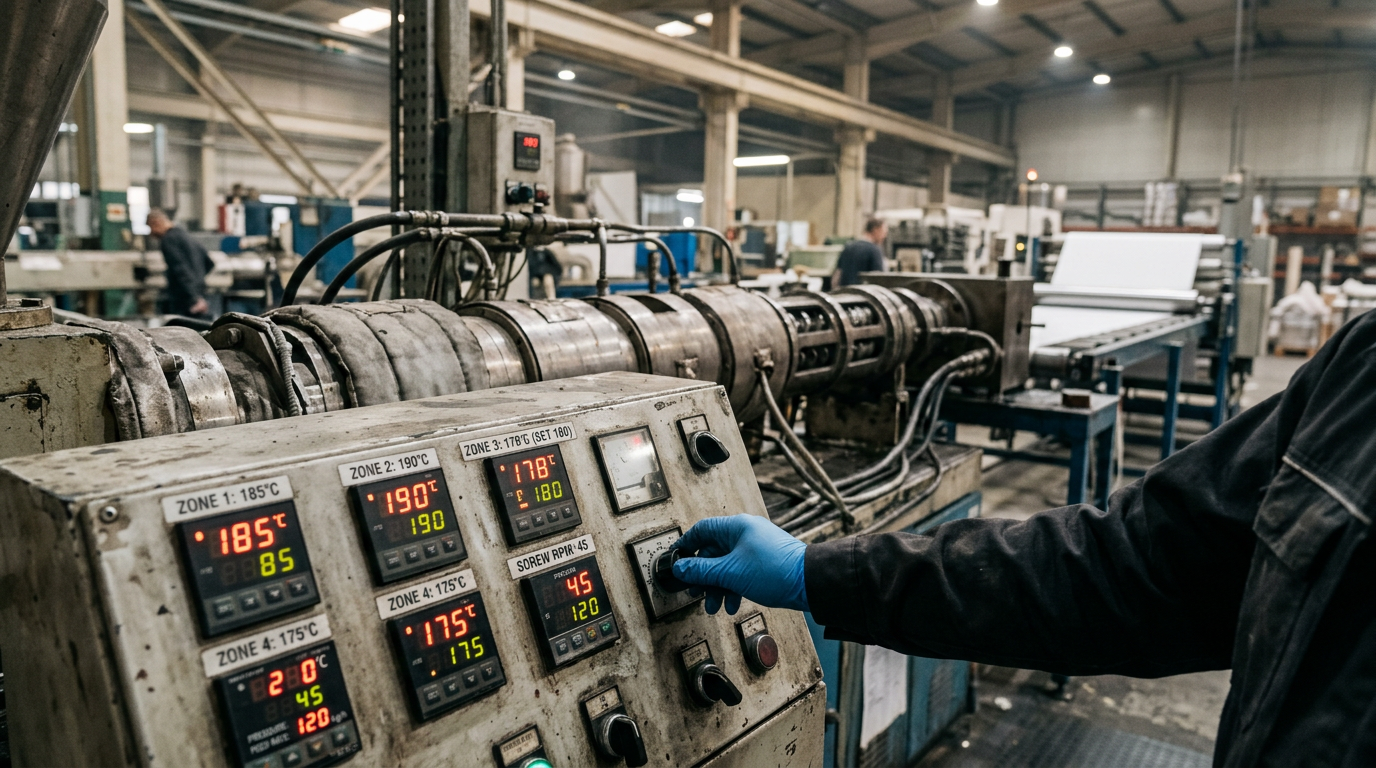
When you reduce stabilizer by 0.5-1.0 PHR, compensate by tightening temperature control to +/-2C rather than the typical +/-5C. The optimal melt temperature window sits at 188-192C. Operating above 195C consumes stabilizer faster and narrows the window where your reduced loading still provides adequate protection.
CFA dosage responds non-linearly. If 1% CFA achieves 15% density reduction, doubling to 2% does not deliver 30% — excessive CFA paradoxically increases final density as cell walls rupture and collapse. When increasing filler, do not automatically increase CFA to compensate — run at existing levels first and measure density before adjusting.
Foam extrusion pressure requirements scale steeply: 40 bar minimum at 160C, 50 bar at 180C, 60 bar at 200C. If your reformulation changes melt viscosity (higher filler increases it, lower plasticizer dosage increases it), monitor die pressure to keep gas dissolved until exit.
Your Next Reformulation Steps
Stabilizer right-sizing is the first lever to pull because it requires no capital investment and delivers immediate cost-per-ton reduction. Start by documenting your actual die temperature and residence time — not the setpoints, but the measured values. If your foam line runs at 188C and your stabilizer was spec’d for 205C rigid pipe, you have room to reduce.
Run stepwise reduction trials: drop 0.3-0.5 PHR per trial, holding other variables constant. Test each batch for color retention (static oven test), cell structure (cross-section microscopy), and density consistency. The point where color just starts to shift is your minimum threshold — add 0.5 PHR back as your working margin.
The deeper savings come from coordinating all four levers on your specific line. Every extruder, every mixer, every CaCO3 grade behaves differently. The formulation ratios here are starting points — your designed experiments, validated by density testing and mechanical property checks, turn general principles into a cost advantage no competitor can copy from a datasheet.