

A -40°C oilfield cable spec lands on the desk, and the existing all-phthalate insulation recipe just failed ASTM D1043 brittleness at -25°C. Adding more DOP won’t fix it — the aromatic ring stiffens too fast below freezing, no matter how much you load.
Dioctyl adipate (DOA) is the cold-flex co-plasticizer that reaches the spec, but only at the right phr split, in the right addition sequence, and only when the cable’s service floor stays above DOA’s practical limit in PVC. The formulation ratio I recommend depends on a single number you must set before opening the resin bag: the cold-flex target temperature.
Set the Cold-Flex Target for the PVC Cable Insulation
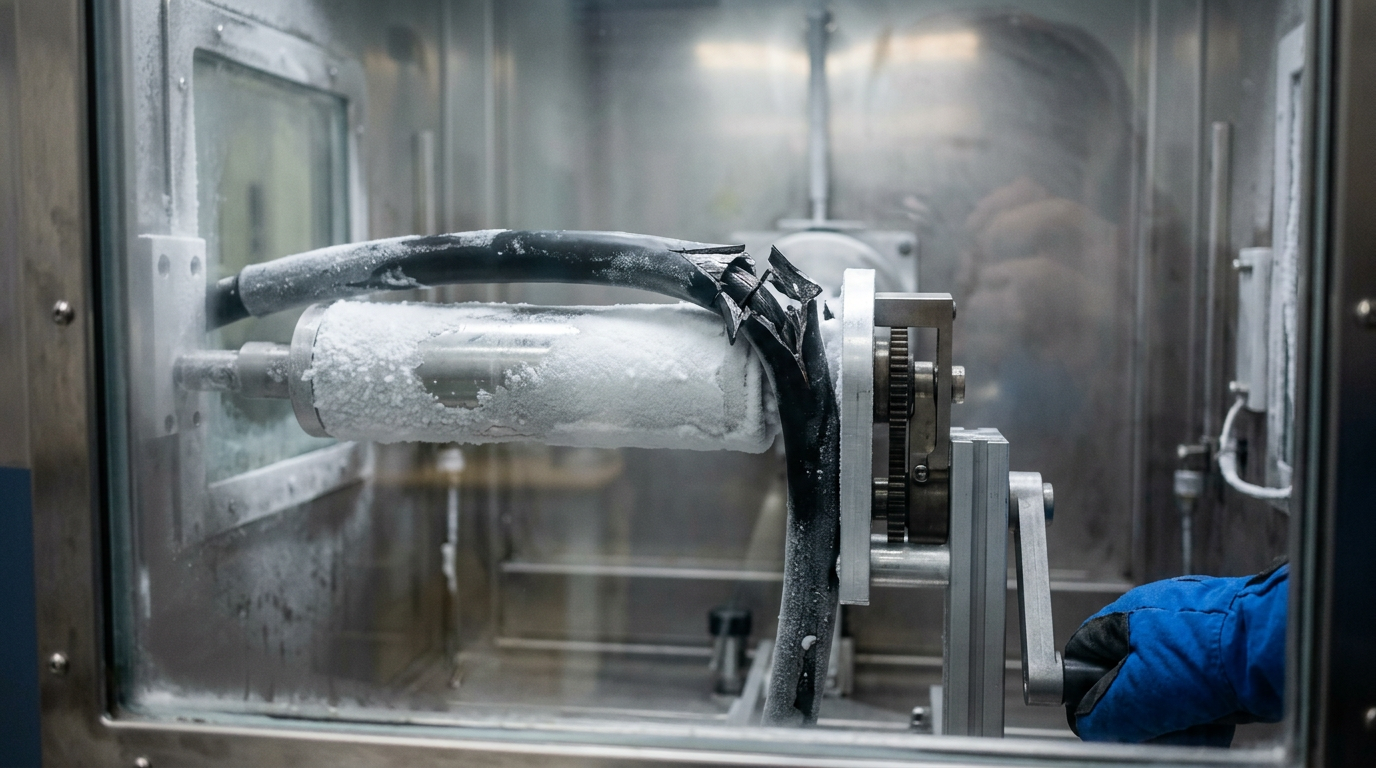
The cold-flex target is the cable specification driver, not a result of the recipe. Indoor and mild outdoor cables target -25°C, oilfield/mining/outdoor cables target -40°C, and Arctic/aerospace cables target -55°C. Each tier maps to a different test threshold — ASTM D1043 brittleness or BS EN 60811 cold-bend — and dictates a different DOA loading.
Before adding anything to the mixer, write down the target temperature, the test method the cable customer invokes, and the pass threshold. The recipe falls out of those three values. If the cable runs at 70°C indoor with no cold-bend requirement, DOA is the wrong answer entirely — stick with DOTP at 45 phr as the primary plasticizer for general flexible cable and skip adipates altogether.
Build the Primary Plasticizer and Adipate Co-Plasticizer Split
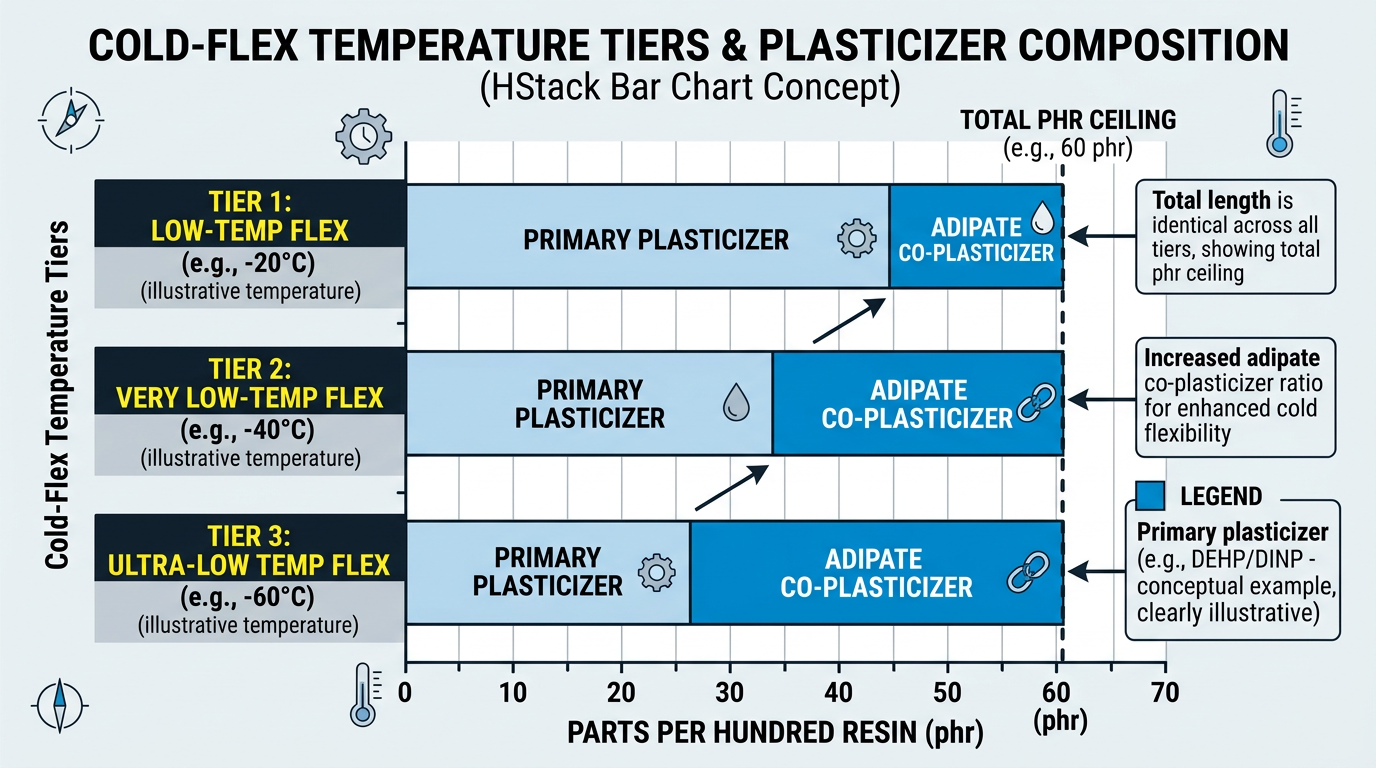
DOA functions as a co-plasticizer at 10-30% of total plasticizer loading, never as a standalone primary. Industry-typical formulation guides converge on this rule because adipates evaporate more readily than phthalates — leaning on DOA alone trades cold-flex gain for oven-aging weight loss. The primary plasticizer (DOP, DOTP, or DINP) carries the bulk of plasticization; DOA buys the cold-flex extension.
Cold-Flex Tier Table
Hold total plasticizer at 45-50 phr and redistribute primary versus DOA per tier:
| Cold-flex target | Application | Primary phr | DOA phr | Test threshold |
|---|---|---|---|---|
| -25°C | Indoor / mild outdoor | 40 phr | 5-8 phr | ASTM D1043 brittleness pass at -25°C |
| -40°C | Oilfield / mining / outdoor | 30-35 phr | 12-15 phr | ASTM D1043 / BS EN 60811 cold-bend at -40°C |
| -55°C | Arctic / aerospace | DOA insufficient | Switch to DOS or polymeric adipate | BS EN 60811 cold-bend at -55°C |
Round out the recipe with stabilizer at 6-8 phr (Ca/Zn or Ba/Zn), lubricant at 1-1.5 phr, calcium carbonate filler at 10 phr, and ESO at 5 phr. Add the DOA grade specification check — ester content ≥99.0%, moisture ≤0.1%, specific gravity 0.925-0.927 — to the incoming-QC list, because a wet or low-purity grade exudates at half the loading you planned for.
The Phr-Substitution Rule
DOA replaces a portion of the primary phr; it does not stack on top. Starting from a 45-phr DOTP baseline and adding 12 phr of DOA lands the recipe at 57 phr total — and ASTM D1203 oven-aging volatility will show it.
Cold-flex gain plateaus around 30 phr DOA while volatility loss and exudation grow faster than the gain. Subtract, don’t add.
The -30°C Decision Trigger
DOA’s effective cold-flex floor in PVC service is -30°C, not the -60°C the supplier marketing pages cite. Below -30°C, oil precipitates from the compound at field-aging timescales and the cable fails the cold-flex spec regardless of loading.
The -76°F figure is a property of DOA in a free state, not in PVC-cable in service. If the cable spec demands -55°C cold-bend, switch to DOS (more cold-resistant, several times the cost), polymeric adipate (lower volatility, slower processing), or TOTM (high-temperature ceiling, less cold-flex).
Run the PVC Dry Blend with the Co-Plasticizer Addition Sequence
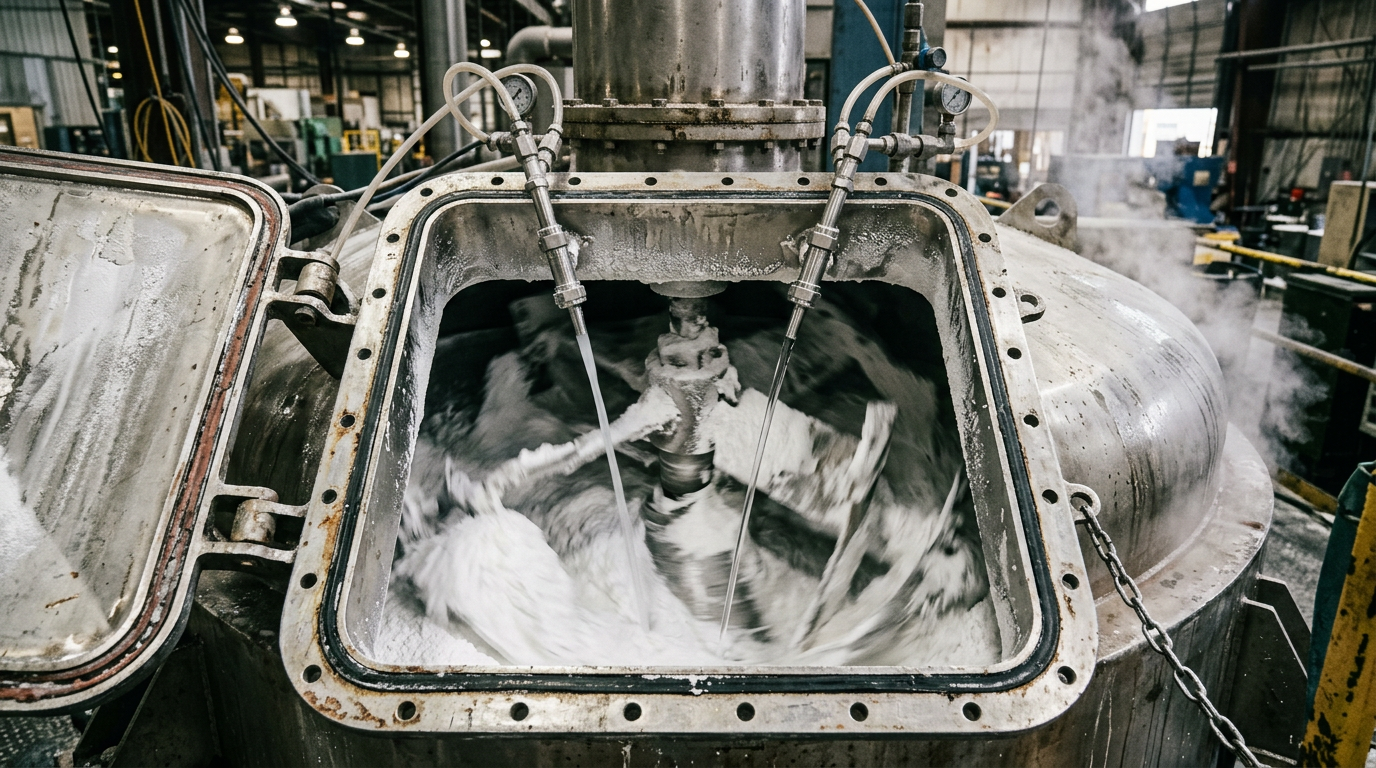
In a high-speed dry-blender, the primary plasticizer and DOA are both liquids and enter together at jacket temperature 70-80°C — BEFORE the stabilizer goes in. Adding DOA after the primary has fully absorbed gives uneven absorption: plasticizer beads on the resin grain in the mixer sight glass, and flow rate drops at the discharge. The 5-8 minute cycle below carries over from the standard DOP dry-blend procedure in a high-speed mixer, with DOA folded into the same liquid-addition step.
- Charge PVC resin (K65-K70 for cable insulation) at room temperature; start the mixer.
- When jacket temperature reaches 70-80°C, dose the primary plasticizer and DOA together — both liquids at once.
- Wait for absorption (resin grain becomes free-flowing, no surface wetness) before adding stabilizer.
- Add stabilizer, then lubricant and filler.
- Hold to 100-110°C for fusion, then discharge.
If you see plasticizer beads on the resin grain after step 2, the addition order broke. Pull the batch, scrape the mixer wall, and restart with simultaneous addition.
Validate the PVC Insulation Recipe Against Cold-Flex Spec
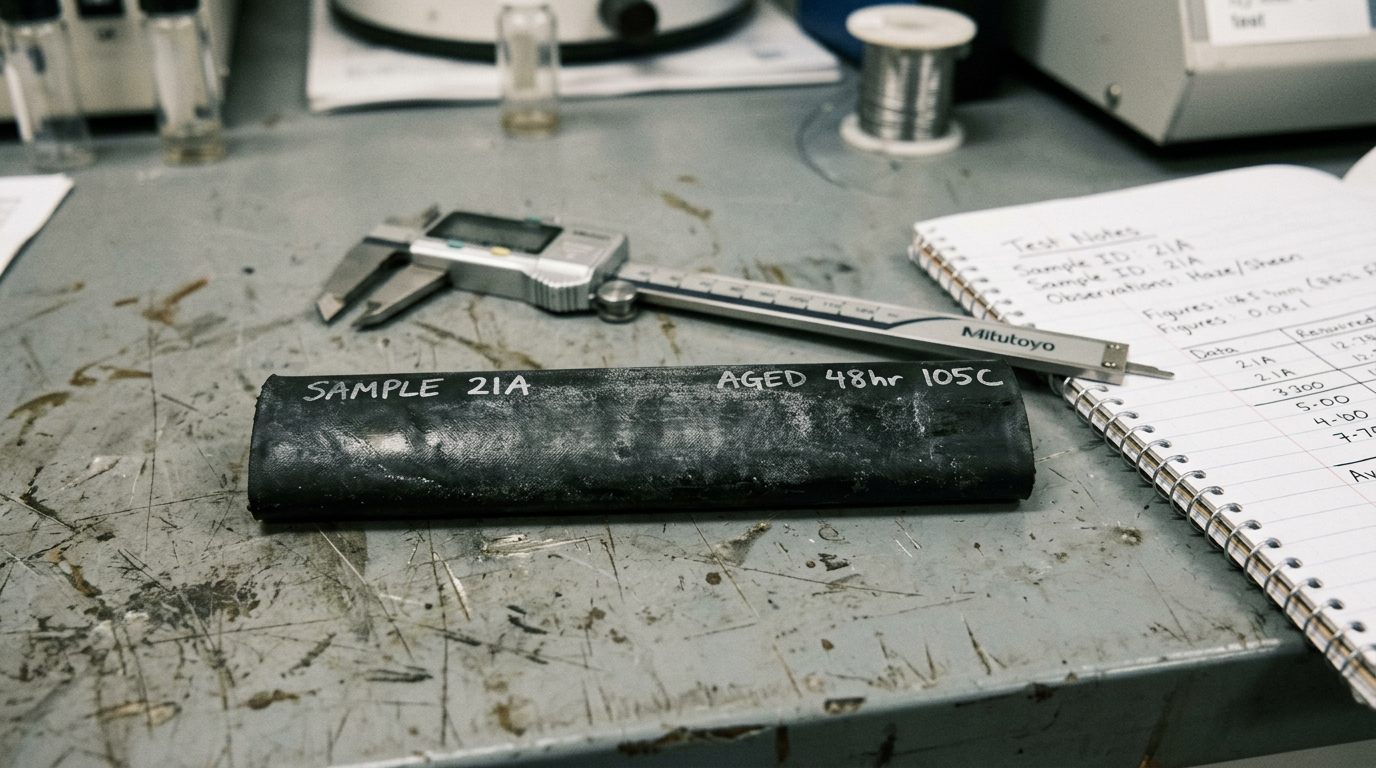
Run cold-flex testing on the extruded insulation, then run accelerated oven aging at 100°C for 168 hours and check three things: weight loss, surface appearance, and durometer shift. A correctly formulated -40°C insulation loses under 3% weight, holds a clear surface, and shifts shore A by less than 5 points.
Cold-Flex Pass Criteria
For -25°C and -40°C tiers, the recipe is sound when ASTM D1043 brittleness passes at the target temperature with no cracking and BS EN 60811 cold-bend passes the mandrel wrap without surface fissures. If brittleness fails at -40°C with the 12-15 phr tier, do not push DOA higher — the volatility penalty will fail oven aging. Re-check primary phr first; under-loading the primary on the assumption DOA covers the slack is a common mis-step.
Over-Dose Signals on Aged Samples
Three visible defects flag a DOA over-dose on aged outdoor cable. First, exudation — haze, cloudiness, or surface bleeding on oven-aged samples, the oily film field engineers describe as “oozing out of wires.” Second, plasticizer migration into the jacket layer, which softens the jacket and stiffens the insulation; this is the most common downstream failure when DOA exceeds 15 phr on a -40°C cable. Third, oven-aging weight loss above 5% at 100°C / 168 hours.
If you see any of these, check the total plasticizer phr first (over 55 invites volatility), re-verify the addition sequence, then re-check the DOA grade certificate. The common error is matching loading only to the cold-flex rating while ignoring migration compatibility with the jacket compound and connectors — the cold-flex number alone does not protect the field installation.
Next Steps
Pull the cable end-use spec, write down the cold-flex target and test method, and start from the -40°C tier (12-15 phr DOA, 30-35 phr primary, 45-50 phr total) only if the application demands it. For -25°C cables, 5-8 phr is usually plenty; for -55°C, DOS or polymeric adipate enters the conversation. Before commissioning the lab batch, verify the grade against ASTM D1203 volatility, and run the first dry-blend trial with simultaneous primary + DOA addition at 70-80°C — that single procedural detail prevents most of the exudation defects that show up after shipment.