

Are you paying premium prices for non-phthalate plasticizers in industrial pipes that don’t require them? Many PVC pipe manufacturers switched to DOTP and other non-phthalate options over the past decade, assuming phthalate restrictions would eventually cover all applications. But January 2025 EPA findings tell a different story: 97% of DINP uses were deemed safe, including water supply piping. For most industrial pipe applications, traditional plasticizers like DINP and DIDP remain the best choice.
What the Regulations Actually Say About Phthalates in Pipes
The regulatory picture for phthalate plasticizers is far more nuanced than marketing materials suggest. In January 2025, the US EPA completed risk evaluations for both DINP (diisononyl phthalate) and DIDP (diisodecyl phthalate) under TSCA. The findings contradicted years of “phthalate-free” marketing pressure.
For DINP, the EPA cleared all 15 consumer uses and 28 out of 32 industrial and commercial uses as safe—approximately 97% of produced volume. Water supply piping was explicitly listed among the safe applications. DIDP fared even better, with 43 of 49 evaluated uses deemed safe—99% of production volume.
The European perspective aligns with these findings. In 2018, ECHA’s Risk Assessment Committee unanimously concluded that DINP does not show adverse effects on sexual function, fertility, or fetal development. As a result, DINP carries no reproductive or developmental hazard classification in the EU.
Where do restrictions actually apply? REACH regulations limit DINP and DIDP only in toys and childcare products that might be placed in a child’s mouth, at concentrations above 0.1%. Industrial pipes don’t fall under these restrictions. Unless your pipe application involves direct food contact, medical devices, or products marketed to children, you likely face no regulatory requirement for non-phthalate alternatives.
Performance Comparison for Pipe Applications
When comparing plasticizers for pipe manufacturing, DINP and DIDP deliver measurable advantages in the metrics that matter most for long-term pipe performance.
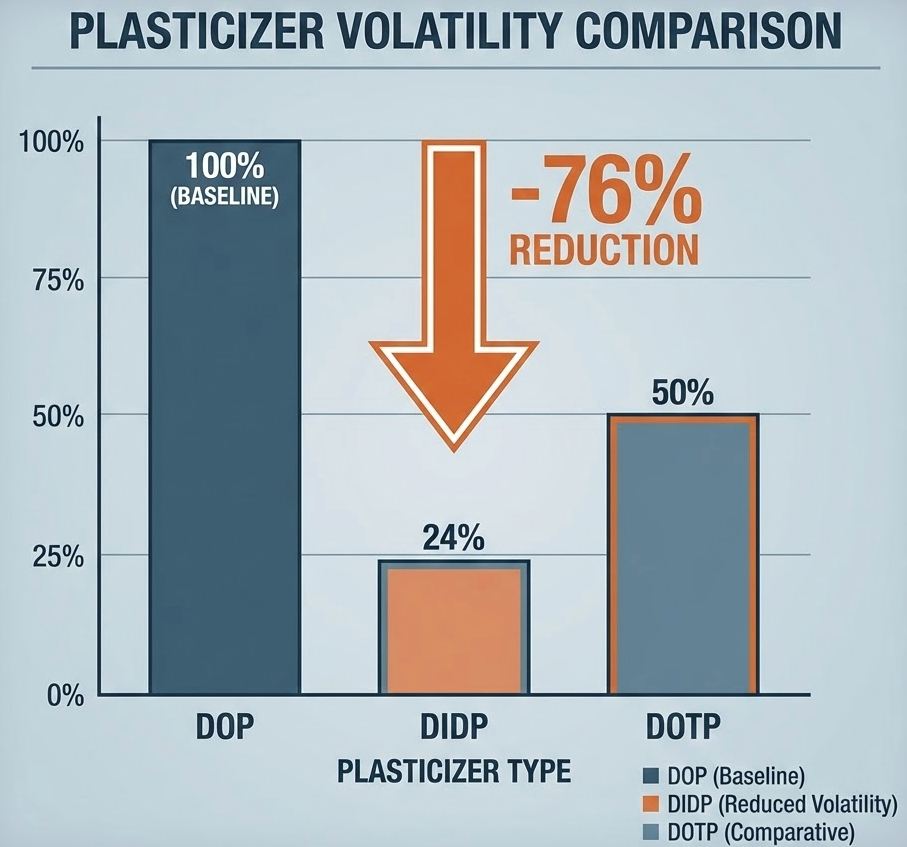
DIDP evaporates 76% less than DOP (di-2-ethylhexyl phthalate), the traditional benchmark plasticizer. This lower volatility translates directly to reduced plasticizer loss over decades of service—critical for buried pipes expected to last 50+ years. DINP offers similar volatility improvements over older phthalate options.
Processing efficiency favors DINP as well. DINP can reduce the melt viscosity of PVC compounds by up to 21% compared to DOP, improving extrusion efficiency and enabling faster line speeds. This processing advantage compounds across production runs.
DOTP (dioctyl terephthalate) does offer some advantages. It provides slightly lower volatility than DINP in certain high-temperature applications and meets “phthalate-free” labeling requirements. However, DOTP is approximately 7% less efficient than DEHP, meaning more plasticizer is required per unit of PVC to achieve equivalent flexibility. This efficiency gap affects both material costs and formulation consistency.
For pipe applications operating below 90C—which covers the vast majority of industrial, agricultural, and construction uses—DINP and DIDP match or exceed DOTP performance at lower cost.
Cost and Efficiency Tradeoffs
The economic case for traditional phthalates in industrial pipe applications is straightforward. US prices for DINP, DOTP, and competing non-phthalate plasticizers typically range from about $1,700 to $2,000 per metric ton. Within this range, DINP generally sits at the lower end while DOTP commands a premium.
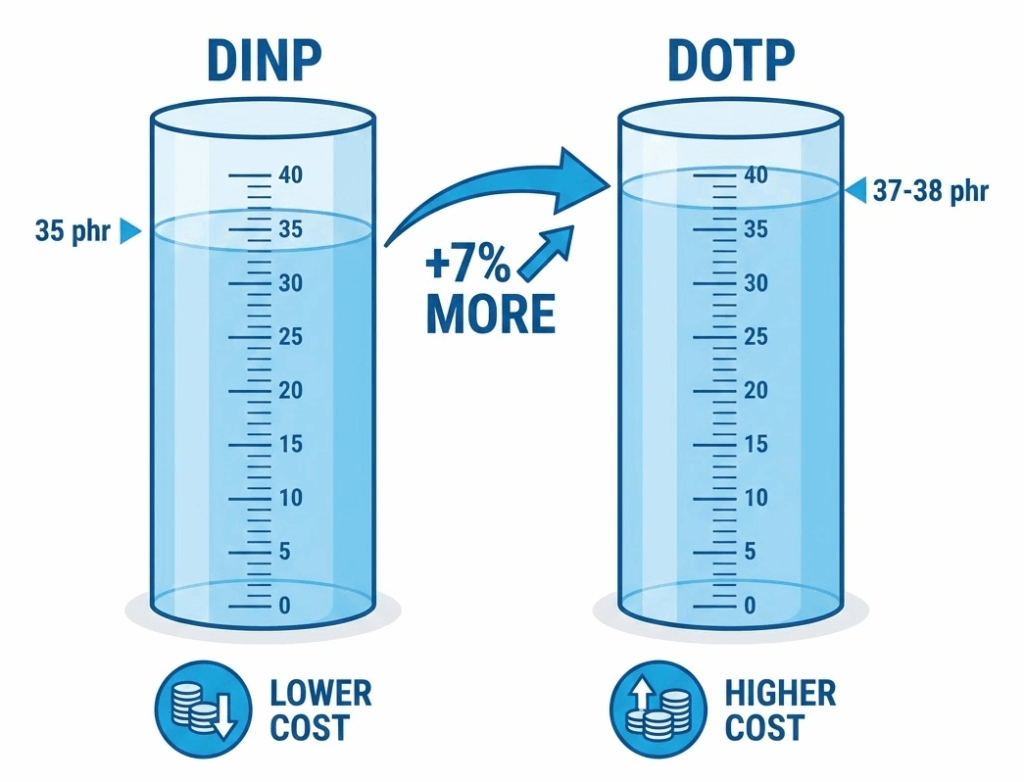
But base price only tells part of the story. DOTP’s 7% efficiency penalty means you need more material to achieve the same flexibility. For a pipe formulation requiring 35 phr (parts per hundred resin) of plasticizer, switching from DINP to DOTP might require 37-38 phr to maintain equivalent properties. That difference multiplies across annual production volumes.
Supply chain reliability adds another consideration. European DOTP production capacity is limited, and the market relies heavily on imports. Supply disruptions in recent years have driven temporary returns to DINP even among manufacturers who had committed to non-phthalate formulations. DINP and DIDP supply chains are more established and geographically diverse.
For procurement managers evaluating total cost of ownership, the calculus is clear: unless regulations specifically require non-phthalate materials, the premium provides no performance benefit for typical industrial pipe applications.
When Non-Phthalate Alternatives Make Sense
I’m not suggesting DOTP and other non-phthalates have no place in pipe manufacturing. Certain applications genuinely benefit from or require these alternatives.
High-temperature applications above 90C present a legitimate case for alternatives. DINP-plasticized PVC can degrade at sustained elevated temperatures. For high-temperature industrial piping, trimellitate plasticizers like TOTM offer superior thermal stability—though they cost roughly three times more than DINP.
Potable water applications in some markets require NSF 61 certification. While rigid PVC pipes certified by NSF contain no phthalates by design (they’re unplasticized), flexible PVC connections or fittings for drinking water systems may need non-phthalate formulations depending on local requirements. Always verify the specific certifications required for your market.
Customer specifications sometimes mandate non-phthalate materials regardless of regulatory requirements. Some end users have corporate policies excluding phthalates from supply chains. If your customer requires it, the business case overrides the technical one.
The inflatable products industry provides a useful precedent. Companies replaced DEHP with DOTP as early as 1999 for toys and similar products—”the switch was fairly seamless, offering no additional challenges.” But this transition was driven by specific regulatory needs for human-contact products, not a universal requirement.
Selection Framework for Pipe Manufacturers
Before selecting a plasticizer for your pipe application, answer these questions:
| Application Factor | If Yes | If No |
|---|---|---|
| Food contact or potable water? | Verify local certifications; may need non-phthalate | Standard phthalates acceptable |
| Operating temperature above 90C? | Consider trimellitates (TOTM/TINTM) | DINP/DIDP suitable |
| Customer requires phthalate-free? | Use DOTP or specified alternative | Choose based on performance/cost |
| EU toy/childcare market? | Non-phthalate required by REACH | Not applicable to industrial pipes |
| Extended outdoor UV exposure? | Add appropriate stabilizers; plasticizer choice secondary | Standard formulation |
For most industrial, agricultural, and construction pipe applications, DINP at 25-40 phr provides an excellent balance of flexibility, processability, and long-term stability. DIDP offers enhanced volatility resistance for applications requiring maximum service life.
Formulation matters as much as plasticizer selection. The processing window for DINP-based pipe compounds is well-established, with decades of field performance data. Switching to DOTP requires reformulation and process adjustment—effort that delivers regulatory compliance where needed, but no tangible benefit where it isn’t.
Making the Right Choice
For most industrial PVC pipe applications, DINP and DIDP remain the best choice. The January 2025 EPA findings confirmed what experienced compounders have known: these materials are safe for industrial use, perform well in pipe applications, and cost less than alternatives.
Before specifying non-phthalate plasticizers, verify that regulations actually require them for your specific application. If your pipes won’t contact food, won’t be used by children, and won’t operate above 90C, you’re likely paying a premium for compliance you don’t need. Put those savings toward quality control, better stabilizers, or competitive pricing—factors that actually affect pipe performance and customer satisfaction.