

Your QC lab can run GC-MS, HPLC, and ATR-FTIR in the same shift — so which one actually answers the migration question your customer is asking? For DOA (dioctyl adipate, also written DEHA in IUPAC-aligned literature), the honest answer is that simulant, matrix, and the regulator’s specific question each steer you toward a different primary method.
Migration rate depends on the polymer-plasticizer compatibility, the contact temperature, and how aggressive the simulant is. These method verdicts assume you already know the DOA chemistry and that DOA migrates from PVC into food contact media.
The Regulatory Frame Sets the LOD Target
Per EU 10/2011, the specific migration limit for DEHA is 18 mg/kg of food simulant, with an overall migration limit of 10 mg/dm² (or 60 mg/kg) covering the full extractable load. Any method you pick has to clear LOD well below 18 mg/kg with enough headroom to quantify near the limit, not just detect at it.
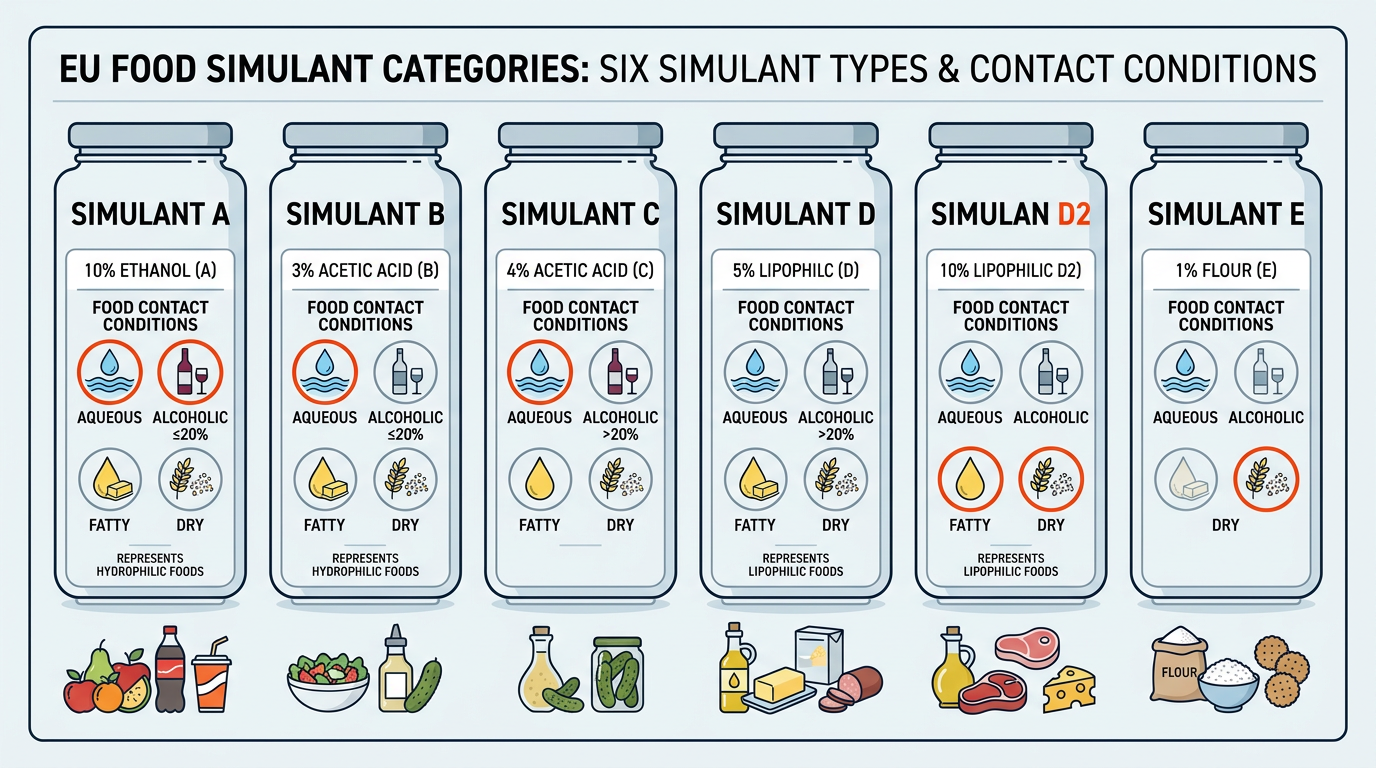
EU 10/2011 Annex III defines six simulants:
- A — 10% ethanol (aqueous, pH > 4.5)
- B — 3% acetic acid (aqueous, pH ≤ 4.5)
- C — 20% ethanol (alcoholic ≤ 20%)
- D1 — 50% ethanol (alcoholic > 20% + oil-in-water emulsions)
- D2 — vegetable oil, typically olive (foods with free fats)
- E — Tenax (dry foods)
When olive oil is impractical, D2 substitutes to D2e (95% ethanol) or D2i (isooctane), but D2i has a 60 °C contact ceiling.
That ceiling matters in practice. For any application running above 60 °C against a fatty matrix, you cannot duck the olive oil sample prep — and that forces a longer extraction-cleanup-injection sequence before GC injection.
DOA is fat-soluble, so D2 (or D2i below 60 °C) is the worst-case simulant — the diester with two 2-ethylhexyl chains partitions readily into oil. The standard long-term storage condition is 10 days at 40 °C.
GC-MS — The Regulatory Workhorse
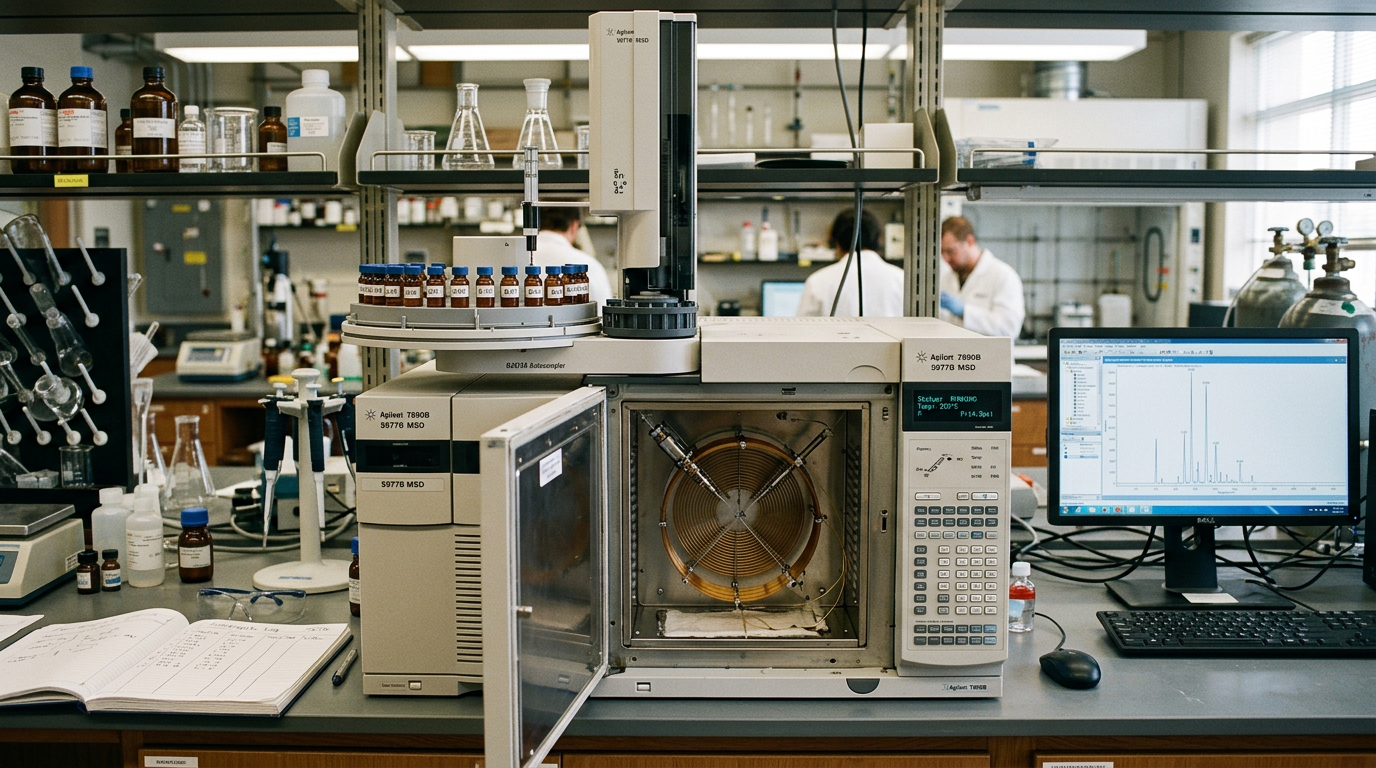
GC-MS is the default primary method for DOA migration into all six simulants — the same instrument that anchors most plasticizer migration testing workflows. Bratinova et al. (JRC EURL-FCM, 2020) reported DEHA LOD 15 ng/mL, LOQ 45 ng/mL, recovery 93.2%, RSD under 15% in simulants A and C, on a 60 m HP-5MS UI column with dichloromethane LLE.
The 18 mg/kg SML against ng/mL LODs gives roughly a 1000× headroom — meaning you have margin for matrix effects, internal-standard variation, and recovery losses. That headroom is why GC-MS is the only method I recommend without qualification for regulatory submission. EI fragmentation produces strong adipate-diagnostic ions at m/z 129 and 147, which makes confirmation straightforward in busy chromatograms.
The 1998 EU enforcement campaign that found DEHA migration of 27.8–135.0 mg/kg in retail cheese — exceeding the 18 mg/kg SML — used GC-MS after isooctane screening (40 °C/2 h) followed by olive oil confirmation (10 d/40 °C). For GB 5009.156 hexane extraction, Qian 2018 reported LOD 0.005 mg/kg with recovery 97-107%.
HPLC-UV/DAD — Single-Plasticizer Formulations Only
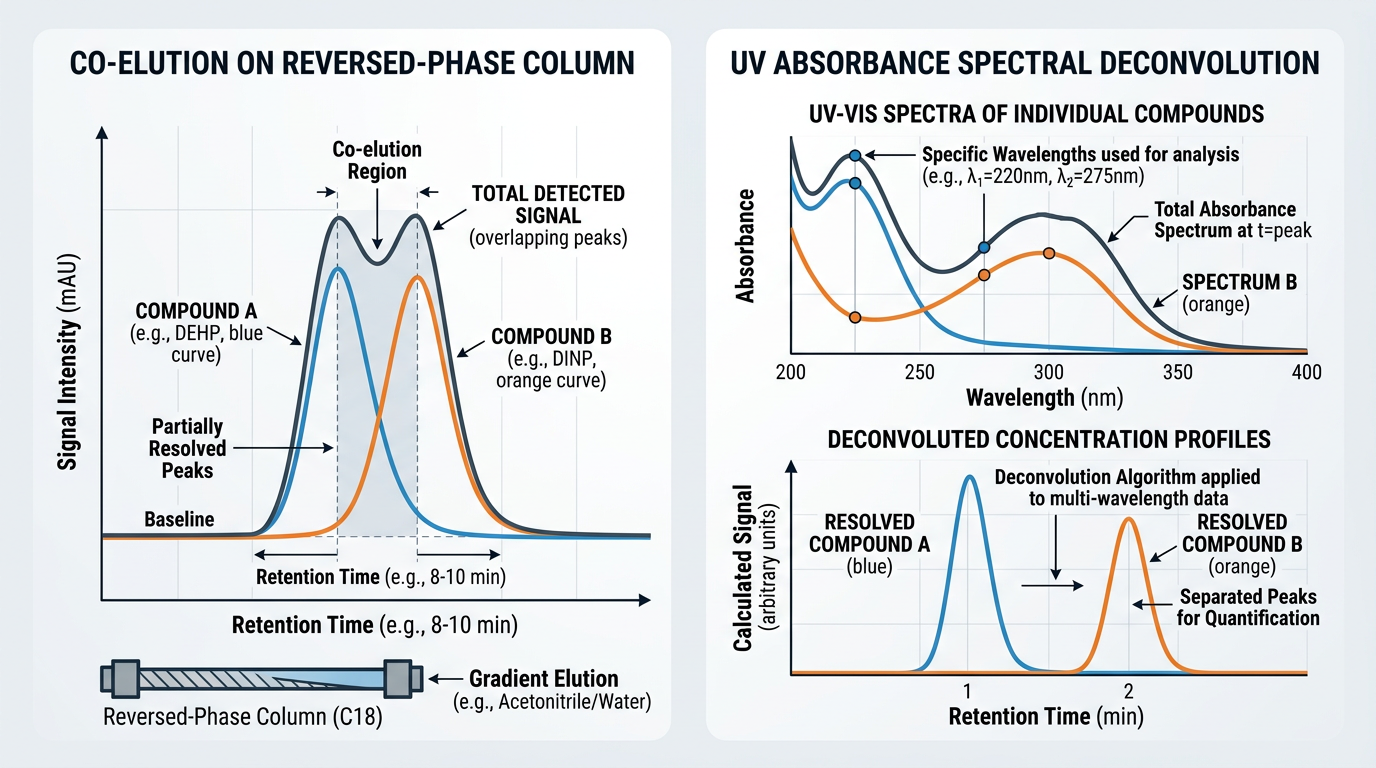
HPLC-UV/DAD works for DOA on a C8 column (2.6 μm, 100 mm × 4.6 mm) with gradient elution at 221 nm — published quantification range 0.3–750 μg/mL across thirteen minutes. Throughput is attractive when you have a long batch of single-plasticizer PVC films coming through.
The hard limit is co-elution. DEHA and DEHP co-elute on standard reverse-phase columns; so do DEHT and DINP. Resolution requires first UV derivative spectrum plus photodiode array deconvolution before you can trust the integration.
Most commercial PVC films are multi-plasticizer formulations — DOA is rarely alone, and DEHP residues from plant-shared lines or recycled feedstock are common enough that I treat HPLC-UV as inadmissible for compliance work unless I have direct evidence the formulation is phthalate-free. Skip the spectral deconvolution step and your DOA quantification will read biased high, and you will not know by how much. Drop HPLC-UV the moment a phthalate is in the building.
LC-MS/MS — Reach for the Hydrolysis Products
LC-MS is rarely the primary method for parent DOA because the molecule (no aromatic ring, MW 370.6) gives stronger response on EI-GC-MS via the m/z 129 + 147 fragmentation pattern than on ESI. Where LC-MS earns its place is the hydrolysis-product question.
At 70 °C aqueous simulant B (3% acetic acid), DOA partially hydrolyzes to mono(2-ethylhexyl) adipate plus 2-ethylhexanol. A GC-MS-only assay reports parent DOA and silently undercounts total adipate-derived migration. Pair GC-MS for parent with LC-MS or IM-HRMS for the polar hydrolysis products when the simulant is hot aqueous and the regulatory question is total mass balance.
ATR-FTIR — Polymer-Side Screen, Not Migration Quantification
ATR-FTIR is the right tool to ask “does this incoming PVC contain an adipate-class plasticizer?” — at one minute per sample, it triages a delivery before the chromatographs are scheduled. Rijavec’s 2022 LDA model on PVC plasticizer spectra hit 99.8% classification accuracy for DEHP, DOTP, DINP, and DIDP, with regression RMSEP of 5±1% (DEHP) and 6±3% (DOTP).
DOA was not in the validated training set. The adipate ester carbonyl sits on the same 1735 cm⁻¹ band as the phthalate ester carbonyl, and manual peak deconvolution does not work — the Rijavec authors concluded GC-MS was necessary for definitive identification and quantification.
Treat ATR-FTIR as a polymer-side screen, never as a migration-quantification primary. If your pipeline is “FTIR triage on raw PVC, then GC-MS on the migration extract for positives,” that is the correct division of labor.
Gravimetric Extraction (ASTM D1239) — Total Mass Loss, Not Per-Substance
ASTM D1239 measures empirical weight-loss after immersion in distilled water, 1% soap, cottonseed oil, mineral oil USP, kerosine, or 50% ethanol. It is fast, requires only a balance, and is standards-aligned for resistance comparisons across formulations. Food-contact-grade DOA from suppliers like Bastone is typically specified against this kind of total-extractable framework.
For SML compliance, D1239 is useless. It cannot distinguish DOA from co-leached DEHP, ESBO, or DOTP.
Aqueous leaching comparisons against GC find gravimetric agrees on order of magnitude but blows up when the formulation is multi-plasticizer — which most commercial PVC films are. Use D1239 as a screening gate against your own historical baseline; never as the regulatory submission method.
Headspace GC and Emerging High-Resolution Methods
Headspace SPME-GC-MS with a 65 μm PDMS/DVB fiber gives reasonable response for DOA in beverage and beer matrices. But DOA at MW 370.6 is semi-volatile at best — classical static headspace returns weak signal, and SPME or solid-phase trapping is required to reach sub-SML LODs. Headspace is auxiliary, useful when the analyte question is specifically the volatile fraction migrating to vapor space.
The high-resolution emerging methods each earn a research-versus-regulatory caveat:
- GC-Orbitrap-MS — DEHA LOD 5.5–17 pg/μL, three orders tighter than SML compliance needs
- DART-HRMS — sub-minute screening of UV-aged PVC, no chromatographic separation
- IM-HRMS — resolves non-volatile migrants and adipate hydrolysis products in one pass
None of these are codified in EU 10/2011 or ASTM compliance frameworks. They are research-grade — fine for non-target dietary-exposure work, off-limits for regulatory submission unless your reviewing authority accepts the method.
Picking the Primary Method and the Confirmation Method
The decision logic is matrix-driven, not instrument-driven. Run through this scenario tree before committing.
| Scenario | Primary | Confirmation | Why |
|---|---|---|---|
| Fatty simulant D2 / D2i, regulatory submission | GC-MS | GC-MS in second simulant | LOD ~1000× under SML; D2i capped at 60 °C |
| Aqueous simulant B at 70 °C | GC-MS (parent) | LC-MS or IM-HRMS (hydrolysis products) | DOA hydrolyzes; mass balance needs MEHA + 2-ethylhexanol |
| Incoming PVC raw-material screening | ATR-FTIR + ML | GC-MS on positives | One-minute triage before chromatography queue |
| Total extractable for spec compliance | ASTM D1239 gravimetric | None required | Single-number lot release, not per-substance |
| Multi-plasticizer formulation (DEHP present) | GC-MS only | Second column or GC×GC | HPLC-UV co-elution kills quantification accuracy |
| Hot-fill / vapor-space migration | Headspace SPME-GC-MS | Liquid-phase GC-MS | Captures volatile fraction bulk extraction misses |
Two execution rules apply across all scenarios. The confirmation method must use a different separation principle (different column phase, different ionization, or different simulant); repeating the primary method does not buy confidence, it just doubles analyst time. And when the formulation is multi-plasticizer, GC-MS always beats HPLC-UV — the DEHP co-elution risk makes UV/DAD a quantification trap unless you have proof of phthalate-free composition.
What Decides the Right Method
The method choice is not about which instrument your lab owns. It is about which simulant the regulator made you use, which co-plasticizers the formulation actually contains, and whether the question is “is there migration above SML” or “what is the mg/kg number.”
GC-MS is the answer in most regulatory contexts because the LOD headroom and the EI fragmentation pattern give you both confirmation and quantification in one run — but the pairing decides whether the submission gets accepted or sent back. For aqueous simulant B at 70 °C, parent-only assay is already wrong before you start; for phthalate-containing formulations, the HPLC-UV report is wrong before you integrate. The method you pick has to match the matrix and the regulatory question being answered, not the instrument that happens to be free this afternoon.