

Every day, manufacturers worldwide face a critical decision: which plasticizer should they choose for their PVC formulations? Get this decision wrong, and you’re looking at products that either crack under heat or cost way more than they need to. Get it right, and you unlock both performance and profitability.
The reality is this: DOP (dioctyl phthalate) and TINTM (triisononyl trimellitate) aren’t interchangeable. They’re fundamentally different tools designed for different jobs. DOP has dominated the market for decades as the go-to, cost-effective workhorse. But TINTM? It’s the specialist—the one you reach for when standard just won’t cut it.
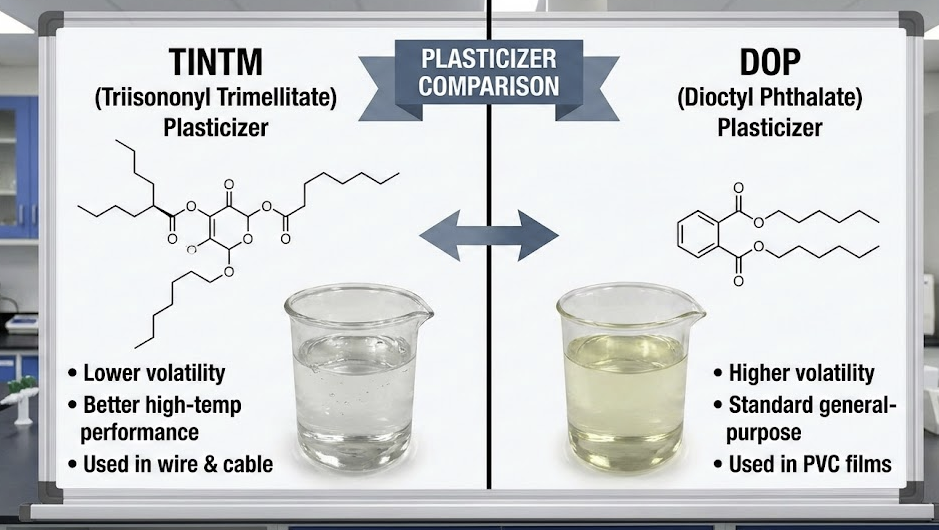
Chemical Composition and Molecular Structure
Here’s where TINTM and DOP start to diverge at the molecular level.
DOP (Dioctyl Phthalate) is built on a phthalate backbone—a benzene ring with two carboxylic acid groups. Two C8 (eight-carbon) chains hang off this core. The chemical formula is C24H38O4, with a molecular weight of 426.68. It’s a clear, colorless liquid with a slight odor and a high boiling point around 386°C.
TINTM (Triisononyl Trimellitate) takes a different architectural approach. Instead of a phthalate base, it uses trimellitic acid (benzene 1,2,4-tricarboxylic acid) as its core. Three branched C9 (nine-carbon) chains attach to this foundation, making TINTM significantly larger and bulkier than DOP. This size difference—while it might sound minor—creates profound performance implications.
The key structural difference is this: TINTM carries a benzene ring just like phthalates do, but its larger molecular weight and three-armed structure make it much harder to evaporate or extract from a plastic matrix. This isn’t coincidental. It’s by design.
| Property | DOP | TINTM |
|---|---|---|
| Chemical Family | Phthalate ester | Trimellitate ester |
| Molecular Weight | 426.68 g/mol | ~500+ g/mol |
| Core Structure | Benzene ring (2 carboxyl groups) | Benzene ring (3 carboxyl groups) |
| Alkyl Chain Length | C8 (octyl) | C9 (isononyl) branched |
| Number of Chains | 2 | 3 |
| Boiling Point | ~386°C | Higher than DOP |
| Appearance | Clear, colorless liquid | Clear, colorless liquid |
How Each Plasticizer Works in PVC
The mechanism seems similar on the surface—both reduce intermolecular forces. But the execution differs in ways that matter for real-world performance.
TINTM Mechanism of Action
TINTM inserts itself between PVC chains and disrupts their tight packing, but it does something else simultaneously: its larger structure and three attachment points create stronger dipolar interactions with PVC molecules. Research shows that TINTM forms two distinct types of carbonyl bonds with PVC—one representing a free state and another representing an aggregated state formed by dipolar-dipolar interactions. This dual-interaction system means TINTM doesn’t just sit passively in the PVC matrix; it actively engages with it.
The result? TINTM doesn’t migrate or evaporate easily. Its bulky structure and strong molecular interactions keep it locked in place within the polymer matrix. This permanence is why TINTM is classified as a “permanent” plasticizer—it stays where you put it.
DOP Mechanism of Action
DOP works more elegantly in some ways. Its two C8 chains provide plenty of molecular spacing between PVC polymers without being oversized. The ester groups on DOP offer polarity that creates good compatibility with PVC, allowing thorough mixing and uniform plasticization.
DOP molecules, though, are more mobile within the PVC matrix. They can migrate when exposed to solvents, heat, or extraction media. This isn’t a flaw—it’s a trade-off. DOP’s mobility means it processes more easily during manufacturing, mixes uniformly, and delivers consistent performance in standard applications.
Performance Characteristics Comparison
When you boil it down, the performance differences between TINTM and DOP cluster around four key metrics: volatility, thermal stability, migration resistance, and compatibility.
Volatility is perhaps the most dramatic difference. TINTM is the least volatile of all monomeric plasticizers. DOP, by contrast, exhibits moderate volatility, especially at elevated temperatures. If you’re running plasticized PVC at 80°C or higher for extended periods, TINTM keeps performing while DOP slowly migrates away—taking your product’s flexibility with it.
Thermal stability depends on application temperature. DOP handles standard industrial applications (up to about 70°C) without issue. But push DOP above that temperature for extended periods, and degradation accelerates. TINTM maintains its stability at 105°C and beyond. In high-temperature wire and cable applications, this difference isn’t theoretical—it’s the difference between a product that lasts 20 years and one that fails in five.
Migration and extraction resistance is where TINTM’s bulky structure truly shines. Its high molecular weight and branched architecture make it resistant to extraction by oils, solvents, and aqueous media. This matters enormously in medical devices (where extraction could leach plasticizer into blood or IV fluids), food-contact applications, and industrial environments with aggressive chemicals. DOP, while reasonable at standard temperatures, shows measurably higher extraction rates in comparative studies.
Compatibility with PVC is excellent for both, but achieved differently. DOP’s smaller size means it mixes and distributes uniformly with ease. TINTM requires careful formulation and higher processing temperatures to fully integrate, but once it does, the result is a more stable, permanent composite.
| Performance Factor | DOP | TINTM |
|---|---|---|
| Volatility | Moderate | Extremely Low |
| Thermal Stability | Up to 70°C | 70-105°C+ |
| Migration Resistance | Good | Excellent |
| Extraction Resistance | Moderate | Excellent |
| Processing Ease | Excellent | Good (requires higher temps) |
| Compatibility with PVC | Excellent | Excellent |
| Cost per Pound | Baseline ($1/lb est.) | 30-50% Higher ($1.30-$1.50/lb est.) |
Key Differences in Temperature Performance
Temperature is where these two plasticizers truly diverge in practical terms.
Think of DOP as the dependable commuter car. It works perfectly fine for everyday driving at highway speeds (70°C equivalent). But push it into a desert rally with extreme heat conditions, and you’re asking it to do something it wasn’t designed for.
TINTM is the rally car. It’s built for extreme conditions. Wire and cable insulation inside automotive engines, appliances in hot climates, or industrial equipment running near thermal limits—these are TINTM applications.
Cable manufacturers know this intimately. For standard building wire rated at 70°C, DOP works fine and keeps costs down. But high-temperature automotive wire specifications demand plasticizers with greater heat resistance. Here, TINTM (often blended with other high-temperature esters) becomes mandatory. The insulation needs to maintain flexibility and mechanical properties across temperature swings that would degrade DOP formulations.
Migration and Extraction Resistance
Migration is the silent killer in plasticized PVC applications. Your product might look and feel perfect initially, but if the plasticizer keeps leaving the material, you’re watching it degrade in real time.
Migration happens three ways: volatilization (plasticizer evaporates), exudation (it sweats out at the surface), and extraction (it leaches into contacting materials like oils, solvents, or food).
TINTM resists all three mechanisms better than DOP, and there’s solid science behind why. Higher molecular weight plasticizers simply can’t move as easily. Imagine trying to squeeze a tennis ball through a chain-link fence versus a marble. The tennis ball (TINTM) gets stuck; the marble (DOP) rolls through.
In real-world testing, this shows up clearly in medical device applications. A flexible PVC blood bag formulated with DOP will show measurable plasticizer leaching into the blood or storage solution. The same bag formulated with TINTM shows dramatically lower migration. For products that touch food or human tissue, this difference isn’t academic—it can determine whether your product passes regulatory testing or fails.
The extraction resistance matters equally in industrial applications. Equipment seals, gaskets, and hoses that contact oils, fuels, or solvents degrade rapidly if they’re formulated with high-migration plasticizers. TINTM’s superior extraction resistance means these components maintain flexibility and sealing integrity years longer than DOP equivalents.
Market Position and Cost Analysis
DOP is cheap. Mass production, commodity pricing, and massive volumes keep prices low—roughly $1 per pound in base pricing. TINTM costs significantly more: 30-50% higher per pound, translating to roughly $1.30-$1.50.
Why? Raw materials matter. The trimellitic anhydride needed for TINTM production costs more than phthalic anhydride. The synthesis process is more complex. Production volumes are smaller, eliminating the economy of scale that DOP enjoys.
Practical Applications: When to Use Each
This is the decision matrix that actually matters.
When TINTM Is The Right Choice
High-temperature wire and cable: If your insulation needs to perform reliably above 90°C—automotive engine compartments, industrial equipment, appliances—TINTM is not a luxury, it’s a requirement. It’s the standard choice for 105°C-rated cable, often blended with other high-temperature esters.
Automotive interior components: Dashboard, steering wheel covers, seat upholstery—these face temperature swings and extended heat exposure that degrade DOP-based formulations. TINTM maintains flexibility and appearance consistency longer.
Medical devices requiring low migration: Blood bags, IV tubing, dialysis components—anywhere the plasticizer could leach into a fluid that contacts human tissue, TINTM’s superior extraction resistance makes the difference between passing and failing regulatory testing.
Permanent plasticized products: Outdoor applications, industrial seals, gaskets, or hoses requiring 10+ year lifespans with minimal property degradation. TINTM’s permanence is worth the cost premium.
Regulated markets: EU, certain Asian markets, or any application governed by strict phthalate restrictions. TINTM sidesteps regulatory complications entirely.
When DOP Remains The Right Choice
General-purpose flexible PVC: Pipes, flooring, roofing membranes, sheet goods—the massive construction applications where cost matters and temperature stays moderate (under 70°C). DOP’s cost advantage and proven performance make it unbeatable here.
Consumer products in non-restricted markets: Toys, household items, decorative goods where regulatory phthalate bans don’t apply. DOP delivers satisfactory performance at 40-50% lower cost than TINTM.
Standard temperature applications: Electrical cable rated at 70°C, standard automotive interior trim, appliance hoses—anywhere your performance requirement tops out at conventional temperature ranges. DOP handles these easily and economically.
Cost-sensitive markets: Electronics wiring, budget consumer goods, large-volume applications where margins are tight. The raw material cost savings with DOP can mean the difference between a viable product and one you can’t sell profitably.
Processing advantages: When you need rapid, uniform mixing during manufacturing, DOP’s superior processing characteristics and lower processing temperatures reduce production complexity and waste.
Conclusion
DOP and TINTM aren’t competitors in most real-world formulations—they’re different solutions for different problems. DOP remains the industry standard for cost-conscious, standard-temperature applications. It works, it’s proven, and it’s cheap. That’s why it dominates the market.
TINTM is the specialist. Choose it when you need high-temperature permanence, superior migration resistance, or regulatory compliance in restricted markets. The 30-50% cost premium becomes trivial when your alternative is product failure or regulatory rejection.
The key insight is this: the “best” plasticizer is the one that solves your specific problem at an acceptable cost. That might be DOP for 95% of applications. But for that remaining 5%—where performance, permanence, or regulatory requirements demand it—TINTM is worth every cent of the premium.