

Getting crystal-clear PVC sheets isn’t magic. It’s chemistry you can control.
I’ve seen too many production engineers struggle with yellowing batches, hazy sheets, and those frustrating fish eyes that ruin an entire run. The worst part? They’re usually just one or two adjustments away from solving the problem.
Here’s the truth: the difference between 85% and 92% light transmittance comes down to your formulation choices and processing parameters. That 7% gap can cost you a major contract or win you a loyal customer.
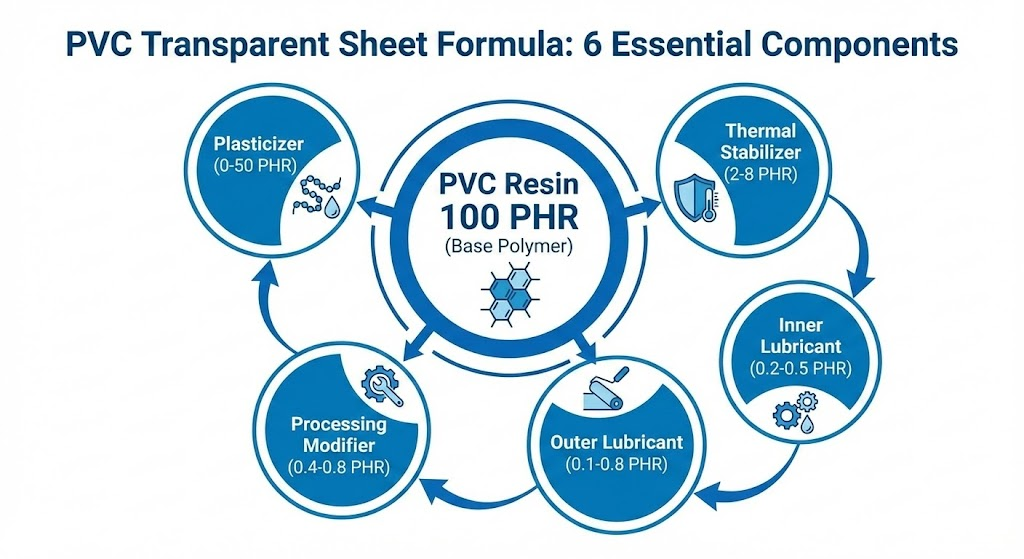
What Are the Essential Components of a PVC Transparent Sheet Formula?
Every transparent PVC sheet starts with the same core ingredients, mixed in precise ratios measured in PHR (Parts per Hundred Resin).
The Core Ingredient Breakdown
| Component | PHR Range | Primary Function |
|---|---|---|
| PVC Resin | 100 | Base polymer structure |
| Thermal Stabilizer | 2-8 | Prevents heat degradation and yellowing |
| Inner Lubricant | 0.2-0.5 | Reduces melt viscosity, improves flow |
| Outer Lubricant | 0.1-0.8 | Prevents sticking, improves surface finish |
| Processing Modifier | 0.4-0.8 | Enhances melt strength and processability |
| Plasticizer | 0-50 | Controls flexibility (higher = more flexible) |
Think of this as your baseline recipe. Every transparent sheet you produce will start here, with adjustments based on your specific application.
Understanding PHR (Parts Per Hundred Resin)
PHR is the universal language of PVC formulation. It tells you exactly how much of each additive to use relative to your PVC resin.
The calculation is straightforward: if you’re using 100 kg of PVC resin and your formula calls for 4 PHR of stabilizer, you add 4 kg of stabilizer. Simple math, but getting these ratios wrong is the fastest way to ruin transparency.
How Do You Select the Right PVC Resin for Maximum Clarity?
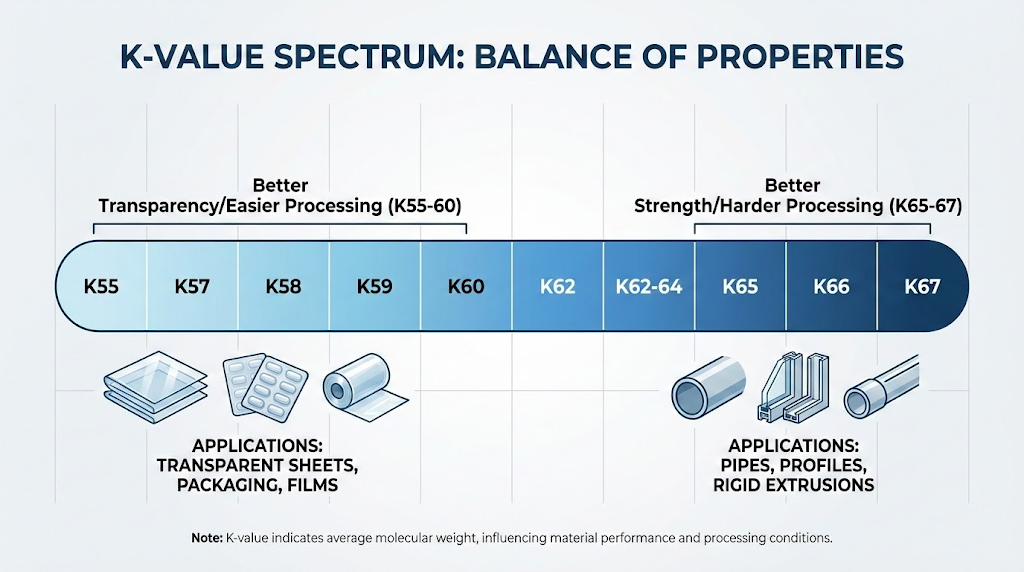
Your resin choice determines 60% of your final transparency. Pick the wrong K-value, and no amount of processing tweaks will save your sheet.
K-Value Selection Guide
| Application | Recommended K-Value | Resin Grade |
|---|---|---|
| Transparent sheets (calendering/extrusion) | K 55-59 | SG7 or SG8 |
| Thermoforming and blister packaging | K 57-60 | SG7 or SG8 |
| Rigid pipes and profiles | K 65-67 | SG5 |
| Blown films | K 65-67 | SG5 |
Here’s the principle I follow: use lower K-value resins (K 55-60) for transparency applications. These lower molecular weight polymers flow better, plasticize more completely, and produce fewer fish eyes.
Higher K-value resins (K 65-67) give you better mechanical strength, but they’re harder to process and more prone to leaving unplasticized particles that scatter light.
Suspension vs. Bulk Polymerization Resins
Bulk polymerization produces the purest PVC resin you can buy. No emulsifying agents, no residual surfactants, nothing to scatter light or leave haze.
Suspension polymerization (S-PVC) is more common and cheaper, but those emulsifying agents stay in the resin. For most transparent applications, high-quality S-PVC works fine. But if you’re chasing maximum clarity for premium products, bulk-polymerized resin is worth the extra cost.
The difference shows up most clearly in thin films under 0.5mm. At that thickness, every impurity becomes visible.
Quality Indicators to Check Before Purchase
Don’t just trust your supplier’s certificate. Check these specs:
Particle size distribution should be tight and consistent. Wide distribution means some particles will absorb additives faster than others, leading to uneven plasticization.
Porosity matters for additive absorption. Higher porosity resins soak up plasticizers and lubricants more readily during mixing. This gives you better dispersion and fewer fish eyes.
Batch-to-batch consistency is non-negotiable. Even small variations between batches can throw off your processing. If your supplier can’t guarantee consistent quality, find one who can.
Which Stabilizer System Delivers the Best Transparency?
Organotin stabilizers give you the best clarity. That’s the straightforward answer. But they’re also the most expensive option, so let’s look at when each system makes sense.
Organotin Stabilizers: The Gold Standard for Clarity
Tin stabilizers dominate transparent rigid PVC applications for good reasons:
- Methyl-tin compounds deliver maximum clarity and gloss. They’re my first choice for packaging films and display applications where optical quality matters most.
- Butyl-tin compounds offer balanced performance with better weatherability. Use these for construction applications that need both transparency and outdoor durability.
- Octyltin compounds carry FDA approval for food contact applications. If you’re making food packaging or medical products, this is your go-to.
The typical dosage range is 0.8-2 PHR for a 6.5% tin stabilizer. Start at the lower end and increase only if you see yellowing or degradation during processing.
Calcium-Zinc (Ca/Zn) Stabilizers: The Eco-Friendly Alternative
Ca/Zn systems have come a long way. Modern formulations can match tin performance in many applications, and they carry significant environmental advantages.
These stabilizers work by neutralizing HCl released during processing. They’re non-toxic, heavy-metal-free, and increasingly required for applications in Europe and other regulated markets.
The catch? Ca/Zn systems typically need co-stabilizers to match tin’s thermal stability. You’ll often combine them with organic auxiliary stabilizers, antioxidants, or epoxidized soybean oil (ESBO) to get comparable performance.
Cost-wise, Ca/Zn systems run about 20-30% cheaper than tin stabilizers. For many manufacturers, that savings justifies the extra formulation complexity.
Stabilizer Comparison: Performance vs. Cost vs. Compliance
| Factor | Organotin | Calcium-Zinc |
|---|---|---|
| Transparency | Excellent (best) | Very good |
| Heat stability | Excellent | Good (needs co-stabilizers) |
| Melt viscosity | Lower | Higher |
| FDA food contact | Yes (octyltin) | Yes |
| Environmental profile | Moderate | Excellent |
| Relative cost | Higher | Lower (20-30% less) |
| Formulation complexity | Simple | Moderate |
My recommendation: if you’re new to transparent PVC formulation, start with tin stabilizers. They’re more forgiving and easier to work with. Once you’ve mastered the basics, explore Ca/Zn systems to reduce costs and improve your environmental footprint.
What Is the Optimal Processing Temperature Profile?
PVC is the most heat-sensitive major thermoplastic. Get your temperatures wrong, and you’ll see it immediately in yellowing, degradation, or incomplete plasticization.
Critical Temperature Thresholds
| Threshold | Temperature | What Happens |
|---|---|---|
| Decomposition onset | ~140°C | HCl release begins |
| Melting point | ~160°C | Polymer becomes processable |
| Safe extrusion range | 170-190°C | Optimal processing window |
| Maximum melt temperature | Below 200°C | Above this, rapid degradation |
That 30°C processing window between 170-190°C is narrow. Stay toward the lower end for better color retention. Go higher only when you need improved flow or faster throughput.
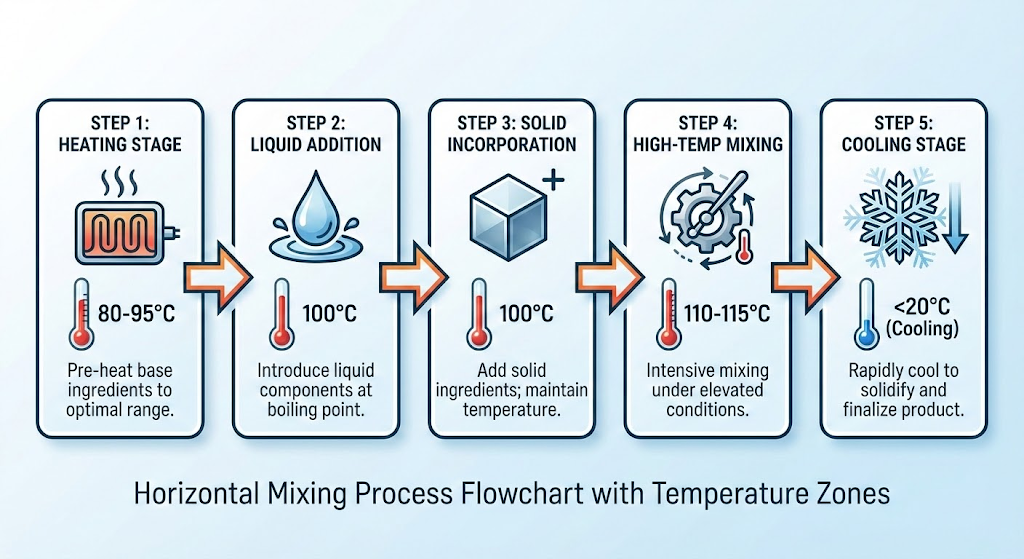
Dry Blend Mixing Temperature Sequence
This sequence matters. Skip a step or rush through it, and you’ll pay for it in quality defects.
Step 1: Initial Heating (80-95°C)
Start by heating your PVC resin to 80-95°C in the high-speed mixer. This drives off residual moisture and opens up the resin’s porous structure to absorb additives.
Don’t skip this phase. Moisture in your compound creates bubbles during extrusion, and those bubbles destroy transparency.
Step 2: Add Liquid Components (~100°C)
When your blend hits approximately 100°C, add your plasticizers and liquid stabilizers. The heated, porous resin will absorb these components efficiently.
Mix thoroughly at this stage. Poor dispersion of liquid additives is a primary cause of fish eyes and uneven clarity.
Step 3: Add Solid Additives (100°C)
Add your fillers, lubricants, pigments, and solid modifiers at the same temperature. These components distribute through the already-wetted resin.
Watch your lubricant levels carefully here. Too much external lubricant and you’ll get plate-out on your equipment. Too little and your compound sticks to everything.
Step 4: Continue Mixing to 110-115°C
Let the mixer continue running until your batch temperature reaches 110-115°C. This ensures complete absorption and homogeneous distribution of all components.
Some manufacturers let their dry blend “mature” for 12-24 hours after mixing. This extra time allows any unabsorbed additives to fully penetrate the resin particles.
Step 5: Transfer to Cooling Mixer
Move your hot blend immediately to a cooling mixer. Reduce the temperature to below 40°C before storage.
Cooling quickly prevents premature fusion and keeps your dry blend free-flowing for accurate feeding into your extruder.
Extrusion Zone Temperature Settings
Set your extruder barrel temperatures in a gradually increasing profile from feed to die. A typical setup:
- Feed zone: 150-160°C
- Compression zone: 165-175°C
- Metering zone: 175-185°C
- Die body: ~185°C
Keep your profile flat to avoid thermal degradation. Sharp temperature spikes do more damage than consistently high temperatures.
Cooling Parameters for Optical Clarity
Your water bath temperature should be 5-15°C for optimal clarity. Rapid cooling “freezes” the molecular structure before internal stresses can develop.
Slower cooling gives better dimensional stability but can introduce haze from crystallization or stress patterns. For transparent sheets, faster is usually better.
What Plasticizer Options Work Best for Transparent Applications?
Your plasticizer choice determines whether your sheet is rigid, flexible, or somewhere in between. All common plasticizers maintain transparency at proper dosages.
Rigid vs. Flexible PVC Formulations
| Type | Plasticizer Level | Applications |
|---|---|---|
| Rigid PVC | 0-10 PHR | Packaging, construction sheets, signage |
| Semi-rigid PVC | 10-30 PHR | Folders, binders, protective covers |
| Flexible PVC | 30-50+ PHR | Films, cable insulation, medical tubing |
PVC is unique among plastics in accepting huge plasticizer loads. You can gradually transform a rigid solid into a soft gel just by adding more plasticizer. This versatility is why PVC dominates so many applications.
Traditional Plasticizers and Their Transparency Impact
DOP (dioctyl phthalate) and DEHP (di-2-ethylhexyl phthalate) have been workhorses for decades. They’re cheap, effective, and produce excellent clarity.
The problem? Phthalates face increasing regulatory scrutiny. The EU has restricted DEHP in most applications, and other markets are following. If you’re still using phthalate plasticizers, plan your transition now.
From a pure transparency standpoint, phthalates work great. But regulatory compliance and brand reputation matter too.
Phthalate-Free Alternatives for Regulatory Compliance
DINCH (1,2-cyclohexane dicarboxylic acid diisononyl ester) is my top recommendation for sensitive applications. It’s approved for toys, medical devices, and food contact. Transparency matches phthalate performance.
Citrate esters like ATBC (acetyl tributyl citrate) work excellently for food packaging and medical products. They’re biodegradable, FDA-approved, and produce good clarity.
DOTP/DEHT (di-2-ethylhexyl terephthalate) offers a drop-in replacement for DEHP in most formulations. Similar performance, no phthalate concerns.
Epoxidized soybean oil (ESBO) does double duty as a plasticizer and co-stabilizer. It’s bio-based, improves thermal stability, and enhances UV resistance. I use it as a secondary plasticizer in most of my formulations.
How Do Lubricants Affect Sheet Clarity and Surface Quality?
Lubricants seem like minor players compared to stabilizers and plasticizers. But get them wrong, and you’ll see defects immediately.
Internal vs. External Lubricant Functions
Internal lubricants reduce friction between PVC molecules as they slide past each other during processing. They lower melt viscosity and improve flow. Common types include fatty acid esters and glycerol derivatives.
External lubricants create a slip layer between your hot compound and metal surfaces. They prevent sticking, reduce equipment wear, and improve surface gloss. Paraffin waxes and oxidized polyethylene are typical choices.
Both types affect clarity indirectly. Internal lubricants help achieve homogeneous plasticization (fewer fish eyes). External lubricants give you that glossy, defect-free surface finish.
Recommended Lubricant Dosages
| Lubricant Type | PHR Range | Common Materials |
|---|---|---|
| Internal | 0.2-0.5 | Glycerol monostearate, fatty acid esters |
| External | 0.1-0.8 | Paraffin wax, oxidized PE, stearic acid |
Start at the lower end of these ranges and increase only if you see processing problems. More lubricant isn’t always better.
What Are Sample Formulations for Different Applications?
Here are three proven starting formulations. Adjust based on your equipment, raw materials, and specific requirements.
Formula 1: High-Clarity Rigid Sheet for Packaging
| Component | PHR | Notes |
|---|---|---|
| PVC Resin (K-58, SG8) | 100 | Bulk polymerized preferred |
| Methyl tin stabilizer | 1.5 | 6.5% tin content |
| Internal lubricant | 0.3 | Glycerol monostearate |
| External lubricant | 0.2 | Oxidized PE wax |
| Processing aid | 0.5 | Acrylic modifier |
| ESBO | 2.0 | Co-stabilizer/secondary plasticizer |
Target specifications: Light transmittance 90%+, haze below 2%
Processing notes: Extrude at 175-185°C with rapid cooling. This formulation produces crystal-clear rigid sheet suitable for blister packs, display cases, and premium packaging.
Formula 2: Weather-Resistant Transparent Sheet for Construction
| Component | PHR | Notes |
|---|---|---|
| PVC Resin (K-57, SG7) | 100 | High-quality suspension grade |
| Butyl tin stabilizer | 2.0 | Better weatherability than methyl |
| UV absorber | 0.5 | Benzotriazole type |
| Light stabilizer | 0.3 | HALS type |
| Internal lubricant | 0.4 | Fatty acid ester |
| External lubricant | 0.3 | Paraffin wax |
| Processing aid | 0.6 | Acrylic modifier |
| Impact modifier | 3.0 | MBS or acrylic type |
Target specifications: Light transmittance 87%+, outdoor durability 5+ years
Processing notes: The impact modifier slightly reduces clarity but dramatically improves toughness. Essential for construction applications where breakage resistance matters.
Formula 3: Food-Grade Transparent Film
| Component | PHR | Notes |
|---|---|---|
| PVC Resin (K-60, SG8) | 100 | FDA-compliant grade |
| Octyltin stabilizer | 1.2 | FDA approved |
| ATBC plasticizer | 25 | FDA-approved citrate ester |
| Internal lubricant | 0.3 | Food-grade glycerol ester |
| External lubricant | 0.2 | Approved stearate |
| Processing aid | 0.4 | Compliant acrylic modifier |
Target specifications: Light transmittance 88%+, full FDA compliance
Processing notes: Every ingredient must appear on FDA’s approved list for food contact. Keep documentation for all raw materials. Process on dedicated equipment to prevent cross-contamination.
Next Steps
Your equipment and raw material suppliers are your best resources for fine-tuning. Share your target specifications with them. They’ve seen hundreds of operations and can spot optimization opportunities you might miss.
Run systematic trials when making changes. Adjust one variable at a time. Document results meticulously. The manufacturers who achieve consistent premium quality treat their process like a science, not an art.
Crystal clarity is achievable. It just takes the right formula, proper processing, and attention to detail.